Violet Beauregarde song
Charlie and the Chocolate FactoryThe Violet Beauregarde song is an Oompa-Loompa performance that follows Violet Beauregarde’s grotesque transformation in the Inventing Room. Sung after her skin and curly hair turn the brilliant purplish-blue of blueberry juice and her body begins to swell, the song converts spectacle into moral instruction: Violet’s compulsive gum chewing is presented as the habit that has brought about her punishment and endangered her future.
Circumstances of the Performance
The song begins when ten Oompa-Loompas roll Violet’s enormous blueberry-shaped body across the Inventing Room toward the door leading to the Chocolate River, where the waiting boat is stationed. Mr Wonka orders them to squeeze the juice out of her immediately and promises Mrs Beauregarde that they will try to repair her. The treatment is therefore both a rescue operation and a public spectacle: Violet’s parents hurry after the workers, while Charlie Bucket and Grandpa Joe remain behind and watch.
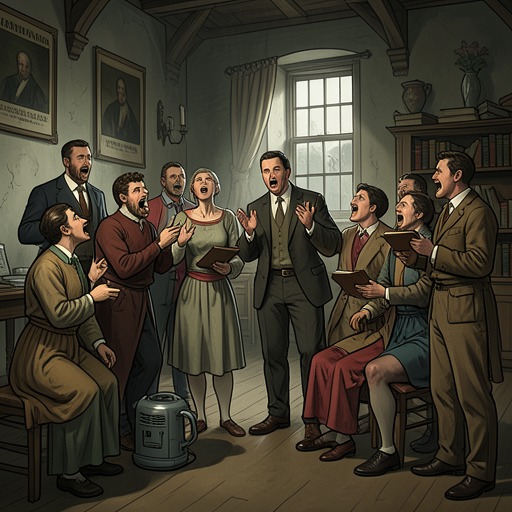
The performance is announced through sound before it is seen. Charlie notices that the Oompa-Loompas in the boat have begun to sing, and one hundred voices carry into the room. Their collective singing gives the scene a ritual quality, as though the factory has a formal response for each child’s downfall. The song about Violet follows the earlier musical reaction to Augustus Gloop and belongs to the same recurring pattern in which an individual misdeed, a grotesque bodily consequence, and a communal Oompa-Loompa judgment are joined together.
Warning Against Gum Chewing
The song opens by addressing its listeners as friends and asking them to agree that there is almost nothing worse to see than a repulsive child who sits around picking the nose. It then turns directly to Violet’s defining habit, insisting that chewing gum will never pay and that the sticky habit is bound to send its user toward ruin. The plain rhyme and blunt vocabulary make the warning easy to remember, while the physical image of Violet’s swollen blue body supplies the consequence that the general statement alone would lack.
The song does not treat gum chewing as a harmless preference. Violet has been characterized by compulsive gum chewing, and her transformation makes that habit visible as an invasion of bodily boundaries. A practice that normally keeps the body occupied at the mouth becomes connected with swelling across the entire body: her face, hands, legs, neck, skin, and hair all become the color of blueberry juice. The grotesque scale of the change gives the Oompa-Loompas’ lesson its force, joining comic exaggeration to bodily fear.
Form and Collective Judgment
The song’s power comes from its combination of repetition, rhyme, and public address. The Oompa-Loompas sing together in a group of one hundred, so the judgment is not presented as the private opinion of one observer. Their voices transform the accident into a shared verdict, while the repeated musical form makes Violet’s fate resemble a prepared cautionary example rather than an isolated surprise.
The performance also places the spectators in a prescribed position. Charlie listens closely and recognizes that a song is beginning; Grandpa Joe confirms his interpretation. The children and adults are not merely watching the rescue but are being taught how to interpret it. Violet’s blue and swollen body becomes evidence, and the song supplies the explanatory frame: the visible punishment is linked to the sticky habit that preceded it.
Consequence and Significance
The song ends by expressing the Oompa-Loompas’ determination to save Miss Violet Beauregarde from suffering the fate described in their warning. Its moral language is therefore severe but not entirely fatalistic. Violet is condemned as a cautionary figure, yet the workers’ effort to squeeze out the juice and repair her leaves open the possibility of recovery. The song’s lesson is attached to an attempted rescue rather than to an explicit death.
Within the factory’s recurring structure, the Violet Beauregarde song establishes a pattern of transformation, musical judgment, and attempted correction. It makes Violet’s accident legible as both a comic spectacle and a disciplinary example. The contrast between the jaunty form and the alarming image of a child swollen into a blueberry produces the scene’s central tension: the audience is invited to enjoy the rhyme while being shown the frightening material result of a habit treated as uncontrollable.