Wonka's Golden Ticket contest
Charlie and the Chocolate FactoryWonka's Golden Ticket contest is the publicity campaign through which Willy Wonka reopens Wonka's Chocolate Factory to five children and converts a secretive industrial site into the destination of a worldwide competition. Its decisive significance lies in the way it joins scarcity, fantasy, commerce, and moral testing: five ordinary chocolate bars conceal access to extraordinary knowledge, while the hunt for them sends consumers, newspapers, families, and children into a frenzy that culminates in Charlie Bucket's lonely survival among the original contestants.
Announcement and Rules
The contest begins with the newspaper headline announcing that the factory will be opened at last to a lucky few. Willy Wonka, described as a confectionery genius whom nobody has seen for ten years, issues the notice himself. He limits admission to five children and promises to show the winners the secrets and magic of the factory personally. The visit is therefore both an exclusive tour and a controlled revelation of an institution that has been hidden from the public.
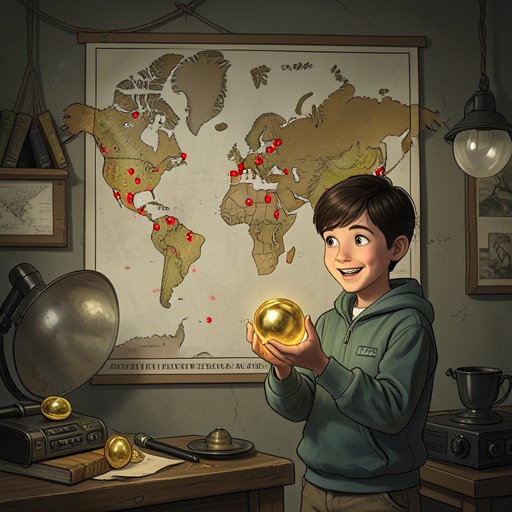
The mechanism is simple but powerful. Five Golden Tickets are printed on golden paper and placed beneath the ordinary wrappers of five ordinary bars of chocolate. The bars may be anywhere in any shop, street, town, country, or nation where Wonka's Sweets are sold. Only the five finders may enter the factory. The ordinary wrapper conceals an extraordinary opportunity, making the product itself the vehicle of the contest and turning every purchase into a possible discovery.
The reward extends beyond the day of the visit. Wonka promises each winner enough chocolates and sweets to last for the rest of life, and the notice adds that the supply can be renewed whenever the winner returns with the ticket. The ticket consequently functions as a continuing claim on the factory's abundance, not merely as a pass for one tour. The announcement also promises other surprises so fantastic that they would exceed the children's wildest dreams, while requiring the winners to arrive at the factory gates at ten o'clock on the first day of February, bring the ticket, and be accompanied by one or two family members responsible for preventing mischief.
Global Hunt and Publicity
The announcement immediately produces a worldwide chocolate-buying spree. Adults buy ten Wonka bars at a time and tear open the wrappers in sweet shops, children smash their piggy banks to obtain more money, and a famous gangster robs a bank of a thousand pounds and spends the proceeds on chocolate. When police find him, he is sitting amid mountains of chocolate, opening wrappers with a long dagger. The contest thus magnifies desire into compulsion and makes the search visible as a series of increasingly extravagant acts.
The hunt also generates fraud, technological spectacle, and public disappointment. A woman in Russia claims to have found the second ticket, but her ticket proves to be a clever fake. Professor Foulbody invents a machine intended to detect a Golden Ticket without opening a wrapper; its mechanical arm instead seizes the gold filling in a duchess's back tooth, causing an ugly scene and the destruction of the machine by the crowd. These episodes show how the contest escapes the limits of Wonka's announcement: the search creates its own rumors, inventions, accidents, and crowds, each extending the brand's presence beyond the factory.
The newspapers keep the competition in constant circulation. They announce the discovery of the second ticket by Veruca Salt, showing her between her delighted parents and waving the ticket above her head. Later, after Charlie Bucket finds the fifth ticket, newspapermen and photographers track the family down and pour into the small house. Their questioning creates several hours of pandemonium and delays Charlie's bedtime until nearly midnight. The contest therefore turns private fortune into public property, with the finder immediately converted into news.
From Consumer Hunt to Factory Tour
The contest's promised reward is inseparable from the conditions of Charlie Bucket's life. His family can afford only bread and margarine, boiled potatoes and cabbage, and cabbage soup; Charlie feels hunger most sharply and longs above all for chocolate. Chocolate is normally available to him only as a small birthday bar, which he stores in a wooden box and eats in tiny nibbles, making a sixpenny bar last for more than a month. Against this background, Wonka's promise of endless sweets is not an abstract luxury. It addresses a material deprivation and makes the Golden Ticket appear capable of changing an entire household's future.
When the tour day arrives, enormous crowds gather outside the factory gates in the snow and cold. Police hold the shouting, pushing spectators back, while the five children and their accompanying adults stand in a group shielded from the crowd. Charlie Bucket is beside Grandpa Joe, holding tightly to his hand; unlike the other children, he does not have both parents with him. The contest has begun as a mass commercial hunt, but its visible climax is a ritual of selection in which five children are separated from the crowd and admitted into Wonka's private world.
Inside, the competition becomes a sequence of warnings, tests, and eliminations. At the Inventing Room, Willy Wonka calls the room the most important in the entire factory and protects its secret inventions with an explicit prohibition against touching, meddling, or tasting. The rule is stated before the children enter, making obedience part of the contest's practical structure. Violet Beauregarde nevertheless takes the experimental gum after Wonka gently warns that it is not yet perfected, and she begins chewing it before he can stop her. The tour consequently turns the promised wonder into a test of whether desire can be restrained in the presence of forbidden objects.
The same pattern governs the Nut Room. Willy Wonka tells the group to look through the glass but not to enter because entering would disturb the squirrels. One hundred squirrels sit on high stools around a large table, shelling walnuts at tremendous speed. The spectacle invites attention while the warning establishes a boundary. The contest repeatedly places marvelous commodities, rooms, and mechanisms before children and then measures what they do when fascination meets prohibition.
Elimination and Final Stakes
As the tour proceeds, the number of eligible children falls. After two children have disappeared, Willy Wonka announces that three good little children remain and urges the group to leave the room quickly before anyone else is lost. His language gives the contest an explicit arithmetic: disappearance is translated into a changing count, and continued admission depends on surviving the factory's dangers and rules.
Near the end, Willy Wonka asks which room should come next, darts into the Great Glass Lift, and asks how many children remain. Grandpa Joe answers that only Charlie is left. Willy Wonka turns and stares at Charlie, who is still holding Grandpa Joe's hand. The contest has therefore moved from a public search for five winners to a private recognition of a single remaining child. Charlie's position is not established by a separate declaration of victory in this sequence; it is revealed through the dwindling group, the adults' answer, and the silence that follows.
The contest also projects its commercial logic into the future. In the Television-Chocolate Room, Willy Wonka imagines a television commercial that would let viewers reach out from home and take a Wonka chocolate directly from the screen. The idea extends the Golden Ticket's central promise: desire should move instantly from advertisement to possession. The contest has already made consumers search through wrappers across the world; the proposed Television Chocolate would remove even that interval, turning mediated attention into immediate consumption.
Narrative and Commercial Significance
As a narrative device, the contest supplies a clear set of rules, a finite number of places, a visible reward, and a steadily narrowing field of participants. The five-ticket limit creates scarcity; the factory visit supplies hidden information and unpredictable tests; the warnings create opportunities for disobedience; and the shrinking number of children gives every subsequent room higher stakes. A marketing announcement thus becomes the architecture of the plot.
As an image of commerce, the contest makes the product inseparable from fantasy and access. A bar of chocolate is no longer only food or a birthday treasure: it is a sealed container of possibility, a passport, a household guarantee, and an invitation to enter a secret world. The worldwide search shows how quickly scarcity can intensify consumption, while the newspapers and crowds demonstrate how the winners themselves become part of Wonka's publicity. The factory tour is simultaneously a reward, a spectacle, and a mechanism for transforming children's behavior into a public demonstration of the brand's power.
The contest's final irony is that its promise of unlimited sweetness is accompanied by loss. The five children begin as celebrated winners, surrounded by crowds and reporters, but the tour reduces their number until only Charlie Bucket remains. Willy Wonka's grand promise remains dazzling, yet the contest's structure makes wonder inseparable from discipline, danger, and exclusion. By the time the group recognizes that Charlie is the only child left, the Golden Ticket has ceased to signify merely luck: it has become the instrument through which the factory selects, judges, and elevates him.