Angkor Leng
Chasing SunlightAngkor Leng is an ancient city hidden beyond ordinary geography and ultimately exposed as a component of a convalescent god’s fever dream. For Jonathan Heights, it is both a destination requiring specialized navigation and a repository of knowledge whose machinery can protect an expedition from the eastern world; for the city itself, however, human investigation becomes the force that ends its suspended existence. Its destruction turns a place of technological promise into one of the expedition’s most consequential encounters with a reality larger and less stable than human history.
Definition and Setting
Angkor Leng was built by the same races that created Tor Ilek, but it occupies a different spatial condition from ordinary settlements. Jonathan Heights explains that the city lies entirely in the extra degrees of a circle, making it inaccessible by a direct route. The circle guide he created at Tor Ilek is therefore not merely a convenient instrument: it is the practical means by which the Endeavor can locate a city that ordinary direction cannot reach. Jonathan distinguishes this device from true guidance, describing its indication as a perceptual trick rather than a conventional compass bearing.
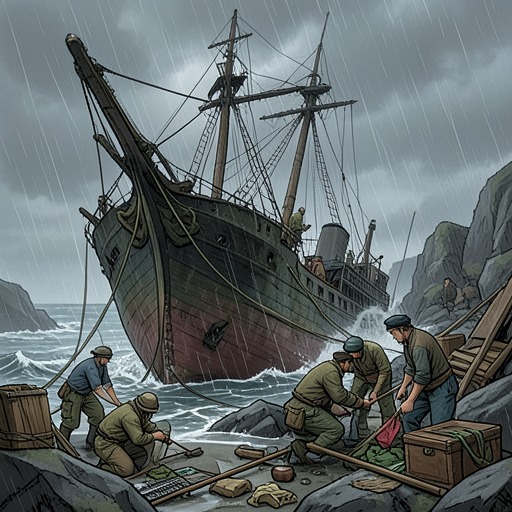
The approach makes Angkor Leng appear less like a remote point on a map than a concealed layer of the world. After the Endeavor passes the remains of a massive fallen statue, red stone gives way to exposed soil, foliage, and a river running beyond the statue’s sightless head. The pilot then follows the strange instrument through long, slow spirals. The ship rotates and holds position while the engines labor against sharply changing indications, and the landscape below subtly rearranges itself: roads and ruined buildings spread and flow as the angles change, until domes and spires emerge from a place where they had apparently always been.
This mode of arrival establishes Angkor Leng as a threshold location whose access depends on altered perception. The city is not simply concealed by distance, weather, or political restriction; its location is organized according to spatial rules that human navigation ordinarily cannot register. The Endeavor reaches it by abandoning the expectation that the shortest visible route is the real route.
Architecture, Knowledge, and Danger
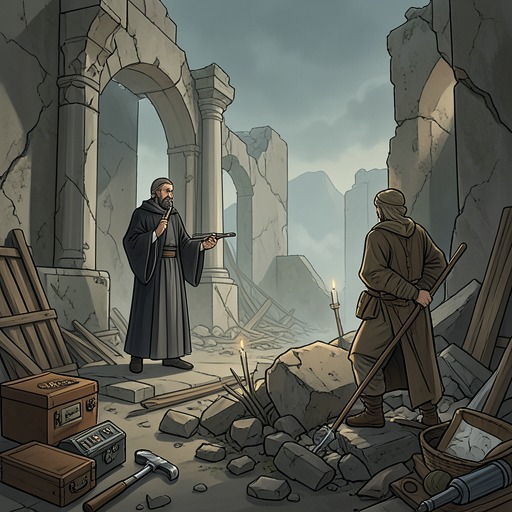
The discovered city is already damaged, with a deserted section suitable for tethering the Endeavor. Jonathan warns the crew that the principal danger is not immediate attack but the machinery that still functions throughout the ruins. Buttons and levers must not be touched until he has examined them, because the city’s abandoned systems remain active despite the absence of inhabitants. Angkor Leng therefore combines the appearance of a ruin with the operational hazards of an intact technological complex.
Jonathan’s investigation leads him through districts where the damage is less severe and the city lights are brighter. One enormous dome is faced with brassy metal panels marked by ominous symbols. Their translated meanings are apparently inoffensive, yet the building’s knowledge is described as fundamentally orthogonal to human experience. The most mundane concepts may be especially dangerous to understand, because Angkor Leng does not merely preserve unfamiliar facts; it exposes forms of thought that can destabilize the person who encounters them.
A newly revealed chamber is large enough to contain the Endeavor and open to the sky. Floodlights flicker on around its walls, saturating the space and erasing its shadows, while rows of heavy glass devices shaped like man-sized gas lanterns hang from the ceiling. These enclosures are the source of the radiance the expedition needs. The chamber’s illumination reverses the usual atmosphere of the eastern world: rather than merely pushing back darkness, it floods an ancient machine-space so completely that shadows themselves seem to lose their place.
Angkor Leng’s importance extends beyond the immediate expedition. Jonathan later explains that the expedition’s time there has provided protections against many hazards of the east. The city’s legacy shields the Endeavor during an eastern storm, and it also mitigates the effects of dangerous weather that turns rain into luminous mud and causes plants to sprout and wither almost instantly. The protection is not perfect or permanent. When fire dust recalls the heat of Angkor Leng’s dream, every airman on the bridge suffers a sudden fever and malaise, and the men may never be entirely free of the lingering touch of the convalescent god.
The God-Dream Beneath the City
The city’s deepest truth is that Angkor Leng is part of the fevered dreams of a sick god sleeping beneath it. Its mechanisms have been bent toward preserving that dream, so the machinery that initially appears to be an ancient technological inheritance is also a system of metaphysical containment. The city’s order is therefore inseparable from the illness below it: what looks like architecture and infrastructure is maintaining a sleeping consciousness and keeping its dream coherent.
Jonathan’s actions shatter the stasis. Once the sustaining condition is broken, the dream begins to end, and the fever is revealed as literal sickness rather than a metaphorical resemblance. The entity beneath Angkor Leng is grander and older than any human could comprehend, yet its condition is that of something convalescent and profoundly ill. The city’s apparent permanence has been a temporary stability imposed upon a divine or prehuman disorder.
The destruction unfolds as a collapse of reality rather than a conventional demolition. As the Endeavor rises, the dried and shrunken streets and walls twist and shimmer before vanishing like soap bubbles. Gold melts from the disappearing buildings and precipitates into glowing waterfalls descending into a newly revealed chasm. From that abyss come whispers, hints, and flashes of things unknown and unknowable to humanity; they rebound from the gold, briefly summoning shapes both fanciful and terrible before collapsing as the dream moves onward.
This ending makes the city’s material wealth and visual magnificence inseparable from its instability. Gold is not salvaged treasure in a stable ruin. It is the residue of a dissolving dream, an ephemeral radiance produced as the city loses its ontological support. Angkor Leng does not merely fall into an abyss; the abyss is uncovered as the condition that had always lain beneath its streets, walls, and mechanisms.
Expeditionary Consequences
The Endeavor’s encounter with Angkor Leng changes the expedition’s practical capacity. Its machinery supplies the radiance sought by the travelers, and its protections later help the ship withstand storms and other eastern hazards. At the same time, the expedition carries the city’s consequences with it. Fever, heat, and vulnerability to the god-dream persist after departure, so Angkor Leng remains present as a bodily condition rather than only as a memory or a ruined destination.
The city also changes the meaning of later travel. At the Arch of Khokorron, the Endeavor’s crew again notices oil, subtle heat, and faces flushed by fever, recognizing the lingering effects of Angkor Leng. In the dark regions beyond, its protections may help, but they do not make unfamiliar storms safe; Jonathan still treats wind as wind and insists on caution. Angkor Leng thus grants the expedition a form of survival without granting mastery. Its benefits are inseparable from contamination by the forces they were meant to contain.
Its destruction becomes one of the decisive images through which Jonathan Heights understands his own past. In his retrospective vision under sunlight, the destruction of Tor Ilek appears as a burning city lighting his path, while the laying of a god to rest is represented by the burning of its corpse. Angkor Leng occupies a related but distinct place in that sequence: it is remembered as a golden city inside a god’s dream, providing an ephemeral radiance. The city’s light is valuable precisely because it cannot endure.
Narrative Significance
Angkor Leng dramatizes the difference between illumination and truth. Beacon’s manufactured zint-light can make civilization appear secure while leaving Jonathan Heights suspicious of its artificial honesty; Angkor Leng offers a more dangerous illumination, one that reveals the machinery of an ancient world and then exposes the god-dream beneath it. Its radiance cannot be separated from fever, forbidden knowledge, and collapse.
The city also complicates the expedition’s language of discovery. Jonathan approaches it with maps, instruments, translations, and technical confidence, yet the city repeatedly defeats ordinary categories of direction, architecture, history, and reality. Even its ancient builders cannot be neatly placed within the fragmentary history of the civilizations surrounding Tor Ilek and the Arch of Khokorron. Angkor Leng is evidence that the world’s past is not a continuous human-accessible record but a scattering of surviving mechanisms, ruins, and dangerous partial understandings.
Finally, Angkor Leng gives physical form to the book’s recurring tension between useful knowledge and knowledge that exceeds the human frame. Its devices protect the expedition, its hidden chamber provides needed radiance, and its navigational logic makes a new route possible. Yet the same investigation breaks the stasis that held the city together. Angkor Leng is therefore neither simply a lost civilization nor merely a haunted ruin. It is a temporary shelter built inside an inhuman dream, and its greatest gift to the living is inseparable from the act that destroys it.