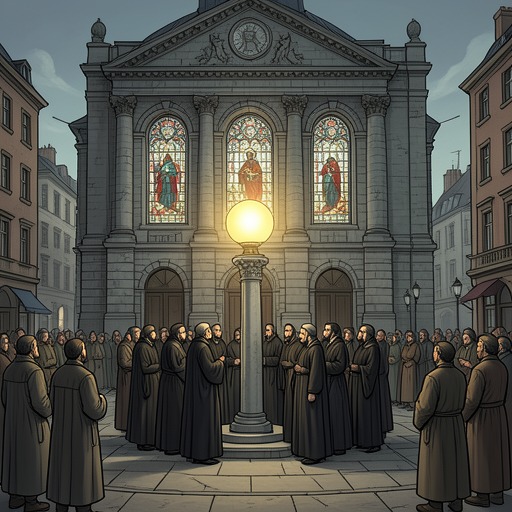
Antomine–Illuminated King relationship
Chasing SunlightThe Antomine–Illuminated King relationship is the political and spiritual bond between an inquisitor and the sovereign whose authority he carries into distant lands. Antomine does not serve the Illuminated King merely as an official subordinate: he treats the King’s doctrine as the organizing truth of human existence, and his final crisis comes when sunlight presents a reality that cannot be subordinated to that doctrine. The relationship therefore joins protection with surveillance, devotion with violence, and service with the gradual destruction of the servant’s independent identity.
Hierarchy and Mission
Antomine describes himself as “the hand of the Illuminated King in such distant lands,” a formulation that makes his body an instrument of royal presence beyond Beacon. His medallion, which he repeatedly touches, is both an emblem of office and a physical reminder of the authority behind his judgments. He understands his duty as guarding the men and women of the Endeavor rather than remaining safely in Beacon, arguing that a guardian belongs at the gates rather than inside a locked keep. The expedition thus becomes an extension of the King’s domain: a remote frontier where royal interests, inquisitorial discipline, and the preservation of human identity are supposed to hold back the darkness.
The larger mission is established in a world of lightless skies, where humanity presents itself as a vigil of light against eternal darkness. The expedition eastward proceeds under the Illuminated King’s imprimatur and the Reflected Council’s endorsement, entering regions that human authority regards as dangerous and impious. At Danby’s Point, the illuminated human track reaches its eastern terminus beside territories inhabited by other races; trade makes contact unavoidable, while the Inquisition attempts to contain it. A great metal gate divides the human section of the plateau from lands claimed by darker forces, making the political geography of the relationship visible: the King’s power is defined by walls, boundaries, and the supervision of what lies beyond them.
Doctrine of Light and Rule
Antomine’s allegiance is expressed most clearly through his theology. He identifies himself as a chaplain trained in priestly duties, languages, and Zint weaponry, and he declares that he will not tolerate corruption by entities from the darkness. His conviction that “Humanity belongs to the light” gives the King’s rule a sacred vocabulary: anything that turns human beings away from the authorized light becomes a secret to be purged rather than knowledge to be examined. His religious and military capacities are therefore inseparable. Pistols, rifles, and cannon are not merely practical tools; they are instruments available to a doctrine that defines protection as exclusion and purification.
The relationship also produces a distinct imperial language. Human civilization is represented by blue-white illumination spreading across the plateau, while eastern peoples, beasts, ruins, and nonhuman powers are grouped within a landscape described as savage, shifting, and dark. Tiuni’s reports of Thrantin houses, caravans, forces, and beasts convert the eastern world into information that can be mapped and managed. Antomine participates in this logic, but he is not simply a detached administrator. His loyalty makes him willing to turn a political boundary into a moral absolute, even though the frontier depends upon trade with the very peoples and powers his ideology marks as corrupting.
His confrontation with Ukari exposes the relationship’s central contradiction. Antomine insists that the Illuminated King has no interest in adopting what dwells in darkness, even while acknowledging that such powers possess force. He argues that humans do not bend to darkness but bend it to suit themselves, using walls to place borders on the dark and permit human freedom. Ukari answers that this safety is imagined and weakens humanity by replacing struggle with decadent certainty. The exchange is not only a dispute between two characters; it tests whether the King’s civilization is genuine mastery or a protected enclosure whose confidence depends upon refusing the reality outside its walls.
Surveillance During the Expedition
The King’s interest in sunlight turns Antomine’s mission into a layered assignment. He is expected to protect the expedition, observe the eastern world, and determine what has been found, but the King also wants access to the discovery. When the Illuminated King says that there is word Jonathan Heights has found sunlight and that the court has “a certain interest in this matter,” Jonathan doubts the sincerity of the phrasing. He suspects that the King wants to harness the discovery, and Antomine’s later equipment confirms that suspicion. The inquisitor is not merely an eyewitness sent to verify Jonathan’s claim.
Antomine’s conduct shows how royal service operates through restriction. When Jonathan’s expedition reaches dangerous environments, Antomine rejects expediency whenever it appears to admit an alien substance into human life. He seizes a quailing fruit, points to its hissing recoil from his touch, and throws it into lava, declaring that its possible benefits are irrelevant beside its hostility to honest light. He permits no use of the fruit while he is present. This is a small action with a large institutional meaning: the King’s representative treats contact itself as contamination, and his authority reaches into the expedition’s food, tools, judgments, and acceptable risks.
Later, Antomine refuses to allow Jonathan to act without supervision. He accepts that metals and spices may have understandable purposes but becomes suspicious of flowers and other purchases, because the expedition’s preparations suggest a path he no longer trusts. He warns that he will not offer merely toothless cautions if Jonathan continues to threaten the integrity of the men and women aboard the Endeavor. Instead, he informs the captain and crew that Jonathan is to give no orders and undertake no excursion without notification. The King’s mission has therefore become direct surveillance of Jonathan: Antomine’s protection of the crew is also an attempt to prevent a discovery from escaping royal control.
The Crisis of Sunlight
Antomine’s understanding of sunlight remains subordinate to the Illuminated King until the expedition reaches Bright Defile. He brings a strange, heavily clamped metal box with crossing seams designed to unfold, presuming that it is meant to capture sunlight for the King’s later examination. When he finally sees the light, his pale eyes are washed out by the sight, and he admits that he had doubted Jonathan’s discovery throughout the journey. Even then, his first response is acquisitive and administrative: he hopes to bring back enough to satisfy the King’s demands.
Jonathan rejects the possibility that the King’s artificial illumination can master what stands before them. He tells Antomine that the light used by him and his King is only a pale imitation of the truth, and that sunlight cannot be harnessed by force or mere mechanism. It must be asked for, and Jonathan doubts that it will serve the King. This distinction transforms their political relationship into a metaphysical conflict. Antomine wants to transport an object of royal knowledge; Jonathan has begun to understand sunlight as a reality that invalidates the King’s claim to final authority.
Antomine’s resistance becomes explicit when Jonathan advances. Antomine closes the box and forbids him to continue, insisting that his role is to safeguard the humanity of the Illuminated King’s people. Under the compulsion of sunlight’s truth, he is unable to conceal the deeper motive: a man such as Jonathan mastering secrets that even the Illuminated King cannot fathom would threaten everything the King has built. The King’s representative thus reveals that the prohibition is not only protective. It is also an act of regime preservation. The discovery must be stopped because it could produce knowledge beyond the King’s interpretive and political control.
The order that follows is at once official and intimate. Antomine invokes the King’s presence through his bright eyes and commands Jonathan, still a human man of the west, to return. Jonathan feels a tether within his mind being grasped, perhaps something established during his meeting with the King or a connection arising from his western origins. Antomine knows how to reach a primal aspect of Jonathan, appealing to belonging rather than imposing a simple mechanical compulsion. The scene shows the relationship’s power at its most disturbing: the King’s authority has been internalized deeply enough that Antomine can call upon a hidden human allegiance in another person.
Collapse and Ambiguous Aftermath
The command fails. Jonathan feels the sun’s warmth, the freedom of the wind, and the liberty of truth before him, and he smiles. His response marks the point at which the King’s servant cannot bring him back into the old order. Antomine has carried the King’s authority to the threshold of a new reality, but that authority cannot cross the threshold with him. The relationship’s final conflict is therefore not resolved by a change of doctrine within Antomine; it ends when Jonathan refuses the identity that the King’s representative attempts to awaken and enforce.
After Jonathan’s passage, Antomine vanishes into Beacon’s tower. The Illuminated King appears brighter and stronger to court functionaries and nobles, and talk begins of extending the kingdom’s boundaries and entering a new golden age. The timing gives the disappearance an ominous political meaning. The King’s public power seems enhanced precisely as the inquisitor who served as his distant hand disappears from view, suggesting either that Antomine’s failure has been concealed or that his service has been converted into another source of royal strength.
No official account settles Antomine’s fate. Rumors claim that he is imprisoned or hospitalized somewhere deep within the tower, accessible only to the King’s closest confidants. Darker rumors say that the young man was consumed by the Illuminated King to empower the ruler’s monstrous life, though the Inquisition suppresses such stories as slander spread by malcontents and heretics. The uncertainty preserves the relationship’s deepest ambiguity: Antomine may remain a hidden servant, a punished dissenter, or the literal substance of the power he devoted himself to sustaining.
Narrative Significance
The Antomine–Illuminated King relationship dramatizes the cost of making one institution the measure of humanity. Antomine’s service begins as a promise of protection for the expedition’s people, but the same promise authorizes censorship, exclusion, surveillance, and violence against whatever threatens the King’s definition of light. His belief that walls make darkness manageable is challenged by the eastern frontier and finally shattered by sunlight, which exposes the difference between possessing illumination and encountering truth.
The relationship also gives the novel’s imperial and religious structures a personal face. The Illuminated King rarely needs to act directly because Antomine carries his authority into trade zones, hostile landscapes, forbidden discoveries, and the minds of those who might cross the boundary of human obedience. Yet Antomine is not reduced to a simple fanatic. He can recognize danger, defend the Endeavor’s crew, distrust Jonathan’s methods, and question whether a sacrifice is worthwhile. What he cannot do is separate judgment from the King’s sovereignty. Even when he doubts the expedition’s path, he leaves final judgment to the Illuminated King; even when sunlight confronts him with a reality beyond the court’s knowledge, his first instinct is still to preserve the King’s order.
The ending turns that loyalty into an allegory of political consumption. The King’s light grows brighter while the inquisitor disappears, and the rumors of imprisonment, hospitalization, or consumption make service indistinguishable from submission. Antomine’s fate remains uncertain, but the relationship’s outcome is clear: the servant who believed himself to be the guardian of humanity becomes expendable when the truth he encounters cannot be made to serve the ruler who defined his mission.