Arch of Khokorron's Toll
Chasing SunlightArch of Khokorron's Toll governs passage through the Arch of Khokorron by demanding a payment that cannot simply be repeated. The rule is only partially understood, but its consequences are decisive: travelers surrender the moment of ignorance becoming knowledge, and the toll must be supplied by something singular enough to satisfy the Arch. For Jonathan Heights, the passage transforms preparation for a journey into an ethical and physical struggle over who must pay with a life.
Nature and Operation
The Arch of Khokorron is not merely a doorway or landmark. It opens access to deeper reaches, but proper passage requires provisions beyond the Arch itself. Jonathan explains to Antomine that the process is not especially esoteric in practical terms, yet he is the only person at risk. This distinction establishes the rule as selective rather than evenly distributed: the entire company may travel through the Arch, while the burden of payment falls upon the person whose knowledge, identity, or life can meet its demand.
The toll is connected to knowledge as much as to bodily existence. Inside the Arch, red burning-lights wash over the travelers and through them while the tunnel's machinery assembles vistas that may never have existed. A cold, rigid, alien presence accompanies the light. The passage takes from the travelers the very moment in which ignorance becomes knowledge, creating a strange condition in which they feel simultaneously familiar and unfamiliar. Jonathan does not understand why this particular payment is demanded or what becomes of its proceeds, but he understands that it cannot be paid twice.
The rule therefore has a hard limit at its center: repetition is impossible. A perfunctory offering will not suffice for a second crossing. The Arch requires something of importance, power, and history, and Jonathan judges that even Antomine's stature would not equal the weight of Jonathan's own presence. The toll is consequently measured not as an ordinary fee but as a unique existential value, one that can be represented by a singular life or by another irreplaceable substance.
Jonathan's Search for a Substitute
By the time the Endeavor reaches Ukaresh, Jonathan knows that he cannot pay the Arch's price himself. He needs a substitute, and the only option he knows requires a sacrifice. His decision is constrained by both necessity and calculation. He refuses to use any passenger or crew member, partly because such an act would be too dark to survive the cleansing light awaiting in Bright Defile, and partly because he doubts that an ordinary member of the expedition would satisfy the Arch at all.
Jonathan instead seeks something large, robust, and capable of drowning out his own life. He goes to the Keeper of the Pits, a monstrous custodian whose many heads and mismatched voices preside over condemned lives. In the Keeper's trade pidgin, Jonathan asks for a life that could outweigh his own. The request places the toll within a marketplace of damnation: lives are treated as entries, and passage depends on finding a person whose history and power possess sufficient exchange value.
This search reveals the rule's moral pressure. Jonathan is not simply looking for a victim; he is looking for a substitute important enough to satisfy a cosmic mechanism while avoiding the people under his immediate protection. The distinction does not make his plan innocent. It shows instead how the Arch turns survival into a hierarchy of lives, encouraging Jonathan to think in terms of comparative worth and acceptable sacrifice.
The Fruit of Life as Payment
Jonathan has witnessed a feat associated with the Black Garden and knows of the fruit that the Sisters of the Immaculate Thorns can produce. Of the alternatives available to him, the fruit of life seems the most certain means of paying for passage. Because Jonathan is a man, he cannot even speak to the Sisters, whereas Eleanor McAvey would be welcomed. The rule thus makes Eleanor's access to the Garden essential to Jonathan's plan and gives her a position from which she can acquire the object he needs.
Eleanor eventually obtains the heart-fruit, and Jonathan keeps it concealed. He touches his coat to confirm that it remains in his pocket while speaking with Antomine about what was recovered from Ukaresh. Later he wraps it in paper and places it in the secret compartment of his safe, treating the pulsing object as both a sacred resource and contraband. His precautions also reveal distrust: he considers it entirely possible that Eleanor will attempt to repossess the fruit rather than accept his explanations.
The fruit is not ordinary nourishment. Jonathan understands it as a full life, not merely an excess of hardiness. Its power is intrinsically part of the Black Garden's secrets, and its meaning depends on knowledge that the Arch itself may intercept. The fruit therefore embodies two forms of singular value at once: it is living substance produced through the Garden's hidden knowledge, and it is a one-use resource capable of replacing the life Jonathan would otherwise have to surrender.
Passage and Irreversible Consumption
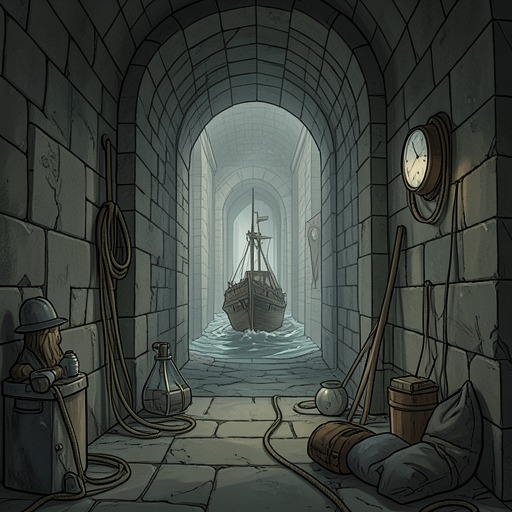
When the Endeavor approaches the Arch, the machinery withdraws and reveals a tunnel several miles in diameter, lined with burning-lights and extending beyond sight. Wind draws the airship inside. As the red light gathers around Jonathan, he reaches for the fruit, knowing that the moment of payment has arrived and that the passage cannot be completed through ordinary preparation alone.
The fruit is missing. Jonathan immediately suspects Eleanor McAvey, sees a flash of her greatcoat as she retreats toward her room, and pursues her. He tears the door from its hinges, finds her hiding, and seizes her by the throat. Eleanor is holding the fruit near her mouth, attempting to bite it, and fights to keep it. Jonathan forces her hand open and wrests the object away from her.
With the red light already collecting around him, Jonathan bites the fruit repeatedly and swallows it in haste. He experiences it as monstrous vitality and dire fortitude, but also recognizes that it constitutes a life in its entirety. The Arch takes that life almost as soon as it gathers within him. Its power and meaning are stolen before they can be fully realized, leaving only the taste of blood on his lips and tongue. The toll is thus paid, but not in the form Jonathan expected: the heart-fruit becomes a life inside him for an instant, then is consumed by the Arch before its deeper benefits can manifest.
Antomine interrupts the aftermath, ordering Jonathan to release Eleanor. Jonathan realizes that he is still gripping her throat and drops her, while Antomine and two maids confront him with drawn daggers. Jonathan defends the act as the retrieval of something that belonged to him and was necessary for the journey. The rule has enabled passage, but it has also converted a hidden disagreement between Jonathan and Eleanor into open violence before the expedition's witnesses.
Consequences and Significance
Arch of Khokorron's Toll makes knowledge itself transactional. Travelers do not merely acquire information by passing through; they pay for the transformation from not knowing to knowing. The Arch's red light, impossible machinery, and alien presence give the rule a cosmic scale, while its one-time limitation prevents the characters from treating it as a repeatable piece of technology. Every crossing carries the shadow of an exhausted resource.
The rule also exposes the expedition's unstable ethics. Jonathan's refusal to sacrifice a passenger or crew member appears more restrained than indiscriminate murder, but his solution still depends on possession, secrecy, and force. He hides the fruit, anticipates Eleanor's attempt to reclaim it, and attacks her when she tries to consume it herself. The Arch does not dictate every action, yet its structure narrows the field until survival is pursued through a calculation of whose life can be converted into safe passage.
Its most important consequence is the collapse of the distinction between object and person. The heart-fruit is purchased as an alternative to a human sacrifice, but the Arch recognizes it as a complete life and takes it accordingly. Jonathan survives the passage without receiving the fruit's full power, while Eleanor survives the struggle deprived of the object she sought to eat. Passage is achieved, but the supposed substitute does not remain available as a reward, cure, or reserve. The rule consumes the value it demands.
In narrative terms, Arch of Khokorron's Toll functions as a threshold law whose mystery is made legible through limitation rather than explanation. The travelers learn what the Arch does because it removes something that cannot be restored: knowledge, a life, or the life-bearing essence of the fruit. That irreversible exchange gives the crossing its force. The Arch opens a route toward deeper territory, but it does so by ensuring that no one can pass unchanged, and by making every later decision answerable to the cost already paid.