Awakening and Destruction of Tor Ilek
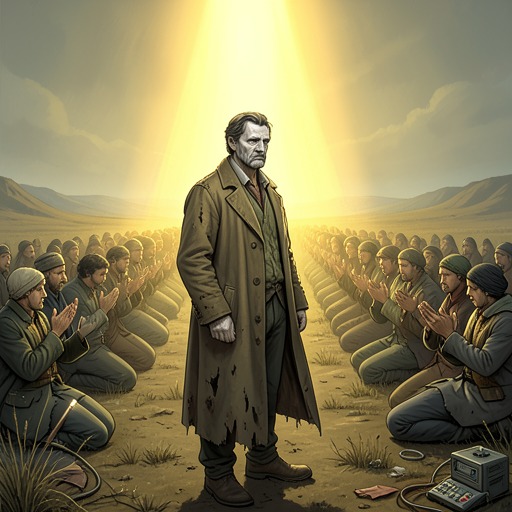
Chasing SunlightAwakening and Destruction of Tor Ilek is the decisive catastrophe of the expedition’s passage through the ancient ruins. What begins as an act of salvage becomes an escape from a force no one can identify or fight: an apocalyptic radiance rises beneath the city, meets the Unflame carried aboard the Endeavor, and consumes Tor Ilek in a fusion of malignant cold, hungry light, and geological ruin. The event preserves Jonathan Heights and his companions, but destroys the site, traumatizes one of the airmen, and deepens the expedition’s governing paradox: knowledge is necessary for survival, yet every discovery may awaken something that civilization cannot contain.
Causes and Background
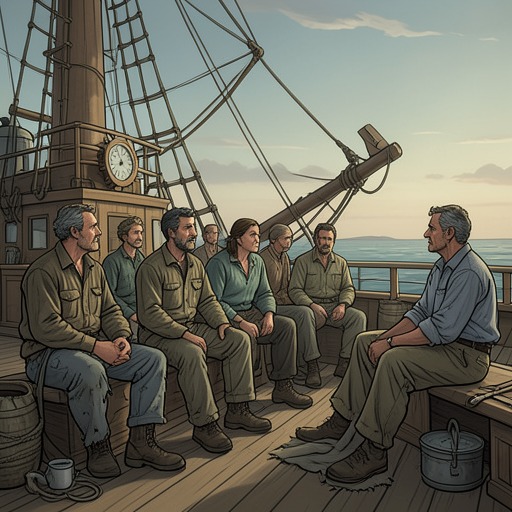
The expedition reaches Tor Ilek as part of Jonathan Heights’s eastward search for Sunlight. He is traveling through a world of lightless skies under the authority of the Illuminated King and the Reflected Council, moving beyond the eastern boundary of human civilization in pursuit of a truth most people dismiss as a myth. The journey has already placed him and his companions among environments where human maps, categories, and safeguards are unreliable. At Danby’s Point, the eastern terminus of the illuminated human track, human construction presses against the architecture and inhabitants of darker forces; beyond that frontier, Jonathan relies on accumulated experience, copied maps, and information purchased from Tiuni.
Tor Ilek therefore represents more than an isolated ruin. It belongs to the ancient and unrecorded world that Jonathan has chosen to enter, a world whose relics can be traded, mapped, and partially understood without becoming safe. Before the catastrophe, the crew explores the decrepit city and gathers treasure from its halls. Jonathan constructs a mechanism of rings and armatures copied from impossible geometry, and its operation alters the ruin’s apparent structure: doorways appear where none had existed, corners open into new passages, and the crew’s opportunity for plunder expands at precisely the moment the site becomes less intelligible.
The immediate cause is the crew’s disturbance of something below or within the ruins. A fleeing airman returns babbling, a deep low sound vibrates through the stone, a hot breeze overwhelms the constant sound of the river, and the gathered metal treasure begins to clink. Jonathan does not know whether the danger is a creature, a phenomenon, or something produced by the expedition’s interference. His conclusion is nevertheless immediate and practical: the expedition must flee. The crew’s greed has converted a salvage operation into an awakening, while the event leaves the nature of what was awakened deliberately unresolved.
The Escape from the Ruins
Jonathan leads the retreat through corridors as furnace heat rises behind the party. The hot air intensifies from a breeze to a gale, driving the expedition forward while beasts and vermin throughout the unlit reaches of Tor Ilek erupt from their lairs. The creatures are not attacking the expedition; they are fleeing in the same direction. Their flight supplies the clearest available measure of the threat, since even the hostile inhabitants of the ruin appear to recognize that remaining behind means destruction.
The expedition catches glimpses of stretched, spider-limbed animals and hulking bodies moving through colors both bright and dim. After the party exits the monolith, something massive plunges into the distant river, its shape only partially visible and its scale comparable to some of the surrounding buildings. Behind them, the roar grows into an unending, apocalyptic sound. Jonathan looks back and sees a glow of bright, hungry color that he cannot name. It behaves less like a passive eruption than a pursuing intelligence, capable of overtaking the fleeing group but choosing instead to nip at its heels.
The escape becomes a physical contest against closing doors, heat, and exhaustion. Jonathan races ahead to reopen doors that have sealed behind the group, including a ring-locked door whose circular handle requires several moments of effort. Eleanor McAvey, Antomine, the guards, the companions, and the airmen follow through the opening. Two injured or incapacitated crewmen must be hauled bodily by the others, and the expedition’s movement remains threatened by the possibility that the airmen may have to choose between saving their companions and carrying away the treasure.
At the final stairwell, the heat becomes difficult to breathe, and the boots of the fleeing crew begin to smoke. The Endeavor waits above, but the crew stationed at the descent line has begun to withdraw it because the strange radiation is spreading through cracks and rents in the ruins. Jonathan reaches the line with Eleanor McAvey and Antomine behind him, followed by the companions, guards, maids, and injured airmen. Once aboard, Jonathan does not simply abandon the ruin. He retrieves an amphora of Unflame from the cargo and throws it down onto the dome as the last crewman is pulled to safety.
The Collision of Unflame and Light
The amphora breaks on the dome, releasing a dark liquid that erupts into black, atramentous flame. Its malignant cold suppresses the heat rising toward the Endeavor and makes the metal descent equipment brittle enough for the cables and tether lines to be cut and released. The device is not presented as a conventional weapon with a controlled target or predictable result. It is a second impossibility introduced into an already unstable site, used by Jonathan because he has no better means of preventing the pursuing force from reaching the ship.
The black fire and the horrific radiance meet and merge. The image is intimate as well as violent: the two forces touch and embrace, and the light appears to drink the darkness. This brief quiescence gives the Endeavor its chance. Montgomery, watching from the bridge, orders the engines to full power and commands an emergency ascent while the deck lurches beneath the survivors.
The apparent reprieve becomes a larger catastrophe. The Unflame and the hungry light fuse into something more terrible than either source, then leap outward through the ancient streets and halls. The illumination exposes Tor Ilek more completely than the expedition has ever seen it, revealing the crumbled grandeur and impossible architecture of the forgotten civilization even as the combined force destroys them. The city is made visible by the very doom that consumes it, so that discovery and obliteration occur in the same instant.
The destruction reaches the river. Unnamable colors leach into steam, the water appears to boil, and the sound of ruin overwhelms the Endeavor’s engines before gradually fading as the airship pulls away. Tor Ilek founders beneath the spreading forces; falling debris enters the river, which churns over the remains and turns them into a watery necropolis of rotted stone and drowned, tombstone-like fragments. The expedition does not merely leave a dangerous ruin behind. It witnesses the conversion of an ancient city into its own graveyard.
Consequences for the Expedition
The survivors emerge physically alive but not unchanged. Eleanor McAvey demands an explanation, while the injured airman who had been attacked or disturbed during the expedition stares into space and speaks only in a language described as unfit for human speech. Reflections of the terrible light remain in his pupils, making his body a lingering record of an experience no one else can interpret. The catastrophe therefore continues after the immediate escape: Tor Ilek has been destroyed, but its effect has entered the survivors and their account of the journey.
Jonathan admits that he does not know what happened. His explanation is not a revelation of hidden lore but a statement of the limits of human knowledge: the darkness contains things without names and phenomena no expedition has previously encountered, and every expedition returns with new records accompanied by more questions than answers. His response protects the group from false certainty, but it also confirms that the event cannot be reduced to an ordinary monster attack or mechanical accident.
The catastrophe establishes a recurring pattern in Jonathan’s expedition. The crew’s maps, tools, trade goods, and mechanisms make contact with the unknown possible, yet those same instruments invite danger. At Danby’s Point, trade and human governance extend into a frontier where the Inquisition is simultaneously strongest and weakest; at Tor Ilek, the expedition’s act of measurement and acquisition opens spaces that were previously hidden. The more successfully the explorers penetrate the ruin, the less stable the distinction becomes between object and threat, artifact and agency, exploration and desecration.
The event also sharpens the conflict between Jonathan’s objective and the wider claims of civilization. Later, at Angkor Leng, Antomine argues that a threat cannot be ignored merely because addressing it is inconvenient, while Jonathan insists that the expedition is not a navy and lacks the time and resources to cleanse an entire city. Tor Ilek gives that disagreement an earlier, more terrible context. The party has already learned that entering, investigating, and attempting to control an unfamiliar site can produce devastation on a scale no small expedition can manage. Jonathan’s refusal to promise mastery is therefore grounded in experience, even though his continued pursuit of Sunlight repeatedly carries him toward precisely such uncontrollable thresholds.
Narrative and Thematic Significance
Tor Ilek is a threshold event in Jonathan Heights’s hero’s journey, but it reverses the reassuring form of an ordeal. The expedition crosses into an ancient space expecting knowledge and treasure; it leaves with survival but without explanation, and the apparent reward of discovery is inseparable from destruction. The city’s architecture becomes legible only while it is being erased. In that reversal, the event gives narrative form to the book’s suspicion that human knowledge does not simply illuminate the darkness; it can also provoke the darkness into answering.
The sequence is structured around a severe value shift. The crew begins by treating the ruin as a source of wealth and information. When the awakening occurs, treasure becomes a burden, exploration becomes flight, and the value of survival temporarily competes with the value of preserving fellow crewmen or salvaged objects. Jonathan’s command to flee is stark because it cuts through that hierarchy. His later use of Unflame changes the terms again: the expedition survives, but only by setting one incomprehensible force against another and accepting the destruction of the place it entered.
The event also occupies an unstable space between the sacred and the profane. Tor Ilek is treated neither as a simple archaeological site nor as a fully explained temple. Its impossible geometry, buried power, and final illumination give it an almost ritual character, while the expedition’s looting and technical intervention belong to commerce and practical exploration. The later funerary ceremony for a dead titan, in which Antomine recites, “From dust ye were made and dust ye shall be,” shows the expedition attempting to impose ritual order on alien death. Tor Ilek offers no comparable closure. Its destruction is witnessed, recorded, and interpreted only as an unanswered danger.
That uncertainty is central to the event’s lasting force. Jonathan is sustained by his faith in Sunlight, yet even that conviction cannot explain the glow that pursues the expedition or the force that consumes the city. He can only preserve the fact of survival and the warning that the ruins’ treasure carries risks beyond human imagination. Tor Ilek consequently becomes one of the sacrifices later remembered on Jonathan’s path toward Bright Defile: alongside Tiuni’s death, the burning of a dead god, the sacrifice of Angkor Leng, and the loss of his former relationships, the destruction of the city marks the cost of crossing from the known world toward Sunlight. Its final significance is not that the expedition solved an ancient mystery, but that it survived long enough to carry the mystery onward.