Black Garden
Chasing SunlightThe Black Garden is a secretive women-only place beneath Ukaresh, guarded by the Sisters of the Immaculate Thorns and associated with rumors of a fruit capable of producing life. It is not merely a hidden location or exotic curiosity: for Jonathan Heights, the Garden is a necessary threshold in his search for the means to pass the Arch of Khokorron, while for Eleanor McAvey it becomes an encounter with a form of knowledge and growth that exceeds human control. Its decisive significance lies in the way it converts a carefully negotiated expedition objective into a catastrophe, exposing the destructive incompatibility between the Garden’s consuming darkness and the sunlight Jonathan carries within his memory.
Location and Access
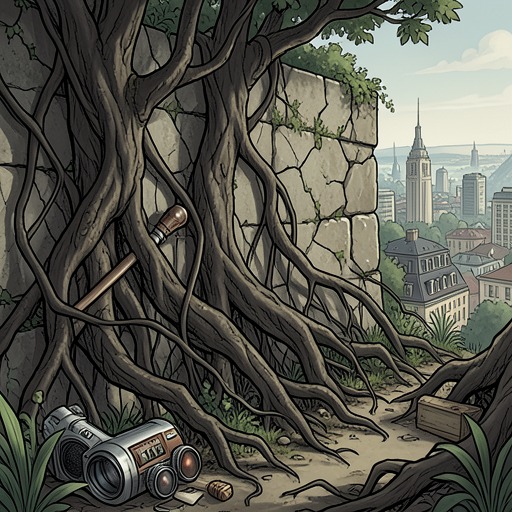
The Black Garden lies somewhere below Ukaresh, the eastern city whose architecture and boundaries merge uneasily with the surrounding landscape. Jonathan Heights knows enough about the Garden to understand that access is restricted by gender as well as by secrecy: only women may enter, and Eleanor McAvey can be welcomed where Jonathan cannot even speak directly to the Sisters of the Immaculate Thorns. Jonathan therefore relies on his former relationship with Ukari, ruler of Ukaresh, to obtain permission rather than attempting to approach the Garden himself.
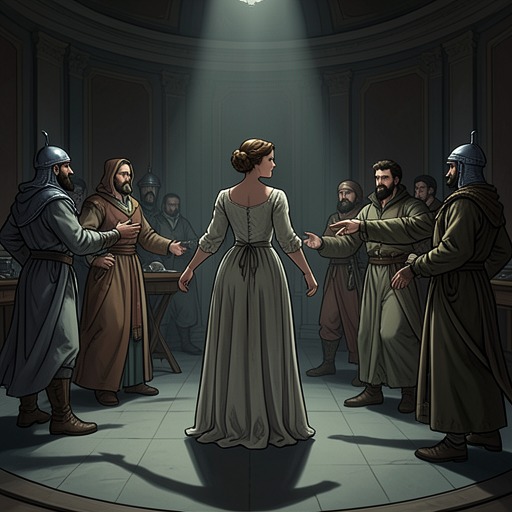
Jonathan presents the request as a practical matter, explaining to Ukari that he had intended to show Eleanor McAvey the Black Garden and asking whether access can be negotiated quickly. Ukari treats the proposal not as a routine favor but as an opportunity for trouble. She draws Eleanor McAvey toward the throne of bone and gold and challenges her to see what the Garden has to show her. When Eleanor asks what the place is, Ukari gives the essential rule plainly: it is a place only women can enter. That restriction immediately changes Eleanor’s position within the encounter. She is no longer merely Jonathan’s companion or an observer of Ukaresh; she becomes the expedition’s indispensable participant.
The Garden’s access rule also deepens the tension between Jonathan Heights and Eleanor McAvey. Jonathan has brought Eleanor because the Garden will accept her, but he does not possess the knowledge required to guide her safely through what lies below Ukaresh. His knowledge is instrumental and incomplete: he knows of the Sisters, the rumors of their fruit, and the use to which that fruit may be put, but he does not understand the secret process by which it is produced. The Garden thus admits Eleanor while withholding itself from Jonathan, creating a dangerous division between the person who needs the result and the person who must undergo the encounter.
The Life-Fruit and the Garden’s Power
Jonathan Heights is familiar with reports that the Sisters of the Immaculate Thorns can provide a fruit of life. He has personally witnessed a feat connected with such a fruit and considers it the surest way to pay the toll required for passage through the Arch of Khokorron. Other forms of payment exist, but none appears as reliable. Because he is a man, Jonathan cannot negotiate with the Sisters himself; Eleanor McAvey’s admission to the Garden is therefore not incidental but central to the expedition’s plan.
Within the Pits of the Condemned, Jonathan asks Eleanor McAvey to harvest the fruit from a massive near-cat frozen at the bottom of a pit. His request is carefully polite because the sacrifice is the reason he has brought her there. Eleanor responds with evident pleasure, raising her dagger and entering a process Jonathan cannot properly understand. What he perceives is not a transparent ritual but a fragmentary impression of blood, dark crawling vines, immense leaves, roots reaching toward the heart of the world, and the savage thirst of growing things. The Garden’s power is presented through effects rather than explanation: its knowledge remains forbidden to Jonathan even while its physical consequences become impossible to ignore.
The result is a single red, smooth fruit that beats like a heart. It is enclosed in a thin lacework of hide and fur and resembles a demented paper lantern, yet its repeated contractions radiate terrible vitality. Eleanor McAvey delights in the object and begins to strip away its skin-husk, apparently preparing to eat it herself. Jonathan Heights stops her by the wrist and takes the fruit, hiding it inside his jacket. The intervention immediately turns their practical cooperation into physical conflict. Eleanor reacts with a murderous glare and reaches for his face, while Jonathan keeps the fruit for the expedition’s larger purpose. The Garden’s promised gift therefore arrives already entangled with possession, danger, and a breach of trust between the two travelers.
The Garden’s Transformation Under Sunlight
The theft of the fruit does not end the encounter, because Jonathan Heights has brought into the Garden a power whose presence changes the meaning of everything around it. When sunlight enters his memory, it denies the primacy of the Garden’s dark vines and crimson appetite. The Garden responds by looking through Eleanor McAvey and taking in that radiance; neither Jonathan nor Eleanor understands the other’s secrets, yet the contact produces a palpable twisting of the Garden’s nature. Its darkness shifts toward something greener and greater, not becoming harmless but flourishing under the one true light. The change passes through Eleanor and echoes back toward the Garden’s hidden source, turning a private harvest into an invasion of revelation.
That transformation immediately exceeds the limits of the original bargain. The Garden bursts forth into the Pits of the Condemned, and something seems to claw its way out through Eleanor McAvey in order to bathe in the pure radiance of Jonathan Heights’s memory. Jonathan and Eleanor are protected, but the surrounding pits are not. The Keeper of the Pits, which had illuminated the sacrifice with its humming note, is altered as woody trunks burst from its barrel and give it two new limbs; the barrel then splits apart as a blood-slick trunk rises toward the ceiling, its roots cracking the stone floor. The place that had been entered to obtain one life-fruit becomes a landscape of uncontrollable propagation.
Eleanor McAvey’s body registers the cost of the contact. She screams and struggles against Jonathan Heights’s grasp while blood leaks from her eyes, tongue, and nails. Around them, every pit trembles. Hundreds of trees rise in the flickering torchlight, one from each pit, until the ceiling shakes and the ground moves beneath them. The Garden has not simply been illuminated or revealed; it has spread into the Pits of the Condemned, converting a contained subterranean secret into a proliferating force that threatens the entire structure.
Jonathan Heights finally puts the sunlight away, and the scorching radiance fades from his mind as Eleanor McAvey collapses. The retreat does not restore the old order. The Black Garden, no longer black, continues growing, with branches piercing the ceiling and chunks of stone falling into the pits. Jonathan abandons the harvest site and drags Eleanor toward the staircase, where the last image he notices is one of the identical defiled engravings: it is smiling. The image links the Garden’s eruption to the wider presence of the Smiling Man’s influence, making the catastrophe feel less like an isolated accident than a breach through which an older and more pervasive power has become visible.
Aftermath and Narrative Significance
The Garden’s consequences continue beyond the immediate collapse of the Pits of the Condemned. Eleanor McAvey survives the encounter, but the experience becomes a lasting wound in her understanding of herself and of Jonathan Heights’s purposes. Later, while the expedition is preparing to approach Bright Defile, she says that she does not want knowledge to control her or to end up like Jonathan, with no interest, no real life, and no freedom. Her reluctance is explicitly tied to what happened in the Black Garden: curiosity remains, but it is no longer innocent, and she recognizes that the Garden’s secrets can consume the person who reaches toward them. Jonathan, for his part, admits that he did not intend for her to be hurt by those secrets. Under the uncompromising truth of sunlight, he releases her from any further obligation to his pursuit and tells her to live as she wishes, acknowledging that the gulf between them has become absolute. The Garden therefore marks not only a physical transformation but the decisive failure of their former intimacy and cooperation.
The location also exposes a recurring structure in the book’s geography. Beacon presents civilization’s light as artificial and dishonest, while Danby’s Point stages human order against alien construction; Ukaresh allows buildings, species, roads, and laws to mingle under a rule governed chiefly by power. The Black Garden intensifies that instability by placing an inaccessible, women-only domain beneath Ukaresh and making its hidden fertility available only through a body Jonathan cannot replace with money, authority, or technical knowledge. Its restricted access reverses the usual expeditionary hierarchy: the male explorer possesses the objective and the plan, but Eleanor McAvey possesses the necessary eligibility. Once sunlight enters the Garden, however, the boundary between forbidden interior and outside world collapses. Trees rise from every pit, the Keeper of the Pits is remade, and the subterranean chamber can no longer contain what it has produced.
The Garden’s horror proceeds by revelation rather than by immediate explanation. Before the harvest, Jonathan Heights knows only rumors, institutional names, and the practical value of the fruit; during the ritual, he receives impressions of blood, vines, roots, and a hunger belonging to growing things rather than to any comprehensible human religion. The fruit is beautiful in its smooth red form and rhythmic vitality, yet that beauty is inseparable from the sacrifice that produces it. The later expansion follows the same pattern: the unseen power becomes visible first through bodily symptoms, then through altered machinery and architecture, and finally through the hundreds of trees that make the entire pit complex tremble. This movement from anticipation to monstrous manifestation gives the Black Garden a distinctly Gothic force, in which an enclosed space preserves a secret until contact with sunlight makes the secret proliferate beyond all intended limits.
At the same time, the transformation complicates any simple opposition between darkness and light. Sunlight does not merely destroy the Garden. It denies the authority of its dark vines and crimson appetite, but the result is a greener, greater growth that remains consuming. The Garden is changed by revelation rather than erased by it, and its new form is arguably more expansive and dangerous than the black growth Jonathan expected. The scene makes the expedition’s central conflict material: sunlight promises truth without shadow, yet truth can act as an invasive force, exposing, altering, and destroying the structures that have survived through concealment. The Black Garden is consequently a threshold between biological fertility, forbidden knowledge, and cosmic transformation—a place where the desire to obtain a single living fruit opens onto a catastrophe that neither Jonathan Heights nor Eleanor McAvey can control.