Bright Defile
Chasing SunlightBright Defile is the final destination of Jonathan Heights’s expedition into the eastern wilderness and the place where the book’s central opposition between eternal darkness and sunlight becomes physical. It is not merely a hidden landscape or a promised refuge: its radiance exposes secrets, its approach imposes graduated limits, and its last barrier demands that the traveler abandon every remaining shadow. Jonathan’s arrival therefore turns exploration into revelation and survival into a question of what identity can endure in perfect light.
Location and Approach
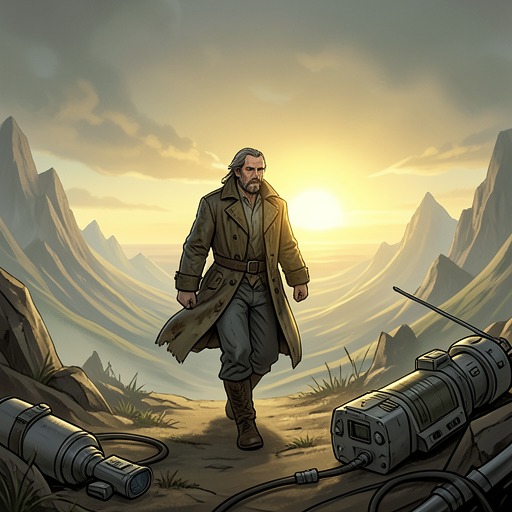
Bright Defile lies beyond the Arch of Khokorron, east of the Grave of Wood, and can be reached from that burial ground by no more than a day’s brisk walk. Jonathan describes the intervening terrain as unremarkable, but the route itself is marked by a severe contrast between ordinary ground and extraordinary destination. The party travels along a dark, straight metal path through the Grave of Wood, passing between the looming forms of salt bodies and wooden biers. The place is quiet, without creatures or weather to trouble them, yet its stillness gives the journey the character of a procession toward a forbidden boundary rather than a normal trek. The wider route has already stripped away the infrastructure and assumptions of human civilization. Around the Arch of Khokorron, the land is barren and crumbled, populated only by small, harsh, venomous creatures. The Endeavor reaches the Arch through a landscape whose emptiness differs sharply from the busy human settlements encountered earlier, and the passage through the monument carries the travelers from one distant desert to another. When the vessel emerges, its aperture is set into a sloping hill at the far end of a vast barren desert. From there, the remaining distance must be crossed on foot, with supplies hauled on a sled that Jonathan expects they will scarcely need.
The Sunlit Valley
Bright Defile appears suddenly beyond a narrow valley between two looming mountains. The transition is instantaneous: after the edge of the last flagstone, existence is clarified by a single ray streaming down from above. The illumination is described as bright, pure, and perfect, but its most remarkable property is that it casts no shadows. Instead, it produces only more light. Its warmth reaches the travelers even from a distance, soothing both body and soul, while its colors exceed the endurance of ordinary reality: trees, flowers, mountains, and the surrounding country take on a vibrancy that the dark world has denied them. The valley is therefore both beautiful and dangerous. Its sunlight does not simply reveal objects; it threatens the conditions under which the travelers have understood themselves. Jonathan warns the assembled expedition that most of them have reached their limit and should go no farther. Each step toward the light will test them, and although retreat remains possible, crossing the limit carries consequences for which the traveler may not be prepared. His warning is not theoretical. Captain Hardiman and Stoneface had reached Bright Defile with him during the previous expedition, but only Jonathan survived to leave. The location preserves their absence as part of its meaning: the route is not a scenic approach to discovery but a selective ordeal.
Threshold and Final Barrier
Bright Defile operates according to a progression that turns distance into moral and epistemic pressure. The deeper Jonathan goes, the more the ordinary protections of concealment and self-possession fall away. At the final threshold, statues no longer mark the route. A deep gulf opens before him, and the physical interruption is inseparable from a barrier of understanding. In a land defined by revelation, the darkness at this point is paradoxically clear because no secret remains beneath it. The obstacle is not ignorance in the usual sense; it is the recognition that entry into sunlight requires the traveler to shed whatever still allows him to possess a hidden self. The final crossing makes that demand literal. Jonathan places his cane, the weapon concealed within it, as a thin sword-blade across the last stretch and releases it as a sacrifice to bridge the impossible gap. The act completes a pattern already established by the expedition: progress requires the abandonment of tools, protections, and claims that once made the journey possible. He crosses the perilous gap, takes the final step through darkness washed by light, and enters Bright Defile itself.
Jonathan’s Arrival and Revelation
Beyond the narrow valley lies a great green country extending upward and outward beneath proud mountains and clouds of pure white. Rivers move through the landscape, and the narrative presents every leaf, blade of grass, stone, and drop of water as inscribed with the secrets of all time and space. Above it all stands the sun, older than worlds and older than time, vaster than anything the traveler could imagine. Bright Defile thus fulfills the expedition’s objective while radically exceeding the language of geographical discovery: Jonathan has not found a resource or a hidden settlement but a reality whose scale makes the world he left behind appear negligible. The contrast is especially severe when Jonathan looks back. The shrouded lands from which he came have become a dim mote floating in a gap between sunbeams, an overlooked corner of creation. This perspective reverses the hierarchy upheld by the lightless human world. Civilization had treated its own illuminated settlements as a defense against darkness and a measure of order; from Bright Defile, that civilization is reduced to a nearly invisible fragment within a much larger creation.
Narrative Significance
Bright Defile is the culmination of a quest that begins in a world where sunlight is treated as a dangerous secret and humanity keeps vigil against eternal darkness. Jonathan’s earlier knowledge of the location gives the final approach a different force from a first discovery: he is returning to the site that ended his previous expedition, carrying the memory that Captain Hardiman, Stoneface, and the other members of that venture did not survive. He insists that the destination is near and that the journey home awaits the others, but his own conduct shows that he is not simply escorting a party to a geographical endpoint. He is preparing to cross a threshold that only he has previously survived. The location also gathers the book’s recurring tensions between knowledge and danger, civilization and wilderness, ritual departure and irreversible transformation. The expedition passes through ruined and guarded spaces, performs a formal burial ceremony for an ancient and alien being, activates machinery capable of shaking the ground, and crosses the Arch of Khokorron before reaching the path through the Grave of Wood. Bright Defile is the terminal form of those earlier transitions. At its final barrier, knowledge is no longer something Jonathan can collect in notebooks, and the light is no longer something human institutions can regulate. It is an environment that demands complete exposure, making the explorer’s victory inseparable from the loss of every shadow that could have concealed him.