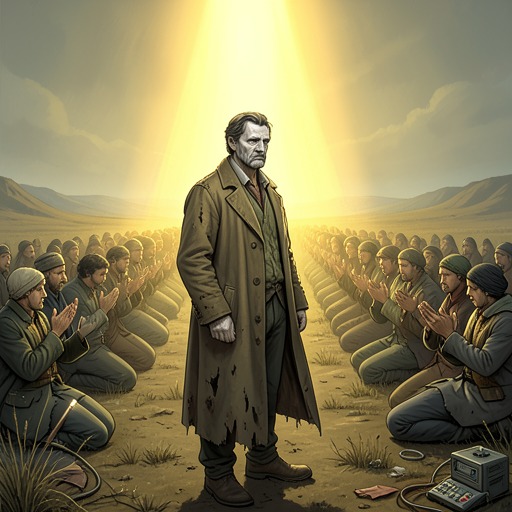
Bright Defile's final barrier
Chasing SunlightBright Defile's final barrier is the last and most exacting condition imposed on Jonathan Heights before he can enter sunlight. It is not merely a physical obstacle in a valley: in a land where sunlight exposes every secret, the barrier becomes a gulf between concealment and revelation, and crossing it requires the abandonment of every remaining shadow of the self he has been. Its decisive significance is that Jonathan does not overcome it by force or knowledge alone; he pays for passage through a sequence of personal sacrifices, until even his cane must be surrendered and he can stand in the light without a path of retreat.
The Barrier as Threshold
The approach to the barrier follows Jonathan's passage among ancient salt statues, whose worn surfaces retain the vestiges of failed understanding. As he advances, the distinction between what is inside him and what lies outside him grows less stable. The statues are therefore more than scenery: they mark earlier failures to comprehend or pass beyond the conditions of Bright Defile, while Jonathan's own reflected memories remain both a source of strength and a burden that continues to judge him.
At the threshold, the statues end and a deep gulf opens before him. The gulf is simultaneously geographical and intellectual. Its darkness is especially stark because Bright Defile is defined by sunlight, yet the darkness is not mysterious in the ordinary sense; its nature is entirely clear because the revelatory reality of the place leaves no secrets concealed. The final barrier thus converts understanding into an existential demand. To live in sunlight is to have no shadow left, and crossing requires more than discovering truth: it requires surrendering the parts of a life that depend on incompleteness, attachment, and return.
The Price of Passage
Jonathan's empty estate is the first memory to burn, igniting only a small fraction of the gulf. His chauffeur and housekeeper follow as two further sacrifices. These losses show that the barrier recognizes not only grand ideals but the concrete structures of ordinary life. His estate represents material continuity; the servants represent personal ties and the domestic world that once received him. Each sacrifice erases another route back to the person he had been.
The payment then gathers the decisive losses of his eastern journey. The death of Tiuni and the destruction of Tor Ilek become part of the fire lighting his path. The books Jonathan threw from the deck of the Endeavor appear as individual points, like stepping-stones across the impossible distance. The burning of a dead god provides another light, while the sacrifice of Angkor Leng appears as a golden city within a god's dream, radiating only briefly. The images make the barrier's logic cumulative: no single ordeal is sufficient, because the threshold measures the total cost of Jonathan's commitment.
The losses of relationship and belonging are equally important. Jonathan's friendship with Eleanor McAvey is counted among the sacrifices, as is his banishment from Ukaresh. The stern visage of She-Who-Must-Be-Obeyed appears briefly and seems to acknowledge him before adding its own contribution to the pyre. Jonathan has also rejected the Players and the Game, described as the dark inverse of sunlight's bright truths. The final barrier therefore demands the surrender of social recognition, former loyalties, political or supernatural protection, and the alternative order represented by the Players.
The Final Act of Surrender
At the end, Jonathan's cane lies across the last stretch like a thin sword-blade. The object is both practical support and a visible extension of the identity with which he has traveled. He must let it go as well. This final sacrifice differs from the earlier memories because it removes an immediate aid rather than a recollection of what has already been lost. Crossing becomes physically perilous, but Jonathan cannot shrink from it: the barrier has reached the last object that could help him remain the same person while entering the light.
He takes the final step through darkness washed by light and closes the infinitesimal gap between himself and sunlight. Once across, he stands within Bright Defile rather than merely approaching it. Beyond the narrow valley lies a vast green country with mountains, white clouds, rivers, and a blue sky; the secrets of time and space are written into every leaf, stone, and drop of water. Behind him, the shrouded lands he crossed have become a dim mote suspended between sunbeams. The scale of the transformation confirms what the barrier required: the world of concealment has not been conquered so much as left behind.
Narrative and Thematic Significance
The final barrier gives a moral and structural shape to Jonathan's entire expedition. Earlier thresholds are associated with unstable civilization, hostile laws, altered time, enormous machinery, and journeys whose costs are measured in knowledge or life. The Arch of Khokorron, for example, takes ignorance as a toll that cannot be paid twice, while the passage through its tunnel carries the travelers from one impossible geography to another. Bright Defile's final barrier changes the currency. It does not ask Jonathan to surrender an abstract secret or a single physical payment; it makes his accumulated history itself the price.
The rule also reverses the expectation that enlightenment is simply a reward for perseverance. Jonathan reaches the sunlight because he accepts irreversible loss. His progress is not a clean ascent from darkness into truth, since every advance burns away a possession, attachment, memory, or affiliation. The threshold treats freedom as inseparable from responsibility: Jonathan is free to continue, but he must accept what continued movement destroys. In that sense, the barrier is both a gate and a judgment on the kind of person who wishes to pass through it.
Its conclusion remains triumphant without restoring what was sacrificed. Jonathan feels the sun's warmth, the wild wind at his back, and the liberty of truth before him, and he smiles. The smile marks completion, but not recovery. The final barrier has made sunlight attainable by ensuring that the traveler who enters it is no longer able to return with his former estate, companions, cane, or shadowed identity. Bright Defile's rule is therefore the terminal expression of the book's recurring contrast between civilization's protective boundaries and the dangerous freedom beyond them: the light is real, but admission requires becoming answerable to everything the light reveals.