Captain Montgomery
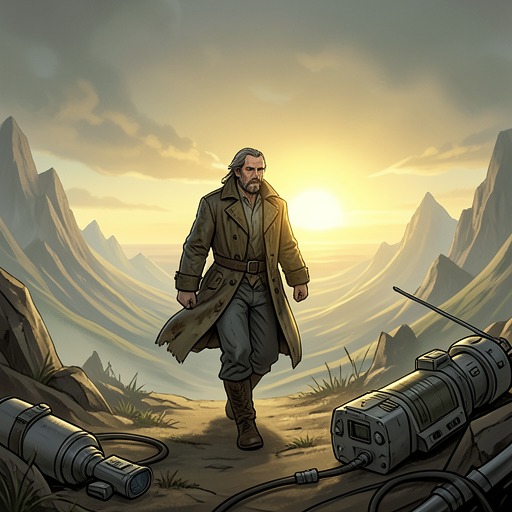
Chasing SunlightCaptain Montgomery is the veteran airman and commander of the Endeavor, the practical center of an expedition increasingly drawn beyond the limits of ordinary navigation and human certainty. Jonathan Heights recruits him not because the ship is sound or the mission safe, but because Montgomery has brought a nearly destroyed vessel back to port, has flown for a very long time with an excellent reputation, and is desperate enough to accept an improbable venture. His authority is therefore founded on endurance and professional judgment rather than comfort: Montgomery is the man who must keep a damaged ship, an understrength crew, and reckless passengers alive while the world around them becomes less intelligible.
Identity and Command
Montgomery first appears as a seasoned captain whose outward discipline conceals exhaustion and pressure. When he is brought into Jonathan’s presence after a night of drinking, he nevertheless looks fresh, alert, and professional in a spotless dark-blue airman’s uniform, with polished captain’s wings; only his face sags slightly as he settles into the chair. The contrast establishes the terms of his character. He is not untouched by fatigue or uncertainty, but he has learned to put both beneath the visible requirements of command.
His command is inseparable from the condition of the Endeavor. The ship Jonathan sees in drydock is more scrap than vessel: part melted, part dissolved, with most of its envelope burned away and sections of its superstructure crazed by cracks from luminiferous detonation. Montgomery’s skepticism is consequently practical rather than timid. When Jonathan points to the money and gems available for the expedition, Montgomery observes that such wealth could purchase a new dreadnaught and asks why anyone would bother with him. The answer—that he returned this ship to port, has long experience and a strong reputation, and is desperate—recognizes both his competence and the vulnerability that makes competence exploitable.
Montgomery’s crew is another measure of his responsibility. Twelve members of his original company remain with him through “hell or high waters,” but the Endeavor needs twenty people to operate properly. He expects that many of the newer recruits will leave after the expedition’s violence and danger, and he knows that finding replacements willing to travel beyond human lands will take time. His calculations are logistical, yet they also reveal continuity and loyalty: the old crew is not merely labor, but the surviving core of a professional community that has endured with him.
The Captain in the Expedition
Montgomery’s relationship with Jonathan is built on wary cooperation. He asks about routes, duration, chains, cargo, engines, and stores, while Jonathan supplies objectives whose danger cannot be reduced to ordinary seamanship. The Endeavor follows the Khorus River south and east, and Montgomery remains responsible for translating an explorer’s intention into a navigable course. When Jonathan insists on an immediate departure because the Baron may commandeer ships to respond to a Rising, Montgomery recognizes that interrupting shore leave will make neither of them popular, but ultimately accepts the argument and calls the crew back.
He does not confuse caution with refusal. When Jonathan senses that the crew has disturbed something they cannot fight, he knows that the threat may be a creature or a phenomenon, but Montgomery’s role is to make room for that judgment rather than demand an ordinary battle. In quieter moments, the two men drink together in the captain’s cabin, sharing high-proof liquor in silence. Montgomery offers the ship’s safe, and even his quarters, for Jonathan’s valuables, demonstrating a practical trust that does not require emotional intimacy.
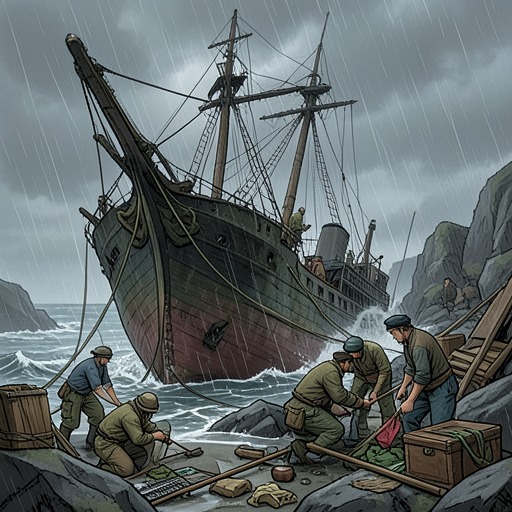
That trust is repeatedly tested by pursuit and scarcity. When Montgomery reports that a ship is running dark and closing to intercept the Endeavor, he gives the situation its plainest meaning: the pursuing vessel has more force and is unlikely to be seeking a friendly conversation. Later, after the expedition has consumed lives and resources, he worries about supplies and asks to recover usable metal and glass from the derelict Discovery. The same captain who manages extraordinary dangers must also preserve salvage, fuel, hull integrity, and navigational capacity.
At Ukaresh, Montgomery’s unease becomes especially visible. Jonathan arranges the Endeavor’s berth with an insect collection because the city’s inhabitants have strange appetites and tastes, but Montgomery, looking through patched bridge windows at the city’s not-quite-human forms, decides that shore leave is unwise. The bridge windows are still partly salvaged, their panes held in hastily machined frames, so the ship itself carries the marks of earlier damage into this unsettling environment. Montgomery’s distrust is not abstract prejudice; it is a captain’s response to a place where the familiar social and material safeguards of human travel appear unreliable.
Risk, Discipline, and Crew Loyalty
Montgomery’s defining habit is to convert uncertainty into procedure. When the Endeavor loses the city that served as a navigational landmark, he refuses to pretend that the problem is minor: without the city, navigation has a “right hole” in it, and the crew must regain its bearings through the maps. His realism contrasts with Jonathan’s appetite for hidden meanings. Jonathan searches Terminus for a dark secret or threatening shadow and becomes frustrated when the town appears almost offensively ordinary; Montgomery, by contrast, treats the absence of a landmark, the condition of the ship, and the availability of supplies as immediate facts requiring action.
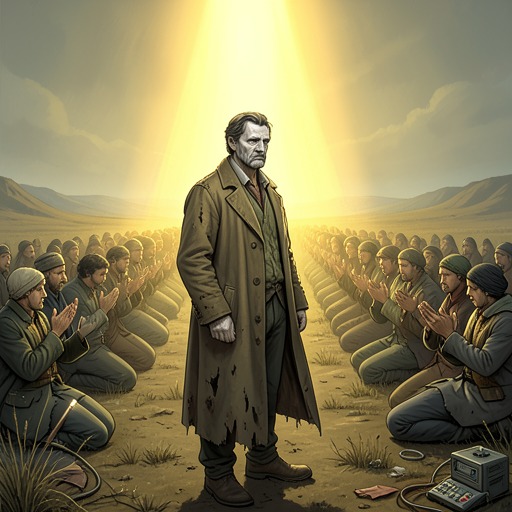
His concern for people is equally concrete. When airmen are stranded among the Flame Cult, Montgomery insists that they remain men in distress and that a good captain does not abandon them, especially in such a place. He asks Lieutenant Azhir for help with fire dust because Azhir can handle it more quickly and with less danger than the Endeavor’s own crew. The request is not a surrender of authority. It is an example of command as delegation: Montgomery identifies the relevant expertise and uses it to reduce danger to everyone aboard.
Montgomery also allows curiosity to overrule his own common sense. During an expedition requiring steel poles with flowers tied to their ends and earplugs for protection, he joins the detail himself for the first time, leaving the bos’n in charge. He remains flanked by armed crewmen, carrying the same flower-rod equipment as the others, but his presence changes the expedition from a captain’s order into a shared exposure to danger. His curiosity does not erase caution; it exists beside pistols, protective measures, and delegated command.
Storms, Damage, and the Endeavor
The Grave of Wood sequence brings Montgomery’s professionalism into its most visible physical register. As a storm pursues the Endeavor, he stands behind the pilot issuing a continuous stream of orders while the bos’n relays commands through the speaking tube. The vessel drops altitude toward enormous carved biers topped by crystalline figures whose faces are hidden beneath cloth. There is no leisure to contemplate the spectacle. Montgomery’s attention remains fixed on altitude, wind, the ship’s frame, and the survival of those aboard.
The escape damages the Endeavor. The airship lists slightly, showing that the envelope has been compromised by the headlong flight, and Montgomery understands that serious failure may be concealed within the machinery even if the vessel remains airborne. His worry is not theatrical panic but maintenance awareness: a ship can continue flying while accumulating invisible defects that later become fatal. When Jonathan claims that the destination may justify the journey, Montgomery answers that he will believe it when he sees it, reserving judgment until the promised value has been demonstrated.
After reaching the expedition’s later stages, Montgomery recommends spending several days checking that the Endeavor is properly sound. He simultaneously acknowledges that supplies are running low and that material from the Discovery could be valuable. The priorities are inseparable: rest and inspection protect the ship, while salvage may be necessary to keep it operating. Even when he joins Antomine on the cargo deck as the crew prepares a descent to the derelict, his immaculate suit and attention to the tethering equipment suggest that ceremony and caution have been absorbed into his working discipline.
Return, Continuity, and Narrative Role
Montgomery’s captaincy survives not through triumph over the expedition’s mysteries but through repeated acts of preservation. The Endeavor brings back immense quantities of gold, enough to attract intense interest in Beacon and make otherwise obscure passengers briefly notable to those hoping to profit from the windfall. Yet material success does not make the return uncomplicated. The wealth arrives alongside the memory of dead crew, including George, whose empty casket is rendered into dust with the others after Antomine’s service. Montgomery’s ship is therefore both a vehicle of riches and a vessel carrying the cost of obtaining them.
The expedition also leaves the Endeavor short of people. Montgomery’s original twelve remain the dependable nucleus, but the need for twenty competent crew members exposes how fragile the ship’s future is. The captain’s problem is not solved by the gold alone: he must recruit people willing to leave human lands, restore a damaged airship, and preserve the habits that make long-distance flight possible. His authority rests on this unfinished labor rather than on a final victory.
The later departure from Beacon confirms his function as a continuing anchor. Eleanor McAvey leaves again with Sarah and Marie behind her, each carrying a cat, while Montgomery stands on the bridge of the Endeavor and receives the direction to travel east. His reply, “East, then,” is brief because his role requires movement after every ordeal. It does not promise that the next expedition will be safer or more comprehensible. It shows instead that Montgomery remains the captain capable of turning renewed uncertainty into a course, a crew, and a ship that can continue flying.