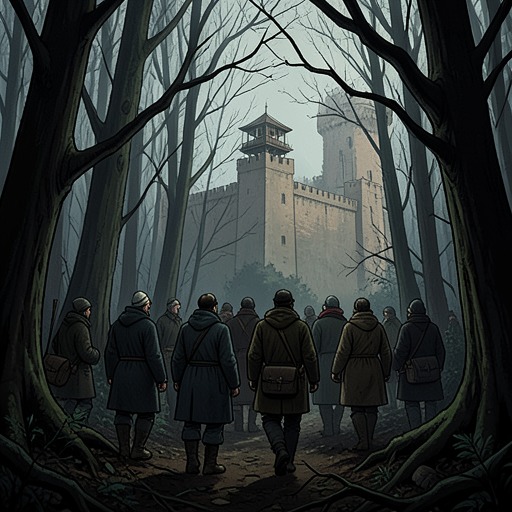
Civilization doesn’t happen on its own
Chasing Sunlight“Civilization doesn’t happen on its own” is a principle articulated by Antomine in opposition to Jonathan Heights’s pragmatism. It means that civilization must be actively made through choices that exceed bare survival: protecting others, confronting dangers before they reach human lands, and extending humane obligations into places where they are costly and uncertain. The phrase therefore becomes more than encouragement. It is a compact statement of Antomine’s ethics, his loyalty to the Illuminated King’s civilizing mission, and the novel’s continuing argument over who has the authority to define civilization.
Antomine’s Principle in Angkor Leng
The expression emerges during the Endeavor’s stay at Angkor Leng, when Antomine identifies a possible nest of Umbraught in the city. He warns that the Umbraught, having learned of zint, may hunt down the substance and carry the danger westward, potentially draining the Endeavor’s engines and leaving the airship without propulsion. Antomine therefore argues that the nest must be purged rather than ignored. His concern is not limited to the immediate safety of the expedition: he treats the threat as a future danger to the wider human world.
Jonathan rejects that demand. The Endeavor is not a navy, he insists, and the expedition lacks both the time and the resources to survey and cleanse a city as large as Angkor Leng. His objective remains the journey toward sunlight, and he has no interest in turning the mission into an Inquisition campaign. For Jonathan, uncertainty, distance, and limited means make withdrawal the sensible choice; a threat that does not directly prevent the expedition from continuing can be left for another day.
Antomine refuses that logic. He tells Jonathan that civilization is built by doing more than the minimum required to get by, making clear that the disputed issue is not merely tactical. A society survives because someone accepts obligations that immediate self-interest would reject. The phrase thus answers Jonathan’s calculation with a theory of collective responsibility: danger cannot be dismissed simply because responding to it is inconvenient.
A Debate over Risk and Responsibility
The exchange places two forms of judgment against each other. Jonathan emphasizes finite resources, the expedition’s schedule, and the danger of allowing every external problem to redirect the voyage. Antomine emphasizes prevention, solidarity, and the consequences that present inaction may impose on those who come afterward. Neither position is presented as simple ignorance. Jonathan recognizes the Umbraught as a possible threat but refuses to make it his responsibility; Antomine recognizes the expedition’s limitations but refuses to treat those limitations as a sufficient moral excuse.
The same dispute returns after the Endeavor’s passage through the Crimson Caldera. Jonathan argues that the expedition’s difficulties are not a matter of luck. He attributes the opposition to Antomine’s presence as a representative of a power antithetical to much of the east, and he identifies the rescue of Airman Stutt as a choice that created additional danger. In Jonathan’s view, compassion in the eastern lands carries risks that would not exist in Beacon, and involving the expedition in another person’s trouble is often imprudent.
Antomine answers that the only way to change this pattern is to bring compassionate behavior into the east. He touches his inquisitor’s seal while watching the airmen secure lines over the canyon, acknowledging both the institutional character of his belief and the immediate labor required to enact it. He does not claim that a single ship can transform the world. Instead, he argues that large changes begin with small actions. In this later formulation, “Civilization doesn’t happen on its own” becomes a doctrine of incremental intervention: a precedent is established whenever people choose to help despite the danger.
Civilization as a Borderland Ideology
The expression gains force from the world in which it is spoken. Humanity lives beneath lightless skies and understands itself as a vigil of light against the eternal darkness, under the authority of the Illuminated King and the influence of the Reflected Council. Human civilization is materially marked by zint illumination, administrative systems, and defended boundaries. At Danby’s Point, the illuminated track reaches the easternmost terminus of human civilization beside a tower built into bruised-purple rock. Human and nonhuman powers meet there through trade, while the Inquisition attempts to contain that contact.
The frontier is not represented as a clean division between civilization and wilderness. A great metal gate separates the human portion of the plateau from territory claimed by darker forces, yet the influence crosses in both directions. Farther spires become twisted and hunched, while structures near the wall are pulled toward straighter lines; human construction and alien construction reshape one another. The fractured appear in clothes that mock human finery, their bodies changing from movement to movement, while the tar-like Umbraught range from creatures no larger than Penelope to immense forms resting among the spires. The setting makes “civilization” visibly unstable: it is an architectural style, a political boundary, a trading arrangement, and an anxious claim to superiority.
Jonathan’s dealings with Tiuni complicate that claim further. At Danby’s Point, he exchanges human literature for information about the eastern lands. Tiuni reports that a third house has risen among the Thrantin and gives him the movements of caravans, forces, beasts, and shifting routes around the Verdant Expanse. Jonathan depends on knowledge gathered beyond human territory even as the human order treats those lands as savage and dangerous. His maps and Tiuni’s intelligence show that civilization is not self-sufficient; it is sustained by contact, translation, commerce, and knowledge taken from the very regions its ideology tends to classify as uncivilized.
The Phrase’s Moral and Political Ambivalence
Antomine’s principle carries genuine ethical weight. It opposes indifference, asks the powerful to consider people beyond their immediate circle, and insists that the future is shaped by present conduct. His appeal to those who come after gives the expression a durable civic dimension. Civilization is not simply the possession of walls, engines, laws, or light; it is the repeated decision to maintain and enlarge obligations when no automatic mechanism will do so.
At the same time, the phrase is inseparable from the institutions Antomine represents. He is an inquisitor serving the Illuminated King, and his proposed response to the Umbraught is that their nest must be purged. The language of protection can therefore authorize surveillance, cleansing, and expansion. The human presence at Danby’s Point already embodies this contradiction: the Inquisition is simultaneously strongest and weakest at the frontier, welcoming the inevitability of trade while trying to restrict and contain contact with other peoples. “Civilization doesn’t happen on its own” can name solidarity, but it can also become a justification for imposing one society’s order on another.
This ambivalence is central rather than incidental. Jonathan sees the eastern world through routes, supplies, maps, threats, and delays, while Antomine sees it through obligations and the need to extend human conduct outward. Both perspectives participate in the power imbalance of the frontier. The expression challenges Jonathan’s refusal to intervene, but it does not escape the assumption that human civilization should organize the east. Its ethical promise and imperial implication remain entangled.
Recurrence and Significance
The phrase functions as a thematic counterweight to the novel’s recurring emphasis on danger, ignorance, and survival. Jonathan teaches his companions the rules of the eastern lands so that ignorance will not bring disaster, and he treats knowledge as a practical tool for keeping the expedition alive. Antomine extends that logic beyond the expedition itself: knowledge and preparation matter because they enable responsibility toward others, not merely because they protect the self.
Its decisive significance lies in the contrast between passive continuation and deliberate making. The human world presents itself as a bastion of light, but light alone does not guarantee civilization. Civilization must be defended, repaired, enlarged, and morally enacted; otherwise it is only an arrangement of walls and machinery. Antomine’s words insist that every expedition, rescue, refusal, and intervention helps determine what kind of world follows. The novel preserves the danger in that conviction: the same will to build a better future can produce compassion or conquest, depending on whose humanity is recognized and whose world is treated as material for reform.