Connor Freeman
Chasing SunlightConnor Freeman is the portmaster of Terminus, the eastern settlement whose apparent normality unsettles Jonathan Heights more deeply than any visible monster. Freeman welcomes the Endeavor with confidence, offers supplies and repairs, and embodies the town’s insistence that honest hospitality can survive at the edge of the map. His importance lies less in a developed personal history than in the contrast he creates: a thoroughly friendly civic official in a place Jonathan’s instincts identify as profoundly wrong.
Identity and Setting
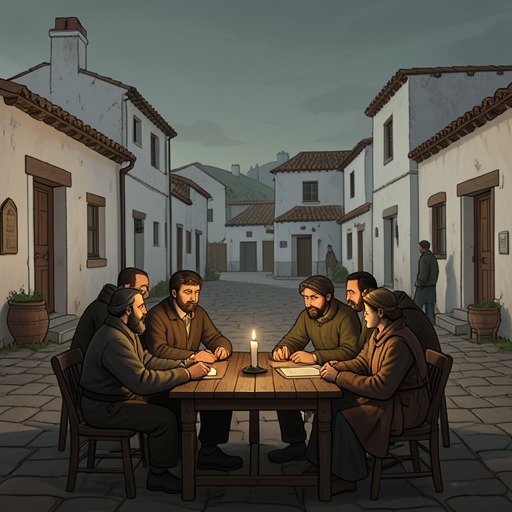
Connor Freeman is introduced as the official responsible for Terminus’s port. When Jonathan Heights and Antomine descend to the settlement, they find a town that appears clean, prosperous, and orderly under abundant zint illumination. Its streets are bright and tidy, its carriages move across smooth flagstones, and its people seem healthy, cheerful, and absorbed in maintenance, repair, and ordinary labor. The absence of visible danger is precisely what disturbs Jonathan, who has spent years exploring ruins and the lightless wilderness. Freeman stands at the center of this disquieting welcome: he is the human face of a settlement that presents itself as a complete rebuttal to the expedition’s expectations.
The town’s location makes that normality especially striking. Terminus lies far to the east, beyond the familiar reach of human civilization and close to regions dominated by immense and poorly understood powers. The expedition has already crossed spaces where nonhuman peoples, ancient ruins, shifting landscapes, and creatures beyond human control make ordinary assumptions unreliable. Connor, however, behaves as though a remote port can be judged by the same practical standards as any civilized town. His manner does not acknowledge the impossibility Jonathan senses; it reinforces it.
First Meeting with the Endeavor
Freeman greets Jonathan Heights and Antomine after they land near the port. He is described as a mountain of a man, both tall and broad, with a uniform strained by his size and a face marked by a lifetime of ebullience. His voice is gruff but friendly, carrying the rough burr of a longtime smoker. The physical impression combines imposing bulk with immediate geniality: Freeman looks capable of authority, yet his first action is to offer his hand and receive the travelers warmly.
He welcomes them to Terminus, praises the Endeavor as a beautiful ship, and tells them they may moor it wherever they wish because the port will take good care of it. He then identifies himself as Connor Freeman, portmaster of Terminus, and asks whom he has the honor of addressing. The exchange establishes him as courteous, direct, and professionally attentive. He does not interrogate the expedition about its purpose or react with suspicion to the presence of Antomine and his guards. Instead, he makes the ship and its passengers feel expected, or at least comfortably accommodated.
The approach to the port is handled through a small but revealing act of procedure. Jonathan raises the green lens of his beam-lantern toward the Endeavor and flashes it several times; after roughly thirty seconds, the airship answers with a single flash before its engines begin maneuvering into port. Freeman watches the signal with interest, then claps Antomine on the shoulder and invites the travelers into his office to complete the docking information. His welcome is therefore not merely verbal. It includes the practical mechanisms of arrival: communication with the ship, docking, registration, and the orderly reception of strangers.
Hospitality and Practical Authority
Freeman presents Terminus as a place equipped to support a difficult expedition. He assures the travelers that the port can handle most repairs and supplies and says that the town prides itself on hospitality. He describes good, honest people as a light for others, a formulation that echoes the book’s broader opposition between civilization’s light and the surrounding darkness. In Freeman’s hands, the language of moral illumination becomes local civic rhetoric: Terminus is not only functional, but proud of its usefulness to those who travel farther east.
When Antomine asks whether the settlement accepts gold, Freeman reacts with amused offense rather than distrust. He confirms that gold is accepted, insists that the inhabitants are not savages, and promises a fair price without gouging. He specifically names lifting gas and terrestrite as available resources for the Endeavor’s tanks. This detail gives his friendliness material substance. He is not simply offering reassurance; he is identifying the commodities that can keep an airship operational in the wilderness and promising that the port’s commercial practices will be reliable.
Freeman’s authority is administrative rather than military or religious. Jonathan allows him to usher the travelers into a clean, neat, organized office, where Freeman slides a ledger across the desk for a signature. The book contains entries in several hands and records ships Jonathan does not recognize, suggesting that Terminus has a history of receiving traffic even though it feels isolated. Freeman accepts Beacon-minted coins without hesitation and continues explaining the town’s attractions while showing Jonathan toward the paternoster. His competence is expressed through records, payment, supplies, and infrastructure—the ordinary systems by which a settlement claims to be civilized.
The Mystery of Terminus
Freeman’s most important narrative function emerges through the gap between his words and Jonathan’s perception. Jonathan asks how long ago Terminus was founded, a question prompted by the settlement’s implausible condition. Freeman laughs and says that it was founded before his time, then immediately reassures him that the town is up to date. He affectionately slaps the side of the port building while promising that the inhabitants can manage repairs and supplies. Nothing in his expression or conduct betrays deception.
Jonathan and Antomine meet each other’s eyes after Freeman’s assurances, yet neither can detect the slightest trace of falsehood in what he says or does. That absence does not resolve the mystery; it intensifies it. Freeman is not exposed as a liar, and no obvious threat appears behind his welcome. The problem is that Terminus seems too peaceful to exist in the world the expedition knows. Jonathan searches for some dark secret, threatening shadow, or sign of hostile wildlife, but repeatedly finds none. The town’s enforced peace and friendliness become a pressure on his judgment, because they deny him the danger he expects to find.
Freeman even suggests that the visitors may like Terminus enough to stay. The invitation is delivered with the same guileless goodwill and civic pride that characterize the rest of his behavior. Jonathan notices the sentence sharply, but cannot establish that it contains coercion or hidden intent. Freeman remains, on the evidence available, an earnest representative of his town. His apparent innocence is therefore structurally ambiguous: it may be genuine hospitality, or it may be the smooth surface of a place whose abnormality has not yet become legible.
Narrative Role and Significance
Connor Freeman is a relatively compact character, but his brief appearance gives Terminus a human voice and a social texture. The wider journey is defined by danger, uncertain knowledge, hostile environments, and competing claims about what civilization must protect or conquer. Freeman counters those pressures with routine. He greets travelers, checks ships into port, accepts payment, discusses fuel and lifting gas, and invites strangers to relax. Through him, Terminus appears not as an abandoned outpost but as a functioning community confident in its own hospitality.
That confidence also exposes a recurring problem in the expedition. Jonathan Heights trusts experience, suspicion, maps, and instinct because the eastern world has repeatedly punished naïveté. Antomine gives greater weight to civilization’s obligations and the need to confront threats before they spread. Freeman offers a third model: the settled belief that ordinary administration and good manners are enough to make a place safe. The portmaster does not participate in the later arguments over whether the expedition should pursue dangers such as the Umbraught, but his earlier welcome provides the emotional and ideological background for them. At Terminus, civilization is presented as a pleasant surface whose security cannot be verified by ordinary means.
Freeman’s significance consequently depends on restraint. He is neither confirmed villain nor heroic guide in the supplied episodes. He remains a warm, imposing, commercially competent official whose handshake, ledger, lantern signal, and promises of supplies make the impossible town feel almost domestic. The more completely he fulfills the role of a trustworthy portmaster, the more sharply the settlement’s unrevealed nature presses upon Jonathan. Connor Freeman is the face of Terminus’s hospitality—and, by embodying that hospitality without visible blemish, one of the figures who makes its mystery most difficult to dismiss.