Danby’s Point
Chasing SunlightDanby’s Point is the easternmost outpost of human civilization and the expeditionary threshold beyond which Jonathan Heights must rely on experience, negotiation, and imperfect maps rather than the settled infrastructure of Beacon. Its decisive significance lies in its double character: it is an endpoint of the illuminated human world, yet also a crowded contact zone where human authority, alien architecture, trade, espionage, and older powers meet under uneasy restraint.
Frontier Terminus and Strategic Function
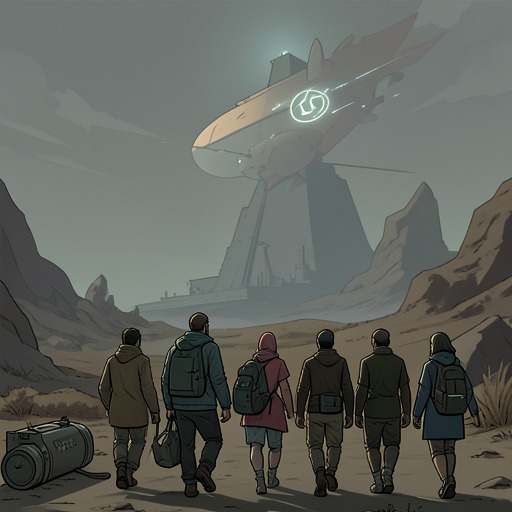
Danby’s Point marks the end of the illuminated track running east from Beacon. The line terminates at the base of a tall tower built into a solid face of bruised-purple rock, while the blue-white lights of human civilization spread along one side of a plateau and climb toward its summit. It is therefore not merely a remote settlement but the final organized extension of the kingdom’s technological and administrative system. Jonathan Heights expects it to supply the Endeavor before the expedition passes beyond reliable human support, and he plans to ship provisions there by train while the airship is being refitted. Because the journey from Beacon to the eastern point is more than a hundred miles, transporting supplies separately allows the Endeavor to travel faster before taking on its full cargo.
The settlement’s importance also derives from its position between human territory and the eastern lands. At Danby’s Point, human officials and the Inquisition are both powerful and limited: trade makes contact unavoidable, while regulation attempts to keep that contact contained. Captain Montgomery’s planned route places Danby’s Point after stops at Autochthon Reach and Whither, and Jonathan treats it as the practical beginning of the truly unknown portion of the voyage. The location thus turns a quest for sunlight into a problem of logistics, fuel, intelligence, and survival.
A Contested Urban Boundary
The plateau is divided by a great metal gate lit with intense zint light. It separates the human portion from territory claimed by darker forces, but the boundary does not preserve a clean division. Architecture changes gradually on either side: the most distant spires are twisted and hunched, while those near the wall have been drawn into straighter forms. Influence crosses the gate in both directions, making the frontier a visible record of mutual pressure rather than a simple line between civilization and wilderness.
The city’s built environment unsettles the human idea of order. Alien illumination reveals colors with no recognized human purpose, while monoliths form angles that human sensibilities find repugnant. The nonhuman constructions crowd against the straight lines of familiar buildings, blurring the boundary and twisting the familiar into something objectionable. Jonathan knows that both the Fractured and the Tarfolk claim to be the spire-builders, but he also knows that neither arrived first. The spires predate humans, Fractured, and Tarfolk alike, and the earliest records already showed every artifact removed and every sign erased by an unknowable hand. Danby’s Point is consequently not only a border settlement but an archaeological absence: its oldest history survives chiefly as the evidence of deliberate erasure.
The inhabitants intensify this instability. The Fractured resemble humans only in the most misleading sense, their faces and bodies changing with each movement or angle. Features flow, limbs seem to skip across space, and hands may gain or lose fingers within seconds. The Tarfolk, by contrast, appear as spindly, many-limbed balls of black tar with unsettlingly human eyes; their size ranges from creatures no larger than Penelope to immense beings that can barely fit among the spires. The difference between the two peoples does not make the city comprehensible. It instead gives human visitors two distinct forms of alterity to fear, misread, and negotiate with.
Trade, Intelligence, and Negotiation
Despite its ominous setting, Danby’s Point operates through ordinary administrative mechanisms. There are no carriages, so Jonathan and his companions travel on foot and by lift to the warehousing district, where he inspects and signs off on the enormous number of crates loaded onto the Endeavor. Even at the edge of civilization, paperwork governs the movement of goods. Antomine’s position in the Inquisition expedites the process, demonstrating how religious and state authority can accelerate commerce even while officially restricting contact with the eastern world.
Jonathan also treats the settlement as an intelligence station. He leads Eleanor McAvey and Inquisitor Antomine toward the boundary and warns them not to insult their hosts, since an attack is unlikely but a refusal to trade could damage the expedition. His caution reflects knowledge accumulated through repeated journeys rather than abstract faith in human superiority. The group goes only as far into the spires as Jonathan considers safe, reaching spiral-marked doors and an indigo-lit courtyard where humans mingle with the Fractured but no Tarfolk are present.
There Jonathan meets Tiuni, a Fractured woman whose apparent identity shifts with every angle and motion. She accepts human literature, including the more salacious volumes she has previously valued, in exchange for information. Her reports concern the movement of forces, beasts, and caravans in the lands to the east: the third house has risen among the Thrantin, caravan routes have shifted, and the Verdant Expanse changes like a tide around ancient ruins. Jonathan copies and compares this intelligence with his maps, narrowing the possible routes through hazards such as the Wandering Slough. Tiuni is his final stop before ventures beyond human lands because the information she provides has repeatedly proved invaluable, even though he does not know how she gathers it.
Danby’s Point also supports commerce that the Inquisition would prefer not to see. Lieutenant Azhir later explains that his ship was trading at Monake, another name for Danby’s Point, while carrying goods associated with the Cult of Flame. The vessel had already exchanged its supplies and held metals and spices that could not serve as fuel. Azhir’s lack of a manifest and his description of the cargo as valuables and information expose the frontier’s underlying economy: trade, smuggling, and intelligence continue beneath the official language of containment.
Threshold of the Unmapped East
Jonathan’s preparation for the eastern journey depends on the resources gathered around places like Danby’s Point. Across earlier expeditions, including his last disastrous one, he charted abandoned mines, ruined cities, isolated oases, caravan migrations, and veins of raw terrestrite that could be distilled into additional zint fuel. Such knowledge turns remote geography into a chain of possible resupply points, but it also makes the expedition dependent on regions the Illuminated King does not acknowledge. Danby’s Point is the last place where those discoveries can be converted into paperwork, cargo, fuel, and negotiated passage before the Endeavor enters a landscape in which human institutions lose their reach.
The location’s frontier status is visible in the people who inhabit it. Humans, Fractured, and Tarfolk meet there under the pressure of trade, but the human side is neither wholly secure nor wholly dominant. Antomine’s guards provide an image of Inquisitorial force, yet Jonathan repeatedly emphasizes restraint because violence would close the routes they need. Danby’s Point consequently reveals the contradiction within the kingdom’s doctrine of light: civilization presents itself as a bounded, disciplined order, but its survival depends on contact with the societies and resources it labels dark, savage, or illegitimate.
Narrative Significance
Danby’s Point externalizes the central tension of Jonathan Heights’s expedition. Beacon’s light promises technological control, but Jonathan distrusts even the city’s illumination and regards sunlight as the only honest source of light. At Danby’s Point, that suspicion becomes spatial: the human lights end at a gate, alien lights continue beyond it, and neither side can remain entirely separate. The settlement makes the ideology of the west concrete while simultaneously exposing its limits.
As a narrative threshold, Danby’s Point changes the nature of the journey. Before reaching it, the Endeavor can be supplied by trains, guided through human territory, and supported by the machinery of the crown and the Inquisition. At the point itself, survival requires Jonathan’s maps, his knowledge of nonhuman languages, Tiuni’s intelligence, and careful conduct among societies that human power cannot simply command. Its function is therefore not just to mark how far the expedition has traveled. It demonstrates what the human world must depend upon at the very moment it claims to stand apart from the darkness beyond its walls.