Danner’s Grasp
Chasing SunlightDanner’s Grasp is a precarious settlement built between the exposed fingers and palms of two enormous stone hands, an ancient monument whose buried scale suggests a civilization older than recorded human history. The Endeavor reaches it while fleeing a mercenary ship through a violent storm, but the town offers no true safety: its inhabitants are infected by the Gospels of the Smiling Man, and the expedition’s attempt to obtain medical help becomes a desperate escape from a corrupted community. By the time the airship departs, Danner’s Grasp is smoldering wreckage, and its destruction has cost the expedition both lives and moral certainty.
Setting and Structure
Danner’s Grasp lies in a rugged landscape of tallshrooms, gorge-bushes, and tanglevines, with low walls and straight lines of farmland visible beyond the wild growth. The settlement occupies the space between two mammoth, six-fingered stone hands that rise from the ground as if an antediluvian monument were still reaching toward the sky. Human settlers have strapped mooring rods to the stone fingers and placed lights in the empty palms, adapting the remains of an unknown structure to the practical needs of an airship port.
The settlement’s infrastructure is improvised rather than built into the monument. A small hut stands on one palm, while a rickety wooden walkway spirals down the wrist toward the ground. The people of Danner’s Grasp have fastened the walkway in place with innumerable ropes and chains because they apparently could not, or would not, drive their artifice into the stone. In the gale, the wood creaks and the chains groan, making the town’s connection to its ancient foundations feel temporary and exposed.
Emergency Landing and First Impressions
The Endeavor is forced toward Danner’s Grasp after a mercenary vessel attacks during the storm. With lightning revealing the surrounding terrain only in brief flashes, navigator Jenkins identifies the settlement as the only place where the ship can tie down. Captain Montgomery compresses the airship’s envelope, drives the lifting gas into pressurized canisters, and deliberately sacrifices altitude to reach the moorings. The ship anchors to three stone fingers, with another line tied to a small building on one palm.
The storm makes the landing dangerous, but the settlement initially appears to provide the expedition with a route to medical assistance. A three-fingered gaffer in the palm hut directs Jonathan Heights and his companions toward a sawbones near the belltower, specifying a red-lit window and a third turning. The instructions are precise even though the gaffer refuses to open the door fully, and his withdrawn manner gives the place an unease that the expedition has not yet understood.
Montgomery permits the passengers to go ashore at their own peril while the Endeavor remains barely stable in the gale. Jonathan Heights carries Marie down by brute force, while Eleanor McAvey and Sarah cling to the handholds as an airman lowers them by pulley. The physical descent makes Danner’s Grasp a threshold in more than a geographical sense: the expedition leaves the relative order of the ship and enters a settlement whose structures, customs, and inhabitants are all vulnerable to the storm.
The Gospel Outbreak
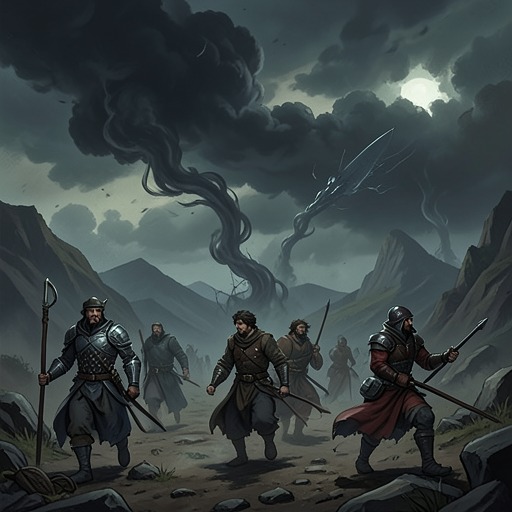
The apparent emergency landing becomes a confrontation with the Gospels of the Smiling Man. When the group retreats from the building where they sought help, Jonathan Heights announces that George is gone and orders everyone to reach the port. A flash of lightning then reveals scores of townspeople appearing in the streets as though summoned by an invisible command. Without their cloaks, hoods, cowls, and scarves, they display the same unnaturally broad smiles, exposing the settlement as a collective manifestation of corruption rather than a collection of ordinary civilians.
Jonathan Heights tells the others to plug their ears and run, but he draws the sword concealed in his sword-cane and fights his way ahead of them. The townspeople carry clubs and belaying pins, and there are too many to confront safely. The storm intensifies the scene: constant thunder and strobing lightning show the converging figures while the survivors sprint toward the great stone hand. Jonathan Heights knocks attackers aside and uses his blade without hesitation, recognizing that the expedition has moved beyond caution into immediate flight.
The route back to the ship is almost as dangerous as the streets below. Jonathan Heights scrambles up the slippery wooden posts, nearly falling when a gust catches him, and finds that the gaffer’s hut has been smashed to splinters. A hissing, glowing residue of zint remains, indicating that Antomine has used destructive force during the retreat. Danner’s Grasp therefore becomes not only a site of infection but also a place where the expedition’s response is reduced to violence, fire, and escape.
Destruction and Aftermath
The Endeavor leaves the remains of Danner’s Grasp once the storm passes. The settlement is described as smoldering zint, with lingering orange fire and fragments of sheltershrooms still emitting green light. The mercenary vessel has been blown miles off course and is unlikely to catch the Endeavor immediately, but the expedition’s escape does not feel like a victory. The crew departs in a somber mood, carrying the knowledge that the corrupted town has been destroyed without any attempt to recover those left behind.
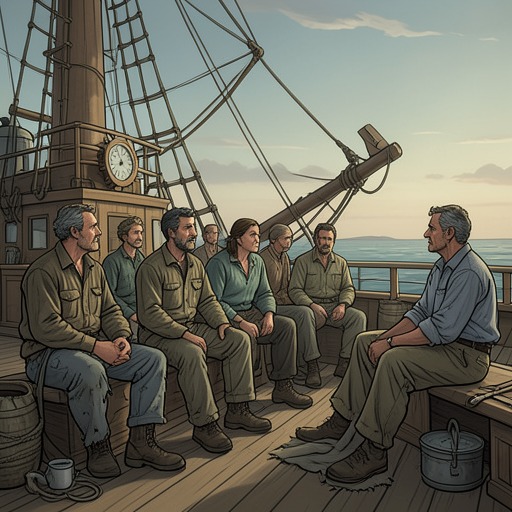
The cost is made explicit in the funeral held aboard the airship. Antomine conducts a service for three dead crew members, all originally recruited in Beacon. George’s casket is empty because no one speaks of searching the ruins for his body. Each closed casket is immersed in distilled luminiferous terrestrite, rendered into dust, and dispersed into the wind. The rite establishes Danner’s Grasp as a place of permanent loss: the town’s destruction has erased both the infected community and the possibility of giving George a recovered body or a conventional burial.
Antomine then conducts a second service for eight mercenary boarders, whose bodies are placed in cheap myceliplank boxes. Two surviving attackers are permitted to attend while Antomine’s guards watch them, and the juxtaposition of enemy dead with the Endeavor’s own dead complicates the boundary between expedition, defense, and war. Danner’s Grasp has forced every participant into the same funerary order, even though the causes of their deaths and the loyalties they served were different.
Narrative Significance
Danner’s Grasp condenses the larger dangers of the eastern expedition into one location. It is a human settlement, yet it is built on the remains of an incomprehensible monument; it offers a mooring and a physician, yet its inhabitants have become agents of an infectious gospel; and it provides a route onward only after the expedition answers corruption with destruction. Its precarious walkways and improvised moorings mirror the fragility of human civilization beyond Beacon, where light, machinery, and formal authority can secure only temporary islands of order.
The settlement also sharpens the conflict between Jonathan Heights and Antomine. Jonathan Heights treats the town as an immediate obstacle to escape and acts decisively when the smiling townsfolk converge. Antomine’s intervention leaves behind the visible residue of zint and is followed by a formal service for the dead. The contrast between Jonathan Heights’s practical violence and Antomine’s ritual duty does not resolve their differences; instead, it reveals two competing responses to the frontier, one centered on survival and the other on the obligations of civilization and faith.
Danner’s Grasp is consequently remembered less as a destination than as a wound in the expedition’s route. The Endeavor survives, but the empty casket, the dispersed ashes, the ruined settlement, and the lingering somberness aboard the ship prevent the escape from becoming simple triumph. The town marks the moment when the journey east demonstrates that the frontier’s greatest threats may not merely attack human civilization from outside: they may inhabit its settlements, wear its faces, and turn its own communal life into an instrument of destruction.