Darkness
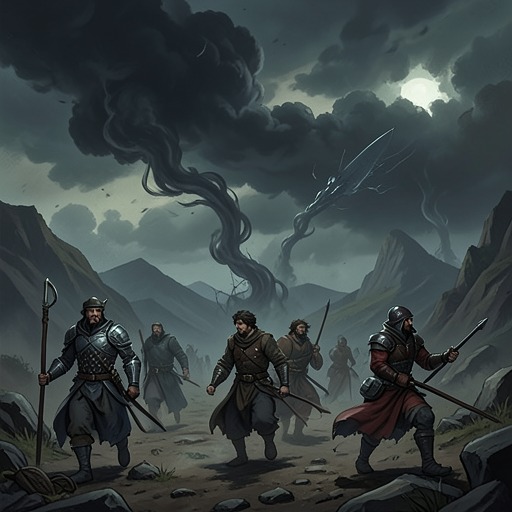
Chasing SunlightDarkness is the world’s defining environment and the condition against which human civilization measures itself. It is not merely an absence of light: it is a vast, inhabited, and resistant outside that surrounds the walled settlements, challenges the authority of human categories, and ultimately becomes the medium through which Jonathan Heights pursues the truth of sunlight. The narrative repeatedly contrasts the artificial illumination of human civilization with the darkness beyond it, while showing that the supposedly secure boundary between the two is porous, contested, and morally ambiguous.
Definition and World Structure
Darkness surrounds the human lands beneath lightless skies and makes civilization an act of vigilance. Beacon’s white stone, Zint-light, machinery, walls, and gates create a habitable island, but Jonathan Heights distrusts the city’s illumination as dishonest compared with sunlight. The contrast establishes Darkness as more than scenery: it is the original condition of the world, while human light is a constructed enclosure imposed upon it.
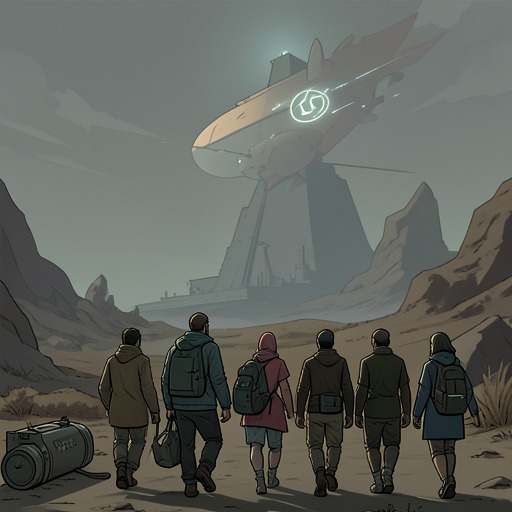
The eastern frontier makes that arrangement visible. At Danby’s Point, the illuminated human track terminates beneath a Zint-lit tower built into bruised-purple rock. Human lights occupy one side of a plateau, while alien illumination and nonhuman architecture crowd the other. The boundary is guarded by a great metal gate, yet influence crosses in both directions: distant spires are twisted, while structures nearer the wall have been drawn toward human straightness. Darkness therefore has no simple outside and civilization no uncontaminated inside. The frontier is a zone where architecture, bodies, trade, and authority continually alter one another.
Inhabitants, Hazards, and Routes
Darkness is populated by forms that human settlements attempt to exclude. Beneath the stone and ancient metal of the Khorus River ruins lie enormous caverns where hostile life gathers, and the existence of such creatures explains why human cities require walls. The expedition encounters evidence of that ecology without ever reducing it to a fully known catalogue: Jonathan Heights recognizes that the crew may have disturbed either a creature or a phenomenon, and his long experience tells him that the thing ahead cannot be fought. When the expedition retreats through furnace heat and rising wind, beasts and vermin flee in the same direction, revealing a scale of danger that exceeds the party’s immediate understanding.
Other beings are not simply monsters but inhabitants of a difficult political and commercial world. At Danby’s Point, the Fractured move through human space in bodies that change from angle to angle, while Tarfolk appear as black, many-limbed forms with unsettlingly human eyes. At a Verdant Expanse caravan, enormous sleds function as houses and marketplaces for half-floating scaled people whose luminous tails ripple beneath a vast hide shelter. Jonathan Heights survives such places by trading, observing customs, and choosing every word with care; his knowledge of nonhuman languages and caravan practice once allowed him to travel on foot through regions where ordinary human camping would be nearly impossible.
Darkness also resists the assumption that travel is a simple movement across stable geography. Jonathan Heights’s maps do not merely connect destinations; they identify places where an expedition can anchor, resupply, and survive. Tiuni supplies intelligence about shifting caravans, the changing Verdant Expanse, and the movements of eastern forces and beasts, narrowing the expedition’s possible routes. Even apparently practical infrastructure can become unstable: far beyond human lands, the Endeavor discovers an unexpected human settlement around a luminous vein of Luminiferous terrestrite, an impossible flame of civilization shining in the wilderness.
Civilization’s Argument with the Dark
The conflict between Darkness and civilization is also an argument between Jonathan Heights and Antomine. Antomine describes the world beyond human illumination as dark savagery and insists that civilization must be carried outward through moral codes and disciplined conduct. He presents the expedition as a mobile remnant of human order, claiming that what separates its members from beasts and inhuman monsters lies in their hearts and souls. His faith makes Darkness a test of ethical identity: the farther the travelers go from Beacon, the more urgently they must preserve the light they carry.
Jonathan Heights rejects the idea that inherited rules can master the wilderness. He argues that the wild dark will not be persuaded by Beacon’s indulgent beliefs and that careful, safe, measured conduct belongs to those protected by walls and guards. His objection is not simple admiration for savagery. He has learned that survival depends on precise knowledge, cultural negotiation, and a willingness to accept danger, but his pursuit of sunlight also turns that practical expertise into obsession. Antomine sees a threat that must be contained; Jonathan Heights sees a route that must be followed. Their dispute over whether to cleanse Angkor Leng of Umbraught becomes a concrete expression of the larger conflict: Antomine places the security of civilization first, while Jonathan Heights refuses to sacrifice the expedition’s goal to an obligation he regards as external to it.
The frontier’s trade reveals another contradiction. Human authority and the Inquisition are simultaneously strongest and weakest at Danby’s Point, where they attempt to regulate contact with nonhuman peoples while depending on that contact for commerce. Jonathan Heights’s own methods participate in this unstable system: he exchanges human literature for Tiuni’s intelligence, uses maps as both knowledge and leverage, and carries specialized goods to secure a berth in Ukaresh. Darkness is therefore not merely conquered from outside. Human expansion depends on translation, bargaining, extraction, and selective accommodation within it.
Threshold Spaces and Altered Perception
Darkness becomes most powerful where ordinary spatial and logical rules begin to fail. In the Khorus River ruins, Jonathan Heights’s lantern reveals a section of floor that is somehow extra: a perfect circle seems to fit within the ordinary lights while containing more space than the surrounding geometry permits. The phenomenon makes material space itself an antagonist, exposing the insufficiency of familiar measurements. Later, the Endeavor crosses the Arch of Khokorron and emerges through a smaller aperture into the barren desert near the Lofted Lakes, where glowing flowers illuminate spheres of water whose boundaries are air rather than earth. These places are not simply remote locations; they are thresholds that rewrite the conditions of passage.
The Dead Battle intensifies this transformation. Jonathan Heights initially treats the spectacle of two forces locked in timeless combat as something impressive but ultimately irrelevant. Only after a full day does he realize that the scene has changed. The Endeavor’s observation room slowly expands, its windows grow larger, and the surrounding tableau seems to draw nearer while immense figures rise in the distance. Knowledge itself catalyzes the shift: understanding what he is seeing changes his perspective and turns spectacle into approach. Darkness thus conceals not only objects but the frameworks required to recognize them.
Ukaresh presents a different version of the same instability. Jonathan Heights warns that the city recognizes few laws except the law of power, and even its weather makes air travel hazardous without carefully arranged protections. The Endeavor finds little company there, and its damaged bridge, patched with salvaged panes, frames a population of not-quite-human forms that unsettles the crew. The city’s danger is social and ontological as much as physical: it cannot be approached through the assumptions that govern human ports.
Revelation, Sacrifice, and Significance
Darkness finally acquires its sharpest meaning at Bright Defile, a land defined by sunlight. Jonathan Heights reaches a threshold where no statues remain and a gulf separates him from the final barrier. In this place, darkness does not signify hiddenness in the ordinary sense; it is the last remaining barrier of understanding within a reality where secrets cannot survive. To cross it, he must shed everything that still gives him a shadow.
The cost is represented through a sequence of sacrifices. His empty estate burns first, followed by his ties to Johann and Agnes. The death of Tiuni, the destruction of Tor Ilek, the books thrown from the deck of the Endeavor, the laying to rest and burning of a god, the sacrifice of Angkor Leng, his lost friendship with Eleanor McAvey, and his banishment from Ukaresh all become lights along the gulf. Even his rejection of the Players and the Game contributes to the path. Darkness therefore records the consequences of pursuit: every advance toward revelation destroys an attachment, a refuge, or a previous identity.
The concept’s decisive irony is that Darkness is both the obstacle to sunlight and the condition that makes sunlight meaningful. It shelters dangers, distorts bodies, defeats maps, and forces human beings to confront the limits of their knowledge. Yet it also sustains the nonhuman societies, routes, resources, and experiences through which Jonathan Heights reaches the threshold of revelation. The narrative refuses to make civilization’s light wholly virtuous or Darkness wholly evil. Human light can be dishonest, coercive, and expansionist; Darkness can be terrifying, but it is also the larger reality that human walls only temporarily interrupt. At Bright Defile, the final barrier confirms that escaping Darkness is not a matter of carrying more illumination into it. It requires surrendering the structures that made the traveler humanly legible in the first place.