Dead Battle
Chasing SunlightDead Battle is an immense eastern battlefield frozen between spectacle and metaphysical revelation. Its visible combat is motionless, yet its arrangement changes between visits, and its presence marks the approach to the Arch of Khokorron. When Jonathan Heights crosses it aboard the Endeavor, the valley ceases to be merely a landscape and becomes a threshold into forces whose knowledge exceeds human history, space, and time.
Appearance and Position
Dead Battle lies in a desolate valley beyond the hills, stretching from the barren hills toward the threshold near the Arch of Khokorron. From the Endeavor, Eleanor McAvey sees massive figures standing in an eternal struggle: towering clay statues wielding enormous iron weapons against gigantic skeletons and twisted animals armed with claws and fangs. Every figure is at least the size of a house. The clay warriors are humanoid but faceless, their smooth helmets recalling those worn by the Lux Guard, while the skeletal and bestial opponents grapple with them in poses that convey savage movement despite their absolute stillness.
Jonathan Heights names the site Dead Battle and uses it as a geographical signpost. Its appearance means that the Arch of Khokorron is close, making the battlefield part of the expedition's navigational knowledge as well as its eastern mythology. The Endeavor does not need to detour around it: the battlefield extends across the route, and Jonathan regards it as a curiosity rather than an immediate obstacle.
A Place That Appears Safe
Dead Battle's visual violence initially misleads the travelers. Antomine considers it a place where they should not be, but Jonathan explains that it is one of the few eastern locations where he has encountered no genuine danger. The figures possess an unmistakable force, and the Battle is not constant in every detail, yet nothing has moved while Jonathan watched. The combatants have never appeared to notice those who passed above, around, or even through the frozen conflict.
That apparent safety distinguishes Dead Battle from the eastern storms, cities, creatures, and unstable regions the Endeavor has already survived. The location is terrifying because of its scale and implication, not because it openly attacks the airship. Jonathan's confidence is therefore based on repeated experience rather than optimism: he has crossed the area before and found its inhabitants—or its statues—indifferent to travelers.
The Expansion of Time and Space
On this visit, however, Dead Battle changes in a way Jonathan recognizes only gradually. A full day after the Endeavor passes above the battlefield, the observation room seems to expand. Its windows grow larger, the carpet spreads over borders that appear to recede, and the tableau below becomes more visible even though the only illumination comes from the ship's spotlights. At the same time, the battlefield seems to shrink, turning ordinary scale into something unstable.
Two immense figures appear in the distance, shaped like mountains in human form. They had been present all along, but Jonathan's understanding of them arrives suddenly, and that understanding itself catalyzes the transformation. The approach unfolds within a distorted temporality: seconds lengthen, movements become languid, and a small turn of the head seems to take ages. The two beings grow closer while remaining both immense and strangely unchanged, as though distance and size no longer govern their relationship to the world.
Jonathan eventually realizes that the figures are as indescribable and indecipherable as the true body of the Illuminated King, with a transcendent scale comparable to Ukari. Their presence explains why Dead Battle has raw power and why its details differ on every visit. The battlefield is not simply an old conflict preserved in stone or clay; it is an expression of powers acting through a reality whose dimensions do not obey ordinary human perception.
The Players and the Game
The two beings identify themselves through the Game that Dead Battle embodies. Jonathan understands them as Players who have seized primal secrets from the depths of the world, contemplated mysteries beyond mortal thought, and returned with enough understanding to shake the firmament. They dwell in the east, where human systems of knowledge have no authority—or perhaps human knowledge has no authority precisely because such beings dwell there.
The Dead Battle is consequently the visible residue of a far larger contest. Its apparent clash is only an outward form, and even that form is misleading. The Game reaches through time and distance, touching histories and futures, secret fires, forbidden knowledge, and strategies whose intentions become incomprehensible to anyone lacking the required understanding. Jonathan compares it with the Exploration Society's immature efforts, but the comparison is deliberately unequal: the Society fumbles at exploration, while the Players conduct a contest on a scale that includes peoples, histories, and forces older than human civilization.
The encounter also exposes Jonathan to temptation. He imagines how the sunlight within him might make him imperishable, allowing him to reach farther into the world, wrest deeper secrets from physical and other depths, and act without dependence on the unenlightened. Dead Battle therefore tests not only his courage but his ambition. Its Game offers a vision of mastery through knowledge, precisely the kind of promise that Jonathan later rejects when he refuses the Players' invitation.
Encounter and Narrative Significance
As the distorted interval ends, Jonathan rises, followed by Antomine and Eleanor. Penelope approaches the two figures with unhurried confidence, and Jonathan accepts the ship's cat's judgment rather than dismissing it as superstition. He strengthens his mind and soul with the sunlight inside him, then walks toward the Game and its Players while the others remain behind him.
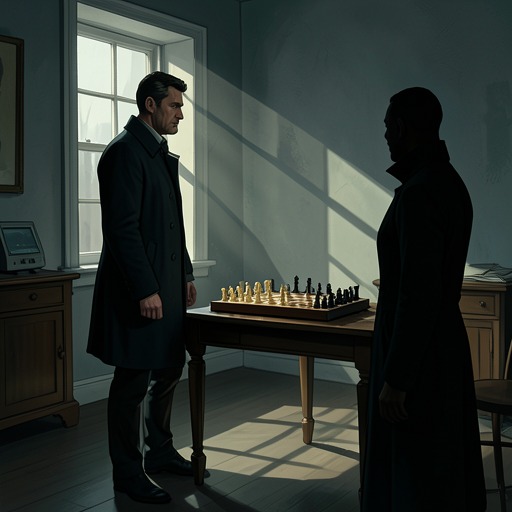
One Player—or possibly only one of the two—addresses Jonathan Heights in an ordinary, accentless language of Beacon. The blandness of the voice is more deceptive than thunder would have been, because it conceals the scale of the speakers behind a familiar human form. They welcome Jonathan, then ask whether he wants to play a round. Looking at the board, he sees the Dead Battle at once as a landscape below and as the Game laid out on the Endeavor's observation deck.
Dead Battle thus functions as a threshold location in several senses. It lies between the known route and the Arch of Khokorron; it occupies a space where the human measurements of distance and size fail; and it opens onto a choice between participation and refusal. Jonathan's later progress toward Bright Defile requires him to shed dependence, history, and even the temptation of the Players' Game. In that larger arc, Dead Battle is the place where the possibility of another destiny becomes explicit.
The location also gains retrospective force from the journey's movement through other impossible regions. The Endeavor eventually emerges from the Arch of Khokorron at the Lofted Lakes, an eastern landscape governed by a different logic, while Jonathan later reaches the final barrier of Bright Defile, where understanding and physical terrain become indistinguishable. Dead Battle anticipates that transformation: it is the first place where the expedition's geography openly becomes a medium for metaphysical knowledge. Its frozen armies remain apparently motionless, but the site itself changes whenever perception catches up with what has been there all along.