Discovery
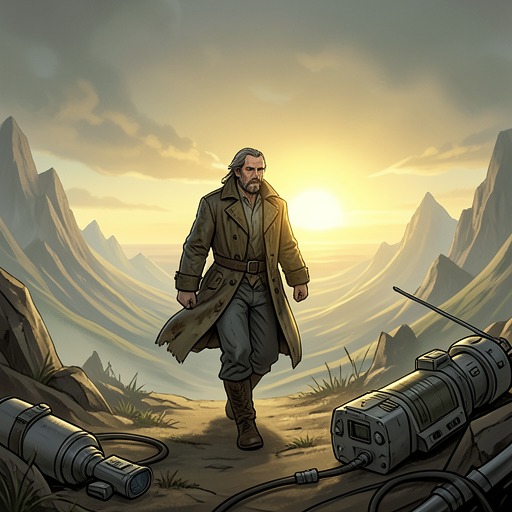
Chasing SunlightDiscovery is the derelict airship that marks the furthest east reached by a human vessel and the point at which the Endeavor’s expedition abandons aerial travel for the approach to Bright Defile. Once a functioning expeditionary craft, it survives only as a low, damaged relic beside the graves of an ancient civilization. Its remaining bridge, supplies, and ship cat make it useful, but its condition and surroundings turn it into a material warning: the route can be extended farther than human knowledge can safely follow, while the vessel carrying that knowledge may be left behind as mere salvage.
Origin and Place in the Expedition
Discovery had been fairly well stocked when Jonathan Heights and his companions left it on an earlier expedition, and Jonathan remembers it as a possible source of supplies. When the Endeavor reaches the Grave of Wood, he therefore suggests inspecting the older ship before continuing. Captain Montgomery is doubtful that provisions will remain useful after roughly three years, especially in the salt-heavy air, and agrees that Discovery should be treated as a last resort rather than an assured resource.
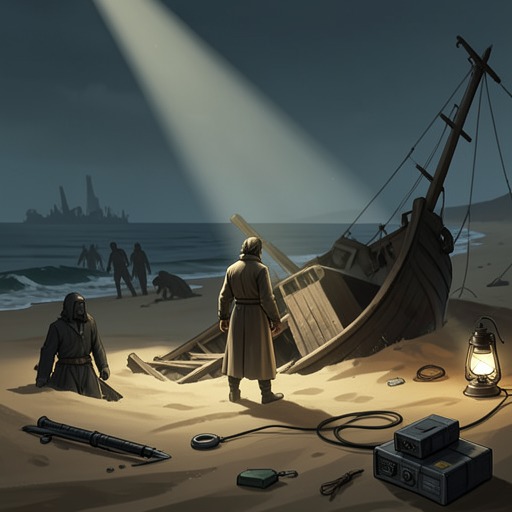
The ship lies near the entrance to Bright Defile, reached by a smooth avenue of enormous metal slabs arranged between monumental wooden biers. Jonathan identifies a particular draped body as the marker for the central path, and the Endeavor follows that alignment until Discovery emerges from the darkness beside the object that had tempted the earlier expedition. The placement makes the airship more than an isolated wreck: it is a fixed point in a landscape organized by graves, guardians, and a thoroughfare leading toward sunlight.
Physical Condition and Survival
Discovery hangs close to the ground because much of its lifting gas has escaped during the intervening years. Its profile is consequently smaller and squatter than the Endeavor’s. Tether chains still hold it in place beside a defaced bier, an enormous sledge leaning against cracked wood and broken salt, from within which something continues to gleam. The contents of the bier are unknown and remain deliberately inaccessible; attempting to cross into it brought the graveyard’s guardian down upon the expedition, and Jonathan refuses to repeat that mistake.
The ship itself is safe in a sharply limited sense. Jonathan warns Captain Montgomery that nobody is to enter the grave or take anything from it, insisting that only Discovery may be salvaged. The distinction is demonstrated by the lingering zint glow on the ship’s bridge. The guardian has not extinguished that human light, whereas anything belonging to the east would have lost its zint as a matter of nature as well as of course. Discovery thus occupies an unstable border between human technology and an eastern environment that rejects or erases what does not belong to it.
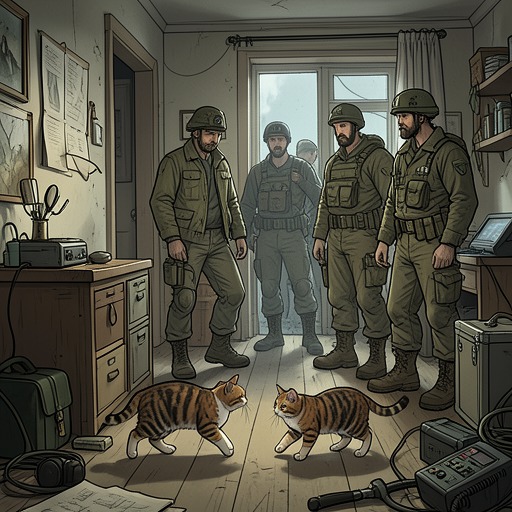
The salt air has preserved the myceliplank relatively well, although the boards have cracked and shrunk, loosening their joins. The tether chains have corroded but remain secure in the still air and protection of the Grave of Wood. Inside, the vessel appears almost exactly as Jonathan left it. Uniforms lie in puddles on the floor without their owners, a remnant of men who seem to have evaporated and, in practical terms, did. Antomine stops at each abandoned uniform to say a few words before the Lux Guards finish their inspection and signal the airmen to begin scavenging.
Recovery and the Ship’s Living Relic
Discovery’s salvage begins only after Jonathan and Antomine lead an inspection detachment. Jonathan knows the vessel, while Antomine considers it his responsibility to examine the final fate of the men who served aboard it. The procedure joins practical recovery to ritual accountability: the ship is a resource, but the uniforms make its absence of crew impossible to treat as an ordinary mechanical failure.
The inspection also produces an unexpectedly hopeful remnant. Dreyfus, Discovery’s ship cat, emerges alive after the attack and years alone. He flies through the open hatch in response to the sound of another cat, Penelope, and briefly confronts her before following her away and finding an immediate companion in Sarah. Dreyfus’s survival does not undo the disaster that destroyed Discovery, but it gives the wreck a living continuity and creates a guarded optimism among the Endeavor’s crew.
Discovery’s material usefulness is therefore inseparable from its emotional and historical charge. It contains supplies that may aid the expedition, but it also preserves the traces of an earlier failure: deserted uniforms, corroded restraints, diminished lifting gas, and a ship that remains intact only because the surrounding power has not judged it worth destroying. The vessel’s survival is selective, and that selectiveness gives every recoverable object an ominous context.
The Eastern Limit
Antomine observes that Discovery represents the furthest east any human vessel has traveled, yet now stands as an abandoned derelict. For him, the wreck contains a moral lesson about the danger of overreaching. Jonathan answers that the real lesson is the unknown itself, the greatest risk not only of exploration but of ordinary life. Their disagreement defines the ship’s interpretive tension: Discovery can be read as a monument to courage, a record of defeat, or evidence that geographical achievement means little when the conditions of survival remain misunderstood.
Jonathan ultimately proposes that the Endeavor go no farther. He asks Montgomery to make Discovery the line beyond which no ship shall pass and recommends proceeding on foot, which would be faster than waiting for the airship. The decision converts Discovery from a failed predecessor into a boundary marker. It is the last human vessel, but not the final stage of the journey; beyond it, the expedition must surrender the advantages of flight and enter the physical and epistemic demands of Bright Defile directly.
Legacy and Narrative Significance
For Jonathan, seeing Discovery in person produces vague, discomfiting memories that sunlight within him quickly burns away. The ship is at once a relic of a profound discovery and merely useful scavenge, a waypoint rather than a destination. That double status captures Jonathan’s transformation: he can acknowledge the vessel’s history while refusing to let memory, attachment, or the prestige of a former expedition divert him from sunlight.
Discovery also reframes the meaning of expeditionary success. Its bridge still glows, its structure can be entered, its supplies can be recovered, and its cat has survived, but the ship cannot continue. The Endeavor’s crew can learn from it, take from it, and leave it behind; they cannot restore the expedition it represents. When Jonathan later crosses into Bright Defile, the abandoned vessel belongs among the sacrifices and discarded attachments that make his passage possible, alongside the destruction of Tor Ilek, the loss of Tiuni, the burning of a god’s corpse, and the rejection of the Players and the Game.
The wreck’s significance extends beyond the immediate journey. After the Endeavor returns to Beacon, the city’s excitement over the expedition and the artifacts from doomed Tor Ilek helps produce the period some call the Winter of Blood. Yet the expeditionary culture continues: Captain Montgomery outfits the Endeavor for another eastern voyage, and Eleanor McAvey departs with Sarah and Marie, while Dreyfus and Penelope remain part of that traveling orbit. Discovery has not made further exploration impossible. Instead, it has established the cost and the limit that later travelers will inherit: the east may be approached again, but the last human ship to reach it remains a warning grounded in wood, salt, lost gas, abandoned uniforms, and one surviving cat.