Dreyfus
Chasing SunlightDreyfus, the Discovery’s ship cat, is a minor but memorable survivor whose reappearance gives human catastrophe an animal counterpoint. Presumed lost when the Discovery disappeared during its disastrous expedition, he somehow remains alive for years in the east and eventually reaches the Endeavor, where his calm reunion with Penelope and immediate attachment to Sarah briefly soften the expedition’s atmosphere of death and uncertainty.
Identity and Survival
Dreyfus is identified by Jonathan Heights as the Discovery’s ship cat when he appears unexpectedly aboard the derelict vessel. The circumstances of his survival are left unexplained: Jonathan can only acknowledge that Dreyfus has remained alive through the attack and the intervening years alone. That uncertainty is part of the character’s significance. Human expeditions are recorded through wreckage, deaths, maps, and recovered artifacts, whereas Dreyfus embodies a living remainder that has escaped the narrative’s expected conclusion.
The cat’s survival also contrasts with the eastern world’s vast and threatening nonhuman life. The Endeavor’s journey passes beneath mountain-sized glacilium, encounters caravaneers with flowing bioluminescent tails, and confronts creatures large enough to provide thousands of pounds of meat. Against these spectacles, Dreyfus is small and familiar, but his continued existence is no less extraordinary. His survival is not explained by human ingenuity or institutional protection; it is simply presented as an accomplished fact that the expedition must accept.
Return to the Endeavor
Dreyfus appears during preparations to inspect and salvage the Discovery. Penelope, the Endeavor’s ship cat, has just emerged from the stairwell when frantic meowing sounds beyond the open hatch. Dreyfus then flies through the hatch on a snap of wings and lands on the deck, a sudden entrance that makes his return feel almost like an interruption from the lost expedition itself.
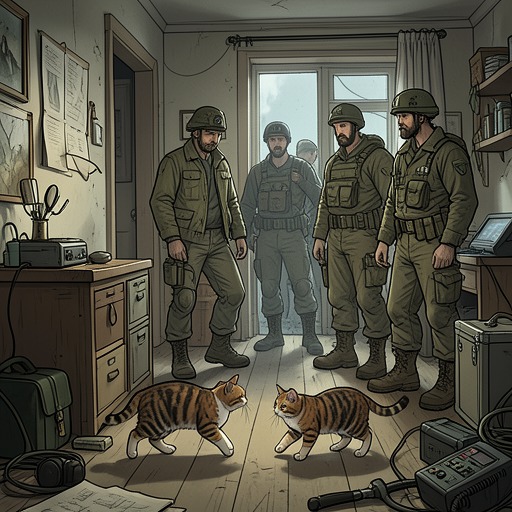
The two cats initially face one another in a brief standoff. Their ears twitch, low growls rise between them, and neither immediately yields the deck. The tension ends without violence when Penelope sneezes and walks away; Dreyfus follows. The exchange is understated but important: the cats determine the terms of their encounter without human direction, and Penelope’s dismissal becomes the practical resolution. Dreyfus does not arrive as a helpless relic requiring rescue. He enters, assesses the situation, and chooses to follow.
Bond with Sarah and the Crew
After following Penelope, Dreyfus finds an immediate companion in Sarah. He jumps into the maid’s surprised arms and answers her question with a purr. Sarah then turns back toward the upper decks to care for him, converting the unexpected discovery into a personal responsibility rather than merely another item connected with the Discovery.
Jonathan’s explanation that Dreyfus is the Discovery’s ship cat gives the animal a documented identity, but Sarah’s response gives him a present one. He is no longer only evidence that the old ship’s life continued somewhere beyond human knowledge; he becomes a living member of the Endeavor’s company. His arrival produces a sense of guarded optimism among the crew, even though the Discovery still must be inspected before salvage can begin. The optimism remains guarded because the wreck retains the danger of the east, but Dreyfus offers a form of survival that does not depend on recovering the dead or understanding the disaster.
Later Life and Narrative Significance
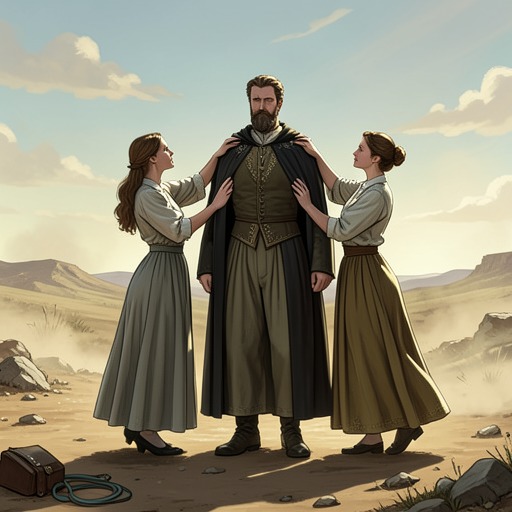
Dreyfus remains with the expedition after the Discovery’s inspection. When the Endeavor later leaves Beacon for another eastern journey, he is no longer presented as a lost animal reclaimed from a wreck. He stands behind Eleanor McAvey with Sarah, a cat draped over each woman’s shoulder: Dreyfus with Sarah and Penelope with Marie. The arrangement places him within the new expedition’s social orbit and shows that his return has had a lasting consequence.
Dreyfus’s role is therefore less about speech or plot agency than about continuity across broken expeditions. The Discovery’s fate includes disappearance and death, while Dreyfus crosses the gap between that ruined voyage and the Endeavor’s renewed departure. His presence quietly resists the idea that the east permits only destruction. At the same time, the narrative does not sentimentalize him into a simple emblem of safety. He survives a hostile environment that remains fundamentally unknowable, and his unexplained endurance mirrors the book’s larger pattern in which familiar forms persist beside forces that exceed human comprehension.
His reunion with Penelope also extends the story’s treatment of animals as participants in the expedition rather than decorative property. Penelope watches ceremonies, travels through supernatural encounters, and appears to exercise an uncanny judgment of her own; Dreyfus, for his part, survives the Discovery’s ruin and chooses companionship on the Endeavor. Their behavior does not become human speech or human explanation. Instead, the cats retain an independent rhythm of confrontation, refusal, movement, and attachment, offering a small-scale alternative to the human characters’ attempts to master the east through maps, weapons, faith, and forbidden knowledge.