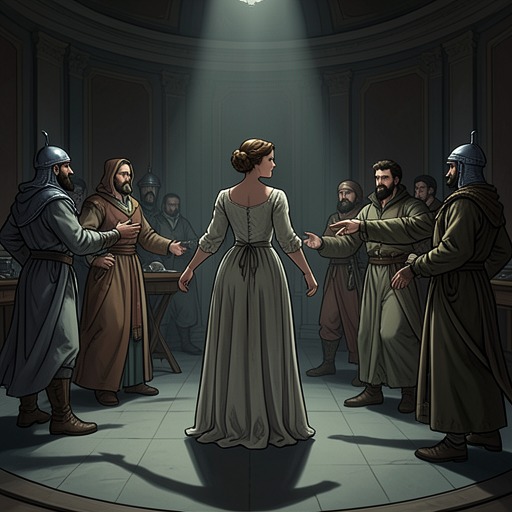
Eleanor McAvey
Chasing SunlightEleanor McAvey is introduced as a young woman who can fade from sight, move without leaving tracks, and approach danger with a mixture of professional competence and insolent humor. Her decisive significance lies in the way she joins Jonathan Heights’s expedition while remaining connected to the Reflected Council: she is at once an assigned observer, an indispensable operative, and a person trying to escape the debts and power structures that have defined her life. As the journey carries her from espionage and sabotage into the Black Garden’s revelations, her skills remain formidable, but the knowledge she acquires makes her increasingly vulnerable to forces neither she nor Jonathan can fully control.
Identity and Introduction
Eleanor first appears inside Jonathan Heights’s home, concealed until he detects her attempted attack. She is dressed in a charcoal greatcoat, with dark red hair visible beneath a cloche hat, and carries a long dagger. Her ability to remain unseen is not merely a trick of presentation: she can fade into view, disappear again, and pass through dangerous spaces while leaving no visible trace. When she remarks that Jonathan is not supposed to be able to see her, he answers that she is not supposed to be able to eschew the light. Their exchange establishes her as someone adapted to concealment and shadow, while also showing that Jonathan possesses unusual means of resisting or perceiving such concealment.
Jonathan addresses her as Eleanor and later formally identifies her as Eleanor McAvey, while the narration makes clear that this is an alias rather than her birth name or the name she uses elsewhere. The alias is sufficiently established between them that Jonathan uses it even when introducing her to Agnes, his housekeeper. Eleanor’s identity is therefore deliberately layered: she is recognizable and trusted within Jonathan’s private arrangements, yet her social existence is built on concealment, alternate names, and institutional surveillance.
Her connection to the Reflected Council shapes the circumstances of the meeting. After Jonathan displayed enough money to attract attention, the Council sent Eleanor to discover what he was doing and determine how it might profit from his activities. The Council presents itself as ruler of the shadows cast by the Illuminated King’s light, and Jonathan regards it as dangerous but useful, strengthened by its dealings with higher nobility and by the fact that the King has not destroyed it. Eleanor’s presence consequently carries the authority and threat of an organization that operates through secrecy rather than open government.
Recruitment into the Expedition
Jonathan turns the Council’s surveillance to his own advantage by inviting Eleanor to accompany his expedition. His proposal is calculated but not disguised: since the Council wants a spy assigned to him, he argues that the spy might as well be one capable of pulling her weight. Eleanor reacts with skepticism, suspecting that Jonathan intends to play her against the Council. Her response shows that she understands both the political maneuver and the danger of becoming useful to a man whose previous expedition ended disastrously.
The dispute becomes personal when Eleanor accuses Jonathan of leaving her to die, along with Stoneface, after his last expedition. Jonathan responds with sudden physical violence, pinning her by the throat against a chair and warning her not to question his honor. He insists that he left nobody and betrayed nobody; in his account, the earlier expedition failed because its participants were unequal to what they discovered, a deficiency he intends to correct. Eleanor’s accusation therefore exposes the moral wound beneath Jonathan’s expeditionary ambition, while his reaction establishes a relationship in which cooperation is inseparable from intimidation and unresolved distrust.
Eleanor nevertheless accepts the practical role Jonathan offers. Her value is not limited to spying. She is an infiltrator who can enter places inaccessible to ordinary travelers, an observer familiar with hidden dealings, and a combatant whose dagger remains effective even when her body is difficult to perceive. The expedition gains an operative who can move between the visible world and the networks beneath it, while Eleanor gains a possible route away from the Council’s control without ever fully severing herself from its reach.
Espionage, Combat, and Expeditionary Work
Eleanor’s usefulness becomes concrete as soon as she begins operating around the expedition’s preparations. After spending weeks gathering information at the Campbell Yards, she returns to Jonathan Heights’s study with blueprints and a compact inventory of what she has observed: smuggling, artifacts, bribery, and spying. Her intelligence is not abstract gossip. She has identified both a Crown agent and a Reflected Council agent aboard the Endeavor, watched them pretend not to recognize one another, and removed three glass sabotage spheres from the ship’s zint tanks. The spheres contain internal mechanisms capable of breaking their own glass and releasing their contents, making Eleanor’s reconnaissance directly relevant to the ship’s survival. Her discovery also confirms that the expedition has drawn hostile attention before it has properly departed.
Eleanor’s relationship to secrecy is practical rather than passive. She can remain hidden even when standing close to an armed observer, but she also knows when concealment should give way to intervention. During the attack on the Endeavor, she flickers into visibility only long enough to strike a heavily armored boarder from behind, then vanishes again while Sarah protects the wounded Marie from gunfire. Later, as two remaining attackers fight back to back near the rear cargo doors, Eleanor’s knife kills one through the spine immediately after Jonathan deflects a grenade, and she gives him a vicious grin before disappearing to deal with the fire and the maids. The sequence makes her an ally in action rather than merely an informant: invisibility creates the opening, but precision, nerve, and willingness to use lethal force complete the work.
The same combination of stealth and audacity appears in the eastern ruins. When Jonathan leads the group through a square building whose dried stone has split open in man-sized rents, Eleanor slips through a crack before he can find a conventional entrance. She confirms that the interior contains gold and then climbs the pockmarked wall to attack a frozen golden mechanism with a pick hammer, tearing away a segment of intricate knotwork despite the delicacy of the machinery. Her instinct is acquisitive and immediate, but it is also suited to the expedition’s material logic: ruined cities are dangerous archives, and valuable knowledge or machinery must often be extracted before the environment destroys it. Eleanor does not approach the ruins as a reverent antiquarian; she enters through the breach and makes the salvage hers.
Surveillance, Sabotage, and Counter-Surveillance
Eleanor’s espionage also makes her a participant in the expedition’s internal security. When Jonathan’s maps are stolen from the Endeavor, she returns with only one maid because Marie is recovering elsewhere, adjusts her cloche hat, and marches up the gangplank without wishing to discuss the matter in public. Jonathan tells her that the break-in may reveal who has placed the expedition in opposition to them, and Eleanor immediately turns to Sarah for assistance. Later, when the crew discovers that valuable luminiferous gems have been taken, Eleanor argues that Sarah and Marie can track the thief through the deserted city, where urban terrain should make pursuit easier than wilderness. Her confidence is characteristic: she treats specialized knowledge and practical movement as tools that can solve problems even when Jonathan sees the setting as neither human nor inhabited. She is not simply the Council’s watcher within the expedition; she becomes one of the people responsible for locating threats, interpreting hostile activity, and converting hidden access into action.
Suspicion, Freedom, and the Limits of Trust
Eleanor’s position within the Endeavor is never reducible to loyalty. She notices the possibility of a plant among the expedition’s personnel and teases Jonathan for failing to detect one, while Antomine admits that compromised people are easiest to identify immediately before or after they act. The exchange places Eleanor on both sides of the surveillance problem: she is accustomed to watching others, yet she also remains someone whom Jonathan and Antomine must evaluate. Her humor turns that instability into a form of control, allowing her to expose the tension without surrendering her own opacity. The suspected saboteurs are associated with the crew acquired at Danby’s, whereas the airmen who came with Montgomery from the Endeavor’s earlier service are considered unlikely to betray the ship; Eleanor therefore operates within a network where old affiliations, recent recruitment, and concealed motives matter as much as visible competence.
Her clearest statement of purpose comes before Ukari, when she explains that she has joined Jonathan because she wants freedom. She imagines returning home able to spit in the faces of those who control her, discard her debts, and choose her own course on her own terms. The declaration gives political meaning to her espionage and expeditionary work: invisibility is not merely an occupational talent but a means of escaping institutions that claim possession of her. Yet the freedom she seeks remains entangled with Jonathan’s plans. He brings her to Ukaresh partly because he intends to show her the Black Garden, and Ukari immediately recognizes her as an interesting presence rather than an autonomous visitor. Eleanor’s desire for self-determination thus enters a world where every powerful figure attempts to classify, use, or possess what she carries.
The Black Garden and the Burden of Knowledge
Eleanor’s pursuit of freedom reaches its most dangerous form in Ukaresh, where Ukari’s authority turns the expedition into a test of possession and obedience. Jonathan presents Eleanor to the immortal ruler as Eleanor McAvey and explains that he intended to show her the Black Garden. Eleanor has already attracted Ukari’s attention: the ruler calls her an interesting morsel, examines her with a single finger beneath the gaze of a city that trembles with every movement, and then allows Jonathan’s request to proceed. The episode places Eleanor between two competing claims. Jonathan treats access to the Garden as part of his expeditionary design, while Ukari treats Eleanor as a living curiosity within her dominion. Eleanor’s stated wish to escape other people’s control therefore meets a more ancient and overwhelming system of control, one capable of rearranging the city itself into a golden and ivory audience hall.
Corruption, Knowledge, and the Breaking Point
The Black Garden does not merely frighten Eleanor; it alters the terms on which she can act. After harvesting the life heart-fruit from the frozen near-cat, she returns with a sudden and profound insight that cannot be unlearned. When Jonathan asks how she is doing, she answers that she is “Pretty terrible,” a blunt acknowledgment that knowledge has become an injury rather than an advantage. She also resents that Jonathan left her alone with Ukari, whose attention and power made the Garden experience inseparable from coercion. His apology is only partly genuine, since he would have pursued the same course regardless, and the scene exposes the limit of his protective claim: he can recognize the damage after the fact, but he still treats Eleanor’s exposure to forbidden knowledge as an acceptable cost of the expedition.
The Garden’s influence soon becomes physical and behavioral. Jonathan wakes to Eleanor struggling with a dagger, laughing hysterically and attempting to claw at him with savage ferocity; the hunger surrounding her is described as both bloody avarice and something darker reaching through her touch. When sunlight briefly drives it back, her violence shifts into a form of sultry lust, making her altered state no less threatening when its expression changes. Jonathan restrains her, removes the weapon, and slaps her when she lunges again. Eleanor’s talents have not disappeared, but the secrecy and self-command that once made them useful have been invaded by an external appetite. Her body remains recognizably hers while her impulses become evidence of the Garden’s power.
The final confrontation over the fruit makes the conflict between Eleanor’s autonomy and Jonathan’s possessiveness unmistakable. When the fruit is missing, Jonathan sees Eleanor retreating toward her room and pursues her, tearing the door from its hinges. He finds her hiding with the red, heart-like fruit raised toward her mouth, her eyes marked by greed and malice. She struggles to bite it, while he seizes her throat and forcibly pries her fingers from it. Jonathan then consumes the fruit himself, knowing that its meaning and power are bound to the Garden’s secrets and that the Arch is already taking much of that power away. Eleanor is consequently denied the object that might have completed her transformation, but the denial is not presented as a restoration of trust. It is another act of domination in a relationship already defined by surveillance, recruitment, intimidation, and competing claims over what Eleanor may know and become.
Eleanor’s arc therefore turns on a bitter inversion of her original gift. At first, invisibility gives her mobility: she can enter restricted places, evade institutions, gather secrets, and strike enemies who cannot defend against what they cannot see. In the Black Garden, hidden knowledge reverses that advantage. What she learns makes her more vulnerable, and the forces attached to that knowledge make her own body an uncertain instrument. Her desire for freedom remains explicit, but the expedition gives her neither simple liberation nor secure belonging. Instead, it carries her from the Reflected Council’s political surveillance into Jonathan’s expeditionary control and finally into Ukari’s supernatural dominion, leaving her caught between the wish to act on her own terms and the powers that continually claim the right to decide what she may carry, perceive, or become.