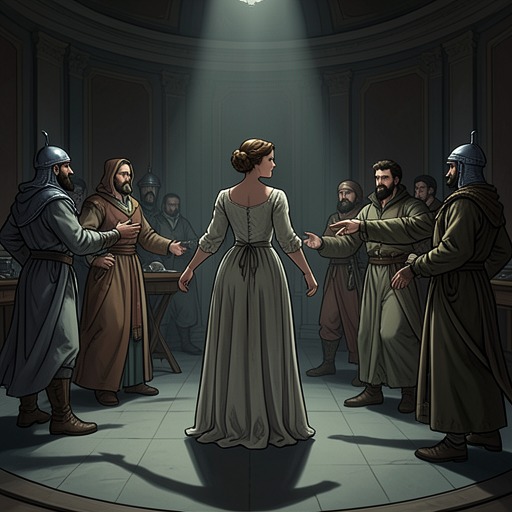
Eleanor McAvey—Reflected Council
Chasing SunlightEleanor McAvey—Reflected Council is a relationship of controlled disclosure rather than open loyalty. Eleanor remains close enough to the Reflected Council to recognize that its business belongs to a world of inhuman architecture and unfamiliar thought, yet she presents herself aboard the Endeavor as an independent companion whose immediate interests are survival, profit, and getting home. Her relationship to the Council therefore shadows the expedition without fully governing her conduct: it makes secrecy necessary, turns ordinary conversation into political management, and leaves Eleanor capable of acting against the Council’s apparent interests while still considering what the Council, and the Illuminated King, may do with the information she acquires.
Concealment and the Fictions of Allegiance
Eleanor’s connection to the Reflected Council is explicit enough to be recognized by the others, but not exposed in a form that would eliminate ambiguity. When she discusses the strange red-stone surroundings with Jonathan Heights and Antomine, she remarks that people remain understandable wherever one goes, unlike the inhuman architecture around them. Her glance toward Antomine matters because he is conspicuously not listening, and the narration states that Eleanor’s allegiances are not secret while also stressing that “certain fictions were better maintained.” The relationship is thus sustained by a shared performance: the facts are visible, but the characters preserve a version of events in which those facts do not yet have to be acted upon.
The Reflected Council is also established through contrast. Eleanor claims familiarity with human behavior, while Jonathan argues that non-human thought can be learned; Antomine rejects that accommodation, warning that thinking too much like another kind of being turns a person into something else. His examples include the Cult of Flame, Invidus Croft, and the Gospel of the Smiling Man. Against this debate, Eleanor’s association with the Reflected Council becomes part of a larger question about whether contact with alien systems merely supplies useful knowledge or changes the person who survives it. The Council is not described as a conventional social affiliation; it is an institution whose practices are sufficiently strange that even proximity to it must be rhetorically managed.
Eleanor’s Motives Beyond the Council
Eleanor’s immediate priorities repeatedly pull her away from any simple interpretation of Council loyalty. She acknowledges that the expedition has already recovered an enormous quantity of precious metal, enough to exceed the amount Jonathan Heights paid for the journey and to leave the crew and passengers materially secure whatever their shares may be. Her response is not to demand a return to the Council’s business but to joke about wanting extra daggers for dealing with people back home. The joke places her social and practical dangers in the foreground: she is preparing for hostile relationships after the expedition, not proclaiming an institutional cause.
Jonathan Heights consequently worries that Eleanor may already be willing to turn back. He believes she would be entirely content to return with the treasure and has no investment in sunlight, the expedition’s ultimate objective. That difference makes their connection more tenuous, because he can no longer rely on her interest in the central quest to carry her forward. Yet he still expects her to seize any treasure that appears. Eleanor’s relation to the Reflected Council follows the same pragmatic pattern. She is not rendered as a pure agent of the Council or as a convert to Jonathan’s vision; she weighs danger, profit, and future leverage, preserving room to move between competing powers.
Information, Surveillance, and Political Leverage
The Council’s influence becomes most apparent in Eleanor’s awareness that information can travel through Antomine. After Jonathan Heights insists that the expedition must abandon a protective resource and accept that people in the east will have to find other methods of defending themselves, Eleanor considers the possibility that alternative methods might also benefit the Illuminated King once Antomine reports. Her thought reveals a triangular structure: Jonathan acts according to his commitment to reaching sunlight, Antomine serves as a channel toward the King, and Eleanor watches both the practical consequences of Jonathan’s decisions and their political afterlife.
This does not mean Eleanor simply obeys the Council’s presumed interests. She accepts that the loss may be necessary, but she also treats the resulting knowledge as something that can be used later, whether by herself or by the Illuminated King. Her position is one of strategic observation. The Council’s power operates not only through direct commands but through the possibility that what Eleanor sees will be reported, interpreted, and converted into policy. Even when Antomine is silent or absent from the immediate exchange, the prospect of his report remains active in Eleanor’s reasoning.
Conflict with the Expedition’s Objective
Eleanor is openly skeptical of Jonathan Heights’s pursuit of sunlight. When he suggests that the expedition’s eastern destinations may contain something more interesting than gold, she asks whether he means sunlight and immediately dismisses the prospect. Jonathan and Antomine cannot answer her in a way that would communicate what they regard as sunlight’s purity and reality. Their silence sharpens the separation between Eleanor and the two men: Jonathan is driven by discovery, Antomine by an undisclosed mission connected to the Illuminated King, while Eleanor remains resistant to the value they assign to the light.
The narrative links this resistance to secrecy itself. Eleanor’s secrets are described as based in darkness and as avoiding the light, while knowledge is figured as jealous and secrets as doubly so. In that formulation, the Reflected Council relationship is not merely a question of employment or past allegiance. It belongs to a conflict between concealment and revelation. Eleanor’s association with the Council helps explain why sunlight is not an attractive promise to her: light threatens not only ignorance but the protective arrangements through which she has maintained independence.
The Relationship’s Narrative Function
The relationship between Eleanor McAvey and the Reflected Council gives the expedition a political dimension beyond its physical route. Eleanor’s presence places a concealed institutional history inside a journey already divided between Jonathan Heights’s pursuit of sunlight and Antomine’s obligations to the Illuminated King. Her guarded remarks, attention to what may be reported, and preference for tangible rewards make her an intermediary without making her a transparent representative.
Its decisive tension is that Eleanor can understand the usefulness of power without sharing the ideals that justify it. She recognizes danger, counts resources, anticipates future enemies, and notices how discoveries may be converted into authority. At the same time, she refuses the spiritual or revelatory promise that Jonathan Heights and Antomine attach to sunlight. The Reflected Council therefore functions as both a background allegiance and a pressure on her identity: it explains the need for maintained fictions, while her continued skepticism and self-interested calculations show that escape from one system does not produce uncomplicated freedom from its influence.