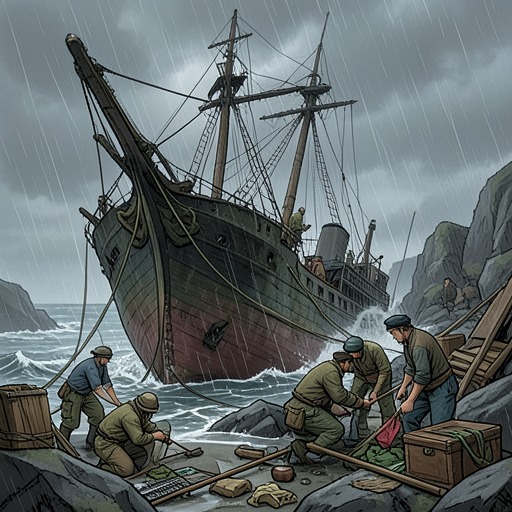
Endeavor Refitting Sabotage
Chasing SunlightThe Endeavor Refitting Sabotage is the series of covert attacks and attempted acts of interference directed at the Endeavor during its refit in Beacon. The campaign begins amid Jonathan Heights’s distrust of both the Crown and the Reflected Council, expands into the discovery of concealed glass devices inside the ship’s zint tanks, and leaves the expedition departing under the knowledge that not every threat has been identified. The sabotage is decisive because it makes the Endeavor’s restoration a political and technical battleground rather than a merely mechanical repair.
Causes and Suspicion
Jonathan Heights treats the refit as exposed to several overlapping dangers. The Crown has taken an interest in his expedition, while the Reflected Council wants a spy attached to him; he therefore assumes that either institution may have reason to interfere with the ship or monitor its preparations. The recent attack on him adds a less clearly defined threat. No one has been identified as connected to that assault, and the difficulty of extracting information from dead attackers leaves the source of the danger unresolved. In Jonathan’s estimation, the absence of a repeat attack proves little: sabotage can remain dormant until the moment when the Endeavor is most vulnerable.
This suspicion also grows out of Jonathan’s previous expeditionary history. When Eleanor McAvey accuses him of abandoning Stoneface and others to die, he reacts with sudden violence, gripping her throat and pinning her against a chair before demanding that she stop questioning his honor. He insists that he betrayed nobody and that the survivors had simply been unequal to what they discovered. The confrontation establishes the emotional pressure behind the refit: Jonathan is not preparing only to travel again, but to correct what he regards as the failures of the previous expedition, even if that determination makes him increasingly intolerant of opposition.
Discovery of the Devices
Jonathan recruits Eleanor McAvey to conduct discreet work around the Endeavor. He asks her to look for suspicious people or materials because he does not trust that the Crown or the Reflected Council has left the refit untouched. Eleanor knows little about airship design but can move covertly and read blueprints, making her useful as an observer rather than a conventional engineer.
Her investigation uncovers three small glass spheres removed from the ship’s zint tanks. Eleanor also reports that a Crown agent and a Council agent were both aboard the Endeavor, each pretending not to know about the other. The competing agents make the ship a site of institutional surveillance even before the devices’ purpose is understood. Eleanor cannot determine who placed the spheres or how they are meant to activate them, so she brings them to Jonathan for examination.
Jonathan identifies the principle behind the devices without mastering the deeper secrets of the zint mechanisms. Each sphere contains a tiny mechanism with a single spike. When driven inward, the spike breaks the glass from within and releases the sphere’s contents. The danger lies in the combination of concealment and delayed activation: the devices can sit unnoticed inside a vital tank until a small internal mechanism turns them into instruments of destruction. Their material construction makes the sabotage physically intimate; the ship carries its own hidden points of rupture within the systems intended to keep it aloft.
Jonathan concludes that the Endeavor has attracted someone dangerous and is surprised that Eleanor has found only three spheres. That expectation is immediately confirmed as incomplete. The shipyard workers discovered additional sabotage attempts and dealt with the worker responsible, but the identity of the person behind the payment is more revealing than the worker’s punishment.
Perpetrators and Countermeasures
The worker was bribed by the widow of Captain Hardiman. Jonathan remembers Captain Hardiman as a good friend, whereas the widow has no comparable loyalty to him. Her motive is connected to the previous disaster: Jonathan, the sole survivor, is now chartering another expedition as though the catastrophe had not ended his career. The sabotage therefore carries a personal grievance into the technical infrastructure of the refit, turning resentment into an attack on fuel, machinery, and collective safety.
The shipyard’s response stops that particular worker and prevents the known devices from remaining in place, but it does not settle the larger question of responsibility. Over the following months, Eleanor frustrates several more attempts. None leads to a person of major importance. Some are attributed to jealous individuals; at least one offender holds a grudge against Crowley, Stanford, and Moore rather than against Jonathan himself. The glass devices never reappear, and no second appearance is made by whoever planted them in the zint tanks. Even so, Jonathan remains convinced that something may have escaped detection. The campaign is thus defined by partial success: visible plots are interrupted, but the possibility of an invisible one persists.
The Endeavor’s refit also depends on specialized objects whose proper use requires knowledge unavailable to most people. Before departure, Jonathan brings a triskolabe to the bridge and explains that it is necessary to reduce the danger of navigation beyond Danby’s. The device combines a compass, an inverted zint loop pointing toward Beacon, Zumar’s Bones, and the Lens of Fools. Its operation can protect the expedition from being blown off course, but its use is itself hazardous; on Jonathan’s previous trip, a navigator needed laudanum for weeks after using the instrument to recover from a storm. The refit therefore restores more than the hull. It reassembles a network of vulnerable mechanisms, procedures, and expert dependencies that sabotage can exploit.
Departure Under Uncertainty
The sabotage does not prevent the Endeavor from leaving Beacon. Jonathan works with Captain Montgomery, who helps him bring Johann home after an attack and later assumes control of the carriage, while Jonathan gives him a stolen pistol as a precaution against further violence. These precautions show that the threat is not confined to the shipyard: the expedition’s personnel and supporters may also be targets.
Once aboard, Jonathan tries to secure cooperation by demonstrating an alien navigational implement to Montgomery and explaining how its rings can indicate a direction when two symbols are locked in place. The object’s value is practical, but it also represents the kind of knowledge the expedition seeks and the kind of technical uncertainty its enemies can weaponize. Jonathan can use the device without fully reproducing its principles, just as he can understand the glass spheres without possessing the deepest secrets of luminiferous terrestrite.
The refit’s consequences follow the Endeavor through later dangers. After the disaster at Danner’s Grasp, Antomine conducts a service for three dead crew members, including George, whose casket is empty because his body cannot be recovered from the ruined settlement. The bodies are rendered into dust by immersion in distilled luminiferous terrestrite and scattered into the wind; the mercenary dead receive a similar service in cheap myceliplank boxes. These rites do not belong to the refit itself, but they reveal what the sabotage campaign threatens: a ship whose technical failure or hidden attack can become a chain of deaths, absences, and ceremonies.
Significance
The Endeavor Refitting Sabotage makes material objects active participants in the expedition’s political drama. The glass spheres are not passive evidence of a conspiracy. Concealed in the zint tanks, they embody a capacity to transform an ordinary component into a delayed weapon; the ship’s own systems become possible agents of catastrophe. The refit consequently exposes the limits of Jonathan’s control. He can inspect, recruit Eleanor, question workers, and study mechanisms, yet he cannot guarantee that the vessel is free of what has been planted inside it.
The campaign also links private resentment to institutional power. Crown and Council agents occupy the same ship while pretending not to recognize one another; a grieving widow pays a worker to compromise the vessel; unknown attackers remain unidentified; and Eleanor’s covert labor becomes essential to the expedition’s survival. These forces are not organized into a single confirmed conspiracy, but their overlap produces the same effect: Jonathan’s expedition is surrounded by competing interests that treat the Endeavor as a means of access, leverage, surveillance, or revenge.
At the same time, the sabotage foreshadows the larger pattern of the voyage. Jonathan repeatedly survives by relying on objects whose principles exceed ordinary human understanding: the triskolabe, alien navigational instruments, the shifting controls that open an ancient dock, and the protective process that leaves the Endeavor feeling stronger and more trustworthy without visibly changing its form. Later, Airman Stutt is recovered after approximately five years in a temporal distortion, and Jonathan ultimately reaches Bright Defile only after sacrificing relationships, possessions, and memories, including the loss of Eleanor’s friendship and his banishment from Ukaresh. Against that scale of transformation, the hidden spheres seem small, but they establish the governing lesson early: the vessel’s apparent stability is never the same as safety, and every journey depends on material powers that human intention can only partly direct.