Extra degrees
Chasing SunlightExtra degrees are the impossible geometric principle that allows the builders of Tor Ilek to create more space than ordinary human perception can contain. Jonathan explains that the builders measured with a circle possessing more than three hundred sixty degrees, producing an architecture that cannot be fully illuminated by ordinary light or understood through human reckoning. The concept is therefore not merely an abstract mathematical anomaly: it is the hidden structure of Tor Ilek’s rooms, passages, locks, and navigational devices, and it determines whether an expedition can move safely through the ruins.
Definition and Perceptual Effect
Extra degrees first become visible when Jonathan’s ordinary lantern reveals a section of floor that lies inside the circle of the surrounding lights yet is somehow additional to it. Observers can trace a complete circle at the edge of their vision while simultaneously perceiving something more compressed within that same whole. The effect makes the architecture appear to exceed the boundaries imposed by normal space, turning a familiar illuminated room into a spatial contradiction.
Jonathan distinguishes this extra space from the limits of ordinary illumination. Zint-light and other conventional sources can illuminate only an ordinary sphere; they cannot disclose what exists beyond the geometry that human builders recognize. A specifically constructed device is required to reveal the hidden extension. Once the lantern exposes it, the expedition must follow Jonathan into a region that seems physically unremarkable despite being impossible by human standards, with the small light failing to reach its far wall and leaving the travelers isolated inside a space whose dimensions cannot be trusted.
Tor Ilek as an Impossible Environment
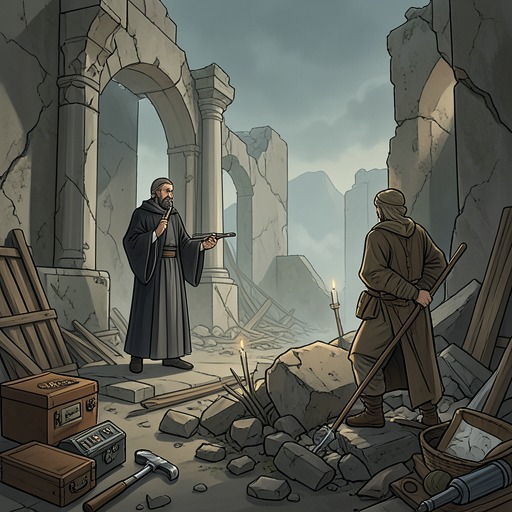
Extra degrees govern more than a single concealed patch of floor. They allow passages to extend in directions that no mortal architecture would dare take, and they complicate the boundary between visible room and inaccessible elsewhere. Jonathan uses the principle to unfold a passage from an intact monolith, leading the party into a hall with a ceiling that rises too high and walls that slope at angles ordinary construction could not support. Rooms open from this hall, while creatures may approach from directions that the travelers cannot readily identify.
The danger is practical as well as philosophical. An airman is dragged backward out of the lantern’s light by an enormous, long-clawed creature whose amorphous shadow wraps around his ankles. The party’s concentrated zint-fire drives the creature away, but the airman is left with torn and bleeding shins. Antomine consequently orders a guard to watch the rear, since the extra degrees make every direction potentially vulnerable, including angles that no human could have created. The geometry converts spatial uncertainty into a tactical threat: the group cannot assume that darkness lies only ahead or behind, because the architecture has multiplied the possible approaches.
The ruins also retain mechanisms shaped by the same principle. After the party crosses the exposed space, it encounters a door whose metal circles carry symbols that move and conceal some of their markings inside the extra degrees. The lock is driven by an arcane calculus and an ever-shifting geometry; ordinarily, opening it would require days or weeks of guesswork, especially because the symbols belong to a dead language and embody an alien logic. Eleanor can open it from the inside, allowing the expedition to proceed, but the door demonstrates that extra degrees are embedded in Tor Ilek’s security systems as well as its rooms.
Construction and Navigation
Jonathan does not fully understand the builders’ knowledge, but he can reproduce some of its procedures. In a long hall, he finds a mechanism composed of interlocking rings, some bearing symbols that correspond to his map. By wrapping wire around the mechanism as a guide, he recreates the alien and excess circles in a portable compass-like device. Each completed ring slides into an armature and locks into another in arrangements that resist human comprehension. The process is slow and physically demanding, yet sunlight burning within Jonathan gives his fingers and mind greater endurance than during his earlier attempts.
The resulting device does not reveal the true secrets of the circles, but it carries a portion of their impossible geometry and points in certain directions. Its presence changes the ruins around it: the surroundings seem to stretch and relax at once, and new doorways appear in corners where no openings had previously existed. The device thus does not merely measure a preexisting landscape. It participates in the spatial instability, making additional routes visible and encouraging the airmen to return into the ruins to salvage more statues, rings, spirals, dark gems, and tarnished gold. What begins as a navigational breakthrough consequently increases the expedition’s exposure to the city’s hidden spaces.
Beyond Tor Ilek
The principle of Extra degrees also clarifies why Tor Ilek cannot be treated as an isolated curiosity of ruins. Jonathan’s triskolabe depends on related geometries, combining a north-and-south compass, an inverted zint loop pointing toward Beacon, Zumar’s Bones, and the Lens of Fools, whose mechanical eye allows a navigator to see beyond what zint-light reveals. He warns that the device must be used sparingly: on an earlier journey, a navigator who had been blown off course by a storm required laudanum for weeks while guiding the ship back. Extra degrees therefore belong to a wider navigational system in which perception is both an instrument and a liability.
The same spatial logic appears at Danby’s Point, where human construction meets the architecture of other races. The outpost marks the eastern terminus of the illuminated track, built against bruised-purple rock and crowded by alien structures whose colors, angles, and forms distort the straight lines of human buildings. Jonathan and his companions enter only a short distance into the spirals, stopping at an interior courtyard lit with indigo rather than attempting to penetrate deeply into the city’s hostile architecture. Although the narrative does not equate Danby’s Point directly with Tor Ilek, both places oppose the assumption that human-made space is the natural measure of the world: in one, alien buildings press against and twist familiar construction; in the other, ancient geometry produces rooms and directions that human architecture cannot contain.
Extra degrees also become a test of expeditionary discipline. Jonathan leads the party into the impossible space because remaining close to the lantern offers the only dependable protection, and the airmen follow him partly because the tapping of his cane provides a familiar sound within an environment that has abandoned familiar proportion. The group must stay alert while machinery rumbles behind rotted gratings, creatures scrape at unseen stone, and the limits of the room remain uncertain. When the portable mechanism reveals additional doorways, the crew’s desire for salvage overrides the obvious danger: sacks of artifacts accumulate while Jonathan waits impatiently, and the expedition only turns back when a strange noise and a hot breeze signal that something more serious has entered the ruins. The geometry thus exposes a recurring conflict between knowledge, profit, and survival. It opens the way, but it cannot decide whether those who use it will proceed cautiously or keep searching for more.
Spatial Logic, Technology, and Civilizational Contrast
Extra degrees belong to a wider technological order in which perception is both an instrument and a liability. Jonathan’s triskolabe combines a north-and-south compass with an inverted zint loop pointing toward Beacon, Zumar’s Bones, and the Lens of Fools, a mechanical eye that permits a navigator to glimpse more than zint-light ordinarily reveals. The device depends on materials and workmanship not favored by the Illuminated King, and Jonathan warns that it must be used sparingly: after a storm blew his previous navigator off course, the effort of guiding the vessel back left that navigator dependent on laudanum for weeks. The triskolabe therefore makes the unknown navigable without making it safe; its expanded perception transfers danger from the surrounding world into the mind and body of the person who must interpret it.
The same principle also illuminates the broader contrast between human and nonhuman spaces. At Danby’s Point, the illuminated track ends against bruised-purple rock beneath a zint-lit tower, while human buildings share the plateau with alien structures whose unnamed colors, hostile angles, and oppressive forms distort the straight lines of familiar construction. Jonathan does not claim that Danby’s architecture is identical to Tor Ilek’s, but both settings reject human space as the world’s natural measure. At Danby’s Point, unfamiliar construction crowds in from the margins and blurs the boundary between human territory and foreign presence; in Tor Ilek, impossible geometry is internalized within floors, halls, locks, and doors, making the margin appear inside the room itself.
Extra degrees also recur as a problem of access and control. The party can enter Tor Ilek’s concealed routes only because Jonathan’s lantern reveals them, and it remains safer to stay close to that limited circle of light. His cane tapping on the stone becomes a familiar point of orientation while the travelers cross a space whose far wall the lantern cannot reach. At the city’s ancient entrance, the geometry conceals symbols inside an ever-shifting lock, transforming the door into a barrier that ordinarily demands days or weeks of decipherment. Eleanor’s ability to open it from the inside bypasses that difficulty, showing that passage through impossible space depends not only on understanding its rules but also on possessing bodies or abilities that can evade them.
Jonathan’s portable reconstruction makes the relationship still more complicated. By copying the interlocking rings and wiring their excess circles into an armature, he carries a fragment of Tor Ilek’s spatial logic away from the ruins. Once completed, the device makes the surroundings seem to stretch and relax simultaneously and reveals doorways that had not previously existed. Its operation therefore does not simply record hidden space; within the ruins, it helps produce a new field of access. The airmen respond by returning to salvage additional statues, rings, spirals, dark gems, and tarnished gold, allowing the device’s promise of knowledge to become an invitation to plunder.
That response gives Extra degrees an ethical dimension. The geometry does not itself compel greed, but it makes more treasure available precisely when the expedition should be withdrawing. Jonathan waits impatiently while the crew gathers loot, and Antomine examines what they bring because a dangerous artifact could disable or destroy the Endeavor before it reaches its destination. When a hot breeze and a deep vibration announce a new threat, the accumulated treasure clinks against the metal around them, and Jonathan reduces the entire calculation to a single imperative: “Flee.” Impossible space thus exposes the expedition’s recurring hierarchy of values. The same knowledge that opens a route toward discovery also enlarges the opportunity for profit, while the architecture’s delayed violence punishes the assumption that a newly visible path is an invitation to continue.
The Limits of Human Measure
Extra degrees finally destabilize the distinction between a strange place and a strange instrument. The principle is embedded in the cities and technologies that organize the expedition, but it also exposes the cultural assumptions behind them. Beacon presents itself as a triumph of illumination, its white stone, bright lights, and Zint-light standing against the lethal darkness beyond its walls; Jonathan nevertheless distrusts that manufactured radiance and regards sunlight as the only honest illumination. Tor Ilek makes the weakness of that confidence visible. Even Zint-light can illuminate only an ordinary sphere, while the builders’ geometry creates a remainder that human light cannot reach and human architecture cannot contain. In that contrast, Extra degrees becomes a structural challenge to the civilization that believes visibility is equivalent to knowledge.
The concept also complicates the meaning of exploration. Jonathan can copy the builders’ procedures without understanding their original discovery, and his portable device can point toward directions that remain perceptually rather than physically fixed. When two symbols are locked into place, the central ring points toward a third regardless of how the apparatus is rotated or shifted across a table, an effect resembling a painted eye that follows its observer. Such a device converts impossible geometry into usable guidance, but not into mastery. Its directions remain dependent on interpretation, and its use exposes navigators to consequences they cannot fully calculate. The triskolabe’s Lens of Fools, the extra circles of the Tor Ilek mechanism, and the newly appearing doorways all enlarge perception while preserving the danger of what perception discloses.
That tension gives Extra degrees its lasting narrative significance. The geometry opens hidden routes, defeats ordinary locks, reveals inaccessible architecture, and permits knowledge to travel beyond the ruins in the form of a navigational device. Yet every gain in access produces a new vulnerability: creatures can attack from unanticipated angles, the ruins can disclose more rooms than the party can safely search, and the crew’s appetite for artifacts can turn discovery into delay. The principle does not merely add another wonder to the expedition’s catalog. It changes the conditions under which space, knowledge, technology, and profit are related, leaving the explorers with a world in which the most useful path may be the one that should never have been opened.