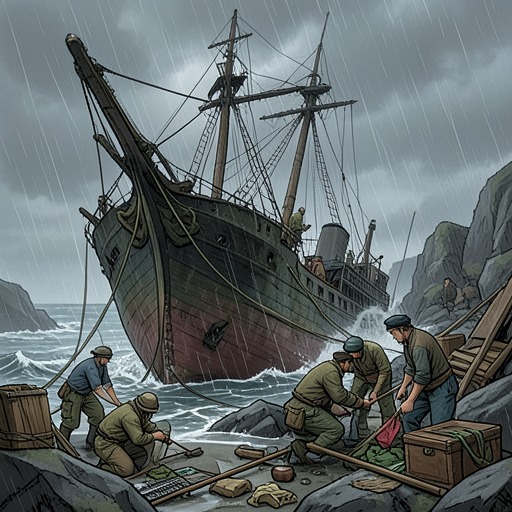
Gillar’s Folly
Chasing SunlightGillar’s Folly is significant chiefly through the damage and political disruption associated with it. The available evidence identifies it as the place where His Majesty stirred up trouble without warning, an action severe enough to leave the airship Endeavor in need of repair and to shape the circumstances of Jonathan Heights’s renewed expedition toward the far east.
Political Crisis and Damage
Gillar’s Folly enters the narrative through Captain Montgomery’s recollection after the Endeavor has been taken to Campbell Yards. Montgomery regards the vessel as a valuable old ship that deserved repair rather than scrapping, but he links its compromised condition directly to the king’s unexpected intervention at Gillar’s Folly. His complaint makes the location more than a distant place-name: it is a point at which royal policy has produced immediate material consequences for an expedition and its crew.
The evidence does not specify what occurred at Gillar’s Folly, nor does it describe the site itself. It does establish that the king’s action was carried out without warning and that the resulting trouble affected the Endeavor badly enough to require extensive work. The location therefore functions as an absent cause whose consequences remain visible in the ship, the expedition’s preparations, and Montgomery’s resentment.
Connection to the Endeavor
The Endeavor’s refitting at Campbell Yards follows the crisis associated with Gillar’s Folly. Jonathan Heights oversees the acquisition and intended use of specific gems in the ship’s engines, insisting that they be installed as part of the repairs. This technical preparation suggests that the damage or disruption connected with Gillar’s Folly is not treated as a minor inconvenience: the ship must be restored with specialized materials before it can resume its journey.
Montgomery’s attachment to the Endeavor gives the aftermath an emotional dimension. He calls the vessel a wonderful old girl and objects to the possibility that it might have been scrapped because of a royal decision made without consultation. His response contrasts with Jonathan’s forward urgency. Jonathan remains focused on the expedition and the search for Sunlight, while Montgomery’s attention returns to the ship’s prior mistreatment and the authority that caused it.
Place in the Eastern Frontier
Gillar’s Folly belongs to the wider geography of a civilization whose illuminated settlements thin out toward the east. Jonathan’s expedition eventually reaches Danby’s Point, described as the easternmost terminus of the human illuminated track, where human construction confronts alien architecture and nonhuman populations behind a great metal gate. At that frontier, trade, Inquisition power, containment, and violence exist in unstable balance.
Against this setting, Gillar’s Folly represents an earlier disturbance within the same contested eastern world. Its importance lies not in a detailed landscape portrait but in the way its crisis precedes later encounters with places such as Danby’s Point and the Verdant Expanse. The expedition moves through regions where human authority claims to organize darkness, yet royal decisions can themselves create disorder before the explorers even reach the boundary of human lands.
Narrative Significance
Gillar’s Folly helps establish the book’s recurring tension between official civilization and the uncontrolled consequences of its interventions. The expedition is presented as operating under the authority of the Illuminated King and amid the competing interests of the Reflected Council, the Inquisition, and the wider underworld. Yet the king’s conduct at Gillar’s Folly damages the very vessel needed to project human purpose into the unknown.
The location also anticipates the conflict between Jonathan Heights’s mission and institutional obligations. Later, at Angkor Leng, Jonathan refuses Captain Antomine’s demand that the expedition interrupt its pursuit of Sunlight to investigate and purge a possible Umbraught nest. His reasoning is practical: the Endeavor is not a navy and lacks the time and resources for such a campaign. The memory of Gillar’s Folly gives this refusal a broader context, because the ship’s condition already bears the cost of political and military interference. Gillar’s Folly thus remains an offstage location, but its consequences help define the expedition’s limited resources, Montgomery’s distrust of royal power, and Jonathan’s determination to keep the Endeavor moving eastward toward his singular objective.