Grave of Wood
Chasing SunlightGrave of Wood is a monumental cemetery in the eastern wilderness and one of the decisive threshold locations of Jonathan Heights’s expedition. It is at once a place of shelter, a forbidden archive of dead civilizations, and the last landscape separating the Endeavor’s voyage from Bright Defile. Its apparent stillness conceals an active law: those who merely pass may be protected, but those who disturb the dead invite the intervention of its enormous guardian. The cemetery therefore turns Jonathan’s exploration into a moral and metaphysical test, forcing him to distinguish knowledge gained through observation from knowledge purchased by violation.
Setting and Appearance
Grave of Wood lies beyond the Lofted Lakes, along the final route Jonathan Heights personally mapped toward Bright Defile. The Endeavor approaches it after crossing a swampy plain threaded with faintly luminous mycelium, where strange forms tend the fungal growth and the ship is battered by worsening winds. In the distance, a flash of ball lightning reveals an array of headstones, at first seeming far too frail to resist the enormous sideways cyclone tearing through the landscape. Their survival is itself evidence of the eastern world’s governing principle: whatever remains in the darkness is protected, guarded, or sustained by forces that human engineering cannot explain.
The cemetery is not composed of ordinary graves. Its monuments resolve into enormous, carven wooden biers, each supporting a crystalline figure whose face is concealed beneath cloth. Their scale is difficult to measure, but the structures appear large enough to shelter the Endeavor. Jonathan Heights believes the interred bodies, or at least the tombs, are of the appropriate size for the construction of the Arch of Khokorron, while recognizing that they are unrelated to the builders of Tor Ilek and Angkor Leng. The site consequently preserves traces of civilizations whose history can no longer be reconstructed from any continuous record.
The interior is arranged around a main thoroughfare. Relative positions of the biers allow Jonathan Heights to identify the route, and the monuments form a fan radiating from the entrance to Bright Defile. Smooth-polished metal slabs, each as large as a city block, make a clear avenue due east. Dust and dirt have gathered against the biers, yet nothing appears to have disturbed the ground for a long time; the absence of footprints gives the place the quiet of a sealed precinct rather than an ordinary road.
Rules and Guardian
The defining rule of Grave of Wood is that nothing may be taken from it. Jonathan Heights warns Captain Montgomery that the prohibition presumably includes the wood itself, although his previous visit was too brief and desperate for him to test the speculation. The rule is not presented as a written law or a threat issued by an authority. It is one of the local conditions that explorers must laboriously discover, often at considerable cost, and then obey without any assurance that every exception has been understood.
Passing through the cemetery without investigating its monuments is comparatively safe. Jonathan Heights explains that the site is guarded, but that the guardian appears to react only to disrespect toward the dead. This distinction shapes the Endeavor’s conduct: the crew may tether beside a bier and use the cemetery as shelter, but they must not pry into the graves, remove objects, or treat the dead as supplies. The cemetery’s danger is therefore conditional rather than random. It does not simply attack intruders; it enforces a boundary between passage and desecration.
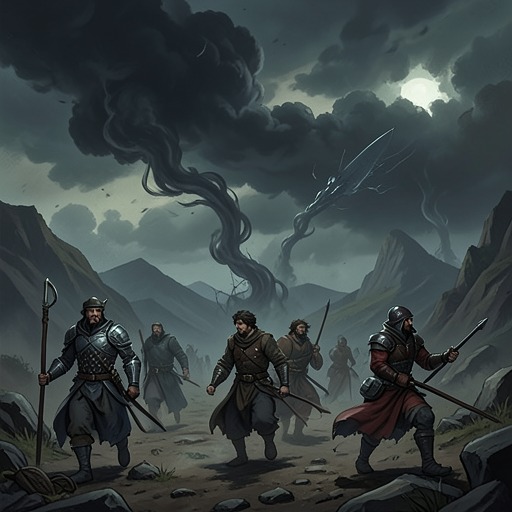
That boundary becomes visible when the storm reaches the cemetery. As the Endeavor shelters behind one of the enormous biers, a massive, sinuous silhouette rises over the graves like a colossal snake. The guardian strikes beyond the monuments and coils around the storm as though the cyclone were solid. Lightning-shot wind, debris, and luminous threads vanish into its gullet, and the guardian consumes the entire storm before returning among the biers. For a moment it seems to look toward the ship, then disappears into the darkness. The scene transforms the cemetery from an impressive ruin into an active power: its protection is not symbolic, and the same force that preserves the graves can erase a natural disaster in moments.
Jonathan Heights and the Previous Expedition
Grave of Wood is inseparable from the failure of Jonathan Heights’s earlier expedition aboard the Discovery. The Discovery had surveyed very little beyond the Arch of Khokorron before coming to grief in the cemetery, and Jonathan tells Antomine that the expedition ended because its members succumbed to greed. The site did not destroy them merely for arriving. Its danger emerged when the explorers treated the cemetery as an opportunity for acquisition rather than as a place whose dead had to be left undisturbed.
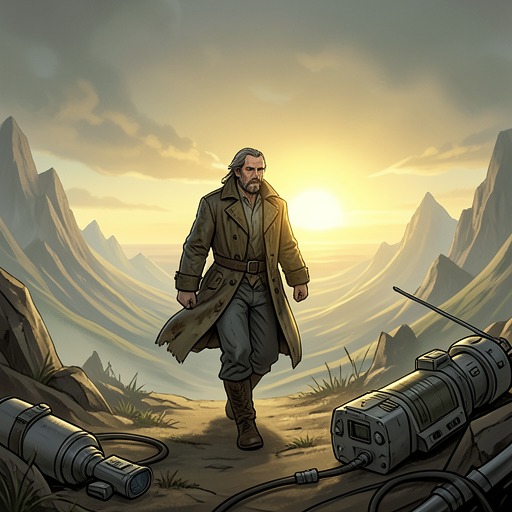
Only Jonathan Heights, Captain Hardiman, and Stoneface reached Bright Defile during that earlier journey, and only Jonathan survived to leave it. The cemetery thus marks both the end of the Discovery’s expedition and the point from which Jonathan’s solitary return began. When the Endeavor later reaches the site, he carries a small notebook containing an estimate of the cemetery’s layout, based on what could be seen from the Discovery’s lights. The sketch is incomplete, but the path toward Bright Defile is all that matters to him; every other secret of the cemetery must remain for another investigator.
Jonathan Heights’s knowledge is consequently practical but scarred by failure. He knows the route, the prohibition, and the likely limits of the ship’s movement, yet he cannot offer Captain Montgomery complete guarantees. The cemetery has to be navigated through partial understanding, just as the wider eastern world does. Jonathan’s reluctance to enumerate every danger is also part of his growing isolation: he believes that dwelling too closely on the threats will create trouble, while the expedition’s survival depends on obeying the rules already learned.
Passage Toward Bright Defile
After the storm is consumed, the Endeavor leaves its shelter and proceeds cautiously through the biers. The pilot uses the angles of the monuments to steer, with the cemetery’s fan-shaped arrangement functioning as an inadvertent navigational instrument. The ship moves slowly, either because of the damage sustained on the journey or because caution is finally taking precedence over speed. A particular shrouded body marks the center path, and the avenue leads the crew toward the wrecked form of the Discovery beside the prize that had tempted it.
Jonathan Heights does not recommend taking the Endeavor farther into the cemetery than the Discovery had reached. The final approach to Bright Defile must be made on foot, both because the route may not accommodate the ship and because exposing the vessel to sunlight is an unknown risk. A detachment of Jonathan, Eleanor McAvey, Antomine, Captain Montgomery, six airmen including Airman Stutt, and the other passengers later proceeds along the empty thoroughfare with a sled of supplies. Most of the crew remain aboard to handle repairs, unwilling to approach sunlight after the dangers of the voyage.
The walking route is deliberately plain beside the cemetery’s monumental scale. Jonathan Heights tells Eleanor McAvey that he followed the path after the Discovery went down because paths lead somewhere, and because a marked avenue offers a better chance of finding something useful than wandering among the monuments or into the wilderness. He remembers that Bright Defile is no more than a day’s brisk walk away, while the Grave of Wood itself remains quiet, free of creatures and weather. The silence is not an invitation to explore; it is the condition under which passage is permitted.
Threshold and Narrative Significance
Grave of Wood occupies an intermediate position between the damaged world of the Endeavor and the revelatory danger of Bright Defile. The Arch of Khokorron has carried the expedition into landscapes that conform less and less to human logic, and the cemetery is the final structured passage before Jonathan Heights crosses into a region defined by sunlight. Its metal roadway, ancient biers, and unbroken eastern orientation make physical travel resemble a progression through layers of buried history.
The cemetery also serves as a counterpoint to the other eastern locations. Terminus is a seemingly welcoming trap whose hospitality Jonathan Heights judges malign; Ukaresh recognizes few laws except power; the Dead Battle reveals the presence of the Players and their Game; and the Arch of Khokorron imposes passage through knowledge and sacrifice. Grave of Wood is different in the precision of its constraint. Its law is narrow, legible, and tied to conduct toward the dead. Yet that narrowness does not make it tame. The guardian’s consumption of the storm demonstrates that even a rule-bound place can contain forces vastly beyond human scale.
At the cemetery’s threshold, Jonathan Heights’s accumulated losses become part of the cost of approaching sunlight. The final barrier at Bright Defile is described as both a barrier of understanding and a barrier in the land itself: to live in sunlight is to have no shadow left. The Grave of Wood prepares that revelation by making the past materially present. Its dead are not scenery, and Jonathan cannot pass through them without recognizing the expedition that ended there, the greed that caused its ruin, and the limits placed upon anyone who would turn the remains of the ancient world into property.
The location’s broader consequences continue after the Endeavor returns to Beacon. The destruction of Tor Ilek and the circulation of its surviving artifacts contribute to the period later called the Winter of Blood, while Captain Montgomery prepares the Endeavor for another expedition. Grave of Wood remains one of the hidden sources of that renewed movement eastward: a place where earlier ambition failed, where the ship survives only by respecting the dead, and where the route to sunlight begins not with conquest but with restraint.