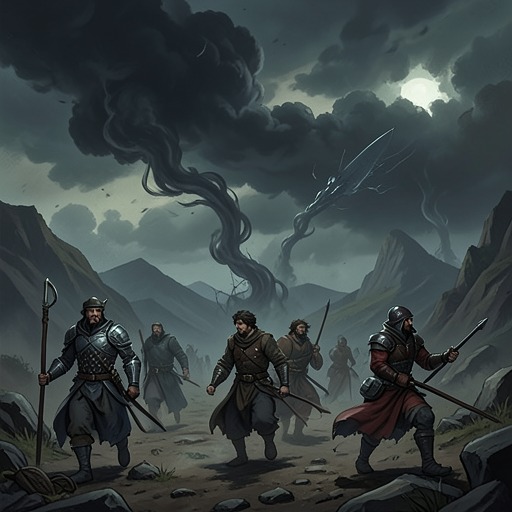
Grave of Wood Guardian Consumes the Storm
Chasing SunlightGrave of Wood Guardian Consumes the Storm is a defining encounter during the Endeavor’s return journey: pursued by a violent cyclone, the airship reaches the Grave of Wood and takes shelter behind one of its enormous biers, only for the cemetery’s guardian to emerge and consume the storm itself. The scene transforms a practical act of emergency navigation into a confrontation with an ancient custodial power, while confirming that the Grave’s safety depends on obedience to its prohibition against taking anything from the dead.
Approach to the Grave of Wood
The action begins as the Endeavor races toward the Grave of Wood through a storm of extraordinary force. Ball lightning flashes across the darkness, thunder strikes the vessel with hammerblows, and the cyclone batters the surrounding landscape. The cemetery’s headstones initially appear too frail to obstruct such a force, but their continued existence reveals the governing condition of the Dark: what survives is protected or guarded, whether by constant human effort in cities and along rails or by powers belonging to the places themselves.
Jonathan Heights knows that the Grave of Wood is not an ordinary landing place. When Montgomery asks what must be understood before attempting shelter, Jonathan explains that nothing may be taken from the Grave, probably not even its wood. Tethering is safe only so far as his limited previous experience permits him to say. His warning is deliberately cautious, because the rules of such locations must be learned through difficult and costly trial rather than assumed from ordinary ideas of ownership or hospitality. The prohibition places the cemetery within the same moral universe as other dangerous thresholds encountered by the Endeavor, where survival depends on recognizing a local law before crossing its boundary.
Shelter Among the Biers
As the Grave of Wood draws nearer, its distant shapes resolve into enormous carved biers, each bearing a crystalline figure whose face is concealed beneath cloth. Montgomery swings the Endeavor sharply across the gale and drives it into the lee of one bier, whose height and breadth are sufficient to shield the airship. The storm’s pounding is abruptly muffled, and airmen leap down with tethers, using zint devices to anchor them in the rocky ground while others hurry to cover the vessel with cloth tarps and metal shutters.
The shelter is precarious rather than peaceful. The Endeavor’s frame creaks under the pressure, and a pane on the bridge crazes and breaks, forcing a crewman to push the shattered glass outward before the wind can turn it into a weapon. Salt and the dry, earthy smell of dead wood enter with the air. The cemetery offers protection, but its atmosphere is wholly without living warmth, and the crew’s refuge remains subject to whatever watches over the graves.
The Guardian’s Attack on the Storm
Before the cyclone can reach the sheltered airship, a slow sliding sound passes through the cemetery, followed by the impression of a vast shadow moving over the graves. In the storm-lit darkness, the crew sees a massive, sinuous silhouette rearing above the biers like an enormous snake. It strikes with blinding speed, not at the Endeavor or at the people clustered around it, but outward into the storm.
The wind’s groaning becomes a howl and then a scream as the guardian coils around the cyclone as though the weather were a solid object. Lightning-shot threads vanish into the creature’s obscured gullet. Jonathan Heights, who had visited the Grave of Wood before, is nevertheless unprepared for the scale and directness of the intervention: the guardian consumes the storm whole. Over the following minutes, the wind, thunder, and pattering debris subside, until the cylinder of violence has disappeared entirely inside the serpent. The creature returns among the graves, seems for a moment to regard the Endeavor, and then vanishes into the darkness between the biers.
The guardian’s action is therefore both rescue and warning. It does not behave like a random monster attacking whatever enters its territory. Its first visible act is to remove the external danger, while its attention toward the airship implies that the visitors remain under scrutiny. When Eleanor McAvey asks whether the guardian is the reason for the cemetery’s rules, Jonathan Heights confirms that the place is guarded and adds that, from what he has seen, it reacts specifically to disrespect toward the dead.
Rules, Thresholds, and Consequences
The encounter clarifies the practical meaning of the Grave of Wood prohibition. Jonathan Heights’s instruction not to take anything is not etiquette in a minor sense; it is the condition under which the cemetery can function as sanctuary. The Endeavor survives because its crew enters defensively, uses the graves as shelter without appropriating their material, and waits under the protection of a power whose jurisdiction is the dead. The guardian’s consumption of the storm makes the cemetery’s boundary visible: violence may rage outside, but the Grave possesses an order capable of enclosing and devouring it.
The action also belongs to the larger pattern of threshold spaces through which the Endeavor travels. The journey repeatedly confronts places where ordinary assumptions about law, geography, ownership, and physical possibility fail. The Grave of Wood is a cemetery, a refuge, and a protected border at once. Its guardian embodies the consequence of crossing that border carelessly, while its intervention offers a narrow form of safety to those who acknowledge the place’s terms.
Narrative Significance
In the wider expedition, the guardian’s storm consumption provides a concrete expression of the book’s recurring contrast between fragile human infrastructure and immense nonhuman powers. The Endeavor depends on engines, patched windows, improvised shutters, and hurriedly driven tethers; the Grave’s guardian neutralizes the cyclone through an act that makes those technologies appear provisional. Yet the scene does not reduce human survival to helplessness. Jonathan Heights’s prior knowledge of the cemetery’s rule allows the crew to reach shelter without provoking the force that protects it, so knowledge remains the difference between refuge and violation.
The Grave of Wood therefore serves as an important counterpoint to other hostile or deceptive locations. Elsewhere, civilization appears as an impossible flame in the wilderness, cities recognize few laws beyond power, and apparent safety may conceal malign temptation. Here, danger and protection belong to the same entity. The cemetery is safe precisely because it is dangerous, and the guardian’s monstrous appetite becomes an instrument of preservation. Later, when Jonathan Heights sacrifices the memory of his past, his relationships, his books, the destruction of Tor Ilek, the sacrifice of Angkor Leng, his banishment from Ukaresh, and other losses on the way to Bright Defile, the Grave of Wood encounter stands among the journey’s earlier lessons in accepting that survival in the Dark requires submission to powers that cannot be mastered by ordinary human claims.