Humanity Belongs to the Light Doctrine
Chasing SunlightThe Humanity Belongs to the Light Doctrine is the central ideological rule of the western human world, defining humanity as a people whose safety, identity, and civilization depend on allegiance to light. Its decisive political consequence is that darkness is not merely an environment or an unknown region: it becomes a moral category, and those associated with forbidden secrets may be treated as contamination rather than as subjects entitled to protection.
Definition and Religious Foundation
The doctrine is expressed most directly by Antomine, who describes his training as that of a chaplain and declares that humanity belongs to the light while secrets that turn people away from it must be purged. His statement is not presented as a casual piety. Jonathan Heights experiences it as a threat directed at his own hidden past, recognizing that Antomine’s religious conviction gives the young Inquisitor a dangerous purpose as well as a formal duty.
Antomine’s belief is deliberate rather than merely devotional. When he observes the lights scattered through the darkness around the Endeavor, he explains human attraction to light as an essential fact of human nature and contrasts humanity with beings that reject or avoid it. His white-pupiled gaze and controlled delivery make the doctrine more unsettling: he is neither mechanically reciting scripture nor surrendering to simple zeal, but reasoning from a considered conviction that light establishes the proper order of existence.
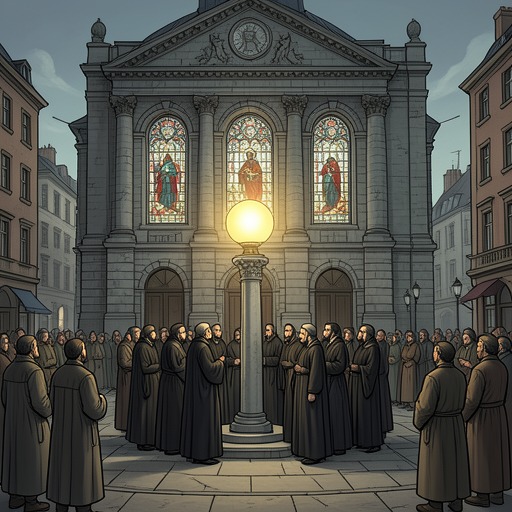
The doctrine also appears in the public definition of civilization. The human lands maintain a vigil of light against eternal darkness under the authority of the Illuminated King, and the monarchy takes an official interest in Jonathan’s alleged discovery of sunlight. The King’s interest suggests that light is simultaneously a religious principle, a political resource, and a possible instrument of power. His glowing token, placed inexplicably in Jonathan’s hand, makes royal authority materially present even before the expedition reaches the eastern frontier.
Institutions and Enforcement
The Inquisition turns the doctrine into an apparatus of surveillance, judgment, and violence. Antomine travels aboard the Endeavor to safeguard the Illuminated King’s interests, carrying authority that can expedite practical matters at the edge of human territory and can also threaten accusations of treason when others resist his commands. The doctrine therefore does not remain inside churches or private belief; it shapes who may act, what knowledge may circulate, and which emergencies authorize force.
This logic becomes explicit when the expedition encounters a settlement associated with the Smiling Man Cult and the Third Gospel. Antomine asks to commandeer Captain Montgomery’s cannon, arguing that the town has been infected with forbidden secrets and that artillery can address the danger. His proposal treats the settlement as a contaminated site rather than a population containing individuals with different degrees of responsibility. When Eleanor McAvey points out that hundreds of people are present and cannot all be followers of the Gospel, Antomine answers through the authority of the Inquisition and asks whether opposition amounts to treason.
Jonathan Heights reinforces the doctrine’s most destructive implication even while disliking the Inquisition’s excesses. He argues that the Third Gospel requires more than an armed squad because no one may remain untainted and even buildings must be destroyed lest they retain echoes. His memory of an earlier encounter, after which a village became a deep lake, shows that the doctrine’s language of purification has already produced catastrophic material consequences. The conflict is therefore not simply between faith and skepticism: it is between a doctrine that defines collective destruction as protection and the human reluctance of those asked to carry it out.
Frontier Boundaries and the Making of the Other
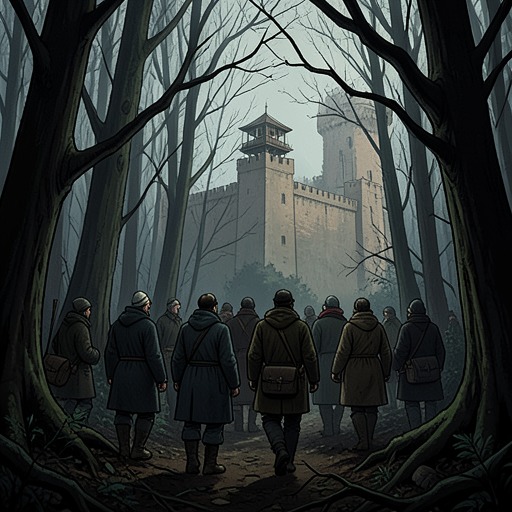
At Danby’s Point, the doctrine organizes the boundary between human civilization and the eastern peoples. The illuminated human settlement ends at a tower and a gate, beyond which alien architecture and nonhuman inhabitants press against the straight lines of western construction. The Inquisition is simultaneously strongest and weakest there: it controls the human side of the frontier, yet must tolerate contact and trade with the powers beyond it.
The great metal gate makes the ideological boundary visible, but the surrounding architecture complicates the claim that influence flows in only one direction. The farther spires are twisted, while those near the wall have been drawn into straighter forms; human and nonhuman environments alter one another. The doctrine calls the eastern world dark and aberrant, yet the frontier reveals a mutual entanglement that its categories cannot fully contain.
The inhabitants of Danby’s Point are described through the doctrine’s hierarchy of humanity and otherness. The Fractured resemble humans while their faces, limbs, and bodies continually change, making them more disturbing to western observers than beings whose strangeness is immediately obvious. The tar-like, many-limbed creatures are less offensive to the eye precisely because they do not imitate humanity. This contrast shows how the doctrine’s anxiety is directed not only at darkness itself but at unstable boundaries between human and nonhuman identity.
Trade and knowledge nevertheless cross the boundary. Tiuni supplies Jonathan with intelligence about political changes among the Thrantin, shifting caravan routes, eastern forces, beasts, and the growing Verdant Expanse. Jonathan exchanges information and human literature for access to that knowledge, even though the same frontier is officially framed as a site requiring containment. The doctrine thus coexists with the practices it distrusts: commerce, translation, mapping, and dependence on those it defines as alien.
Purity, Prohibition, and Practical Conflict
The doctrine governs bodies and substances as well as beliefs. When Jonathan Heights tries to collect a quailing fruit whose vitality could help the expedition cross Bitter Pass, Antomine rejects it as alien contamination. The fruit hisses and shrinks from his touch, and Antomine treats that visible antipathy to human light as proof that any practical benefit is morally irrelevant. He throws it into lava and forbids its use while he remains with the expedition.
This prohibition exposes the difference between Jonathan’s consequential reasoning and Antomine’s doctrinal absolutism. Jonathan evaluates the fruit through survival, route planning, and the possibility of taking Bitter Pass rather than passing around Widow’s Peak. Antomine evaluates it through allegiance: a substance hostile to light cannot be permitted to preserve human lives if contact with it risks corruption. The airmen’s hesitation shows how doctrine disciplines behavior even when no one can establish the exact nature of the danger.
The same conflict returns at Angkor Leng. Antomine argues that a nest of Umbraught must be purged because the creatures now know that zint exists and could carry that knowledge westward, where the consequences might be severe. Jonathan refuses, insisting that the Endeavor is not a navy and lacks the time and resources to survey and cleanse a city the size of Angkor Leng. Antomine replies that civilization is built by doing more than the minimum and by making conditions easier for those who come later. The doctrine therefore presents preemptive violence as stewardship of the future, while Jonathan sees it as an unauthorized diversion from his own mission.
Confrontation with Sunlight
The doctrine reaches its sharpest contradiction when Jonathan finally crosses into Bright Defile. Antomine insists that he must stop Jonathan because his responsibility is to safeguard the humanity of the Illuminated King’s people. Under the compulsion of sunlight, however, Antomine can no longer conceal the deeper political fear behind that responsibility: a man mastering secrets beyond even the Illuminated King’s understanding would threaten everything the monarch has built.
Jonathan’s encounter with sunlight reveals that the doctrine’s supposed opposition to darkness cannot simply absorb the truth he has pursued. Antomine claims that the King has no interest in adopting what dwells in darkness, but Jonathan’s discovery is not merely another eastern power to be rejected. It is a direct challenge to the monopoly by which the monarchy defines legitimate knowledge and human identity.
Jonathan crosses the final barrier by sacrificing his cane, using its thin blade to bridge the last gap between darkness and light. In Bright Defile he finds a green country, white clouds, a blue sky, and the sun itself; the warmth on his face and the freedom of truth are presented as an experience of liberation rather than contamination. His smile marks a personal victory over the doctrine’s limits, while the enormous shadow cast from the far east to Beacon transforms the forbidden seeker into a figure visible across the whole human world.
The doctrine survives as a powerful order, but the ending places its central claim under pressure. Humanity may define itself through light, yet the institution that claims to protect that light fears an individual who reaches it without royal permission. The Humanity Belongs to the Light Doctrine therefore functions both as a sincere survival ethic in a lightless world and as an instrument of ideological control: it protects boundaries, disciplines conduct, and inspires resistance to the dark, while also turning unfamiliar life and unapproved knowledge into grounds for suppression.