Illuminated King
Chasing SunlightThe Illuminated King is the sovereign power behind the light-centered civilization of Beacon and the principal political force shaping Jonathan Heights's expedition to the far east. His public image is that of humanity's radiant protector, but the journey gradually reveals a more dangerous figure: a monarch who treats sunlight as a resource, a secret, and a possible threat to the order built around his authority. Through his representatives, regulations, technologies, and expanding frontier, he defines what counts as human, civilized, lawful, and safe.
Identity and Public Presence
The Illuminated King rules a world of lightless skies in which humanity survives as a vigil of illumination against the eternal darkness. His imprimatur authorizes the expedition eastward, while the Reflected Council's endorsement gives it an additional, morally compromised institutional backing. From the beginning, therefore, the expedition is not merely a private adventure. It is connected to the monarchy's system of secrecy, extraction, and frontier control.
The people of Beacon commonly see the Illuminated King only from a distance, standing atop the palace walls beneath powerful spotlights. That public spectacle makes him appear almost indistinguishable from the artificial radiance surrounding him. When Jonathan Heights is summoned to the Palace, however, the King appears without spotlights and is still cloaked in overwhelming brightness: a silhouette in reverse whose features are washed away. Jonathan can look directly at him, but cannot determine whether this is because of some power belonging to the King or because of his own experience with a more authentic light than zint. The scene makes the King's body itself an instrument of political mystery. He is visible everywhere as an emblem, yet inaccessible as a person.
His voice intensifies that impression. When he tells Jonathan that he may rise, it is deep and resonant enough to be felt in Jonathan's bones. The royal encounter therefore combines ceremony, physical force, and perceptual uncertainty. The King does not need to display ordinary weapons to command obedience; his presence converts authority into an atmosphere.
Rule, Secrecy, and the Machinery of Light
The Illuminated King's authority is maintained through institutions that claim to protect humanity from darkness. The Reflected Council styles itself as the ruler of all the shadows cast by the King's light. Jonathan Heights considers the Council dangerous but useful: it possesses authority through dealings with higher nobility, and the fact that the King has not crushed it gives its actions a practical legitimacy. The monarchy's relationship with the Council is thus neither simple harmony nor open opposition. Both powers operate within a hierarchy of light and shadow, using each other's existence to extend control.
The Inquisition is the King's more direct instrument. Antomine describes himself as the King's representative and insists that he alone can decide whether the expedition has gone too far. His authority is not merely personal. As an inquisitor, he is expected to deliver the law wherever the expedition travels, even though the law becomes difficult to enforce beyond the kingdom's normal boundaries, where it can collide with the needs of captains and nonhuman peoples. The King's power consequently travels through delegation: Antomine carries royal judgment into spaces where the monarchy's institutions are strongest at the border and weakest beyond it.
The frontier also reveals the economic basis of this order. At Danby's Point, human civilization reaches its easternmost illuminated terminus beside territories claimed by darker forces and other races. A great metal gate divides the human plateau from the region beyond, while the surrounding spires show that influence moves in both directions. The Inquisition attempts to contain contact even as trade makes contact unavoidable. The King's world is therefore not sealed from the East; it is an imperial borderland, dependent on exchange while describing the peoples beyond it as savage and dangerous.
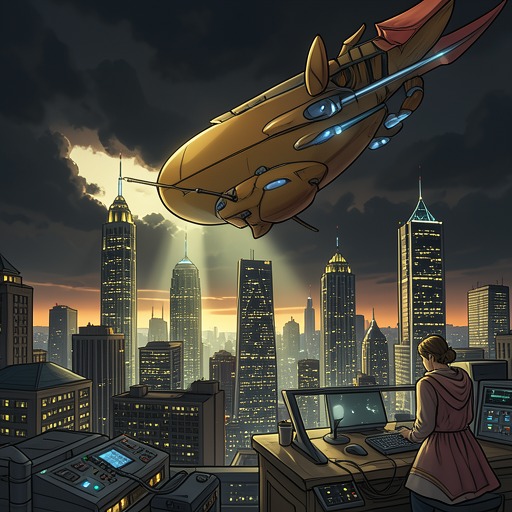
The energy system supporting this civilization is equally political. In Beacon's Industrial Quarter, luminiferous terrestrite is extracted and distilled in immense glass-and-steel stacks, while the enormous zint machinery sends a low vibration through the city. Jonathan finances the expedition with luminiferous gems, and the Endeavor carries a portable luminiferous terrestrite distillation apparatus, lifting-gas equipment, filters, searchlights, and crew-served zint guns. The King's light is not only a spiritual image. It is an industrial system, a military capacity, and a chain of resource extraction extending from the city into the eastern wilderness.
Interest in Sunlight
When the Illuminated King learns that Jonathan is financing an expedition eastward, he states that the monarchy has heard Jonathan has found sunlight and declares that the matter interests him. Jonathan doubts the sincerity of the King's explanation, although he can believe that the King wants to harness sunlight somehow. The memory of a genuine sun appears hollow beside the artificial brilliance of the King's presence, suggesting that sunlight represents an order of reality the monarchy's manufactured illumination cannot fully reproduce.
The King's interest is not presented as detached scientific curiosity. Antomine explains that His Majesty has long sought to illuminate the secrets beyond humanity's borders and that the expedition is not the first one the King has assisted, openly or covertly. This history places Jonathan's journey inside a continuing royal project: the monarchy repeatedly sends agents toward forbidden knowledge while preserving the appearance that human civilization remains safely bounded by its own light.
Jonathan's encounter with the King changes his understanding of the monarchy. A glowing, inscribed white coin suddenly appears in his hand without any memory of receiving it. The experience gives new meaning to cryptic passages in Reginald Heights's notebooks and transforms Jonathan's distrust of the monarchy from dislike of corrupt nobility into something more fundamental. The King is not merely politically compromised; he is connected to powers and forms of knowledge that can act upon a person without explanation.
The monarchy's interest also complicates Jonathan's encounters with the East. Jonathan wonders whether some forgotten artifice resonates with his memory of sunlight, whether Antomine carries a fragment of the King's secret, or whether the King's pursuit itself has provoked danger. Antomine's hostility toward foreign materials is part of this same system. When he destroys a quailing fruit because it recoils from honest light, he treats its possible benefits as irrelevant beside its apparent antipathy to the King's ideal. His prohibition turns the King's theology into expeditionary policy: usefulness cannot excuse contamination when a substance seems to belong to the wrong side of the light-dark divide.
Representatives, Enemies, and the Limits of Sovereignty
Antomine embodies the King's doctrine in its most disciplined form. Trained primarily as a chaplain, he possesses linguistic ability and expertise with zint weaponry, including pistols, rifles, and cannon. He insists that humanity belongs to the light and that secrets turning people away from it must be purged. Far from being a private fanaticism, this conviction bears the King's imprimatur. Antomine's religious fervor is therefore also a political technology, making obedience, moral judgment, and military action appear to be the same duty.
Yet the King's authority is not absolute. Antomine recognizes that Autochthon Reach may be governed by temporal concerns rather than by the King and doubts whether its authorities will properly treat the criminals he has delivered. At Danby's Point, the Inquisition is simultaneously strongest and weakest: it controls the human side of the border but cannot fully dictate the terms of contact with the surrounding peoples. Jonathan likewise refuses to let the expedition become a naval or inquisitorial campaign in Angkor Leng, arguing that the Endeavor lacks the time and resources to survey and cleanse a city of that size.
The King's ideological limits become most visible in the confrontation with She-Who-Must-Be-Obeyed and Ukari. When the ground splits open and a transcendent presence emerges, Antomine declares that the King has no interest in adopting anything that dwells in the dark. He acknowledges the power before him but rejects it as a power humanity would want. Ukari exposes the contradiction by observing that Jonathan has come east in search of sunlight and asking whether sunlight is any less part of darkness merely because it bears another name. The King's system depends on naming and sorting powers into light and darkness, but the expedition repeatedly encounters forces that make those categories unstable.
The danger is not limited to spiritual contamination. Antomine explains that the Umbraught consume luminiferous terrestrite and that the King destroyed or expelled them centuries earlier. The Endeavor's powerful spotlights may have attracted such a creature, although Jonathan suspects that Antomine's presence is the likelier cause. This history presents the King's rule as an active program of extermination and displacement, while the present expedition shows that suppressed forces can return when the monarchy's energy infrastructure reaches into their former territories.
Confrontation at Bright Defile and Aftermath
At Bright Defile, sunlight becomes the test that the King's authority cannot control through ordinary concealment. Antomine arrives with a strange, heavily clamped metal box whose complex frame is intended to capture sunlight for the King's later examination. He advises the others to remain at a distance if the light is as potent as Jonathan believes. When he finally sees the sun, his doubts collapse; he admits that Jonathan has truly found it and hopes to bring back enough to satisfy the King's demands.
The discovery does not reconcile the two men. In the presence of sunlight, Antomine is compelled to speak without dissembling. He says that his duty is to safeguard the humanity of the King's people and that this responsibility requires him to stop Jonathan. He then reveals the deeper political fear behind the order: a man such as Jonathan mastering secrets that even the Illuminated King cannot fathom would threaten everything the King has built. The King's opposition to Jonathan is therefore not only a desire to possess sunlight. It is a response to the possibility that knowledge might exist outside royal custody.
Antomine orders Jonathan to return, asserting that Jonathan remains a human being and still belongs to the men of the west. The order invokes the King's authority as though geography, identity, and obedience were inseparable. Jonathan rejects that claim and crosses into the sunlit landscape: a green country of mountains, white clouds, rivers, and a blue sky, with the sun presented as older than worlds and time. From that vantage, the shrouded lands of the west become a dim mote between sunbeams. Jonathan feels warmth and freedom, and he smiles.
The King's response is indirect but immense. A flash of light appears in the western lands, and Jonathan's shadow stretches from the farthest east to Beacon, where the Illuminated King stands in his tower. For an instant Jonathan becomes a titan seemingly capable of bestriding the world before the image disappears. The shadow is both a visual consequence of sunlight and a political reversal: the monarch's radiant symbol is temporarily placed beneath the image of the explorer who has entered the reality the King sought to possess.
Afterward, Antomine vanishes into Beacon's tower. Those who regularly see the Illuminated King, including court functionaries and nobles, remark that his light seems brighter and his strength greater than before. The court begins speaking of pushing the kingdom's boundaries farther and entering a new golden age. The King has not been publicly defeated; instead, the revelation appears to renew royal ambition. Sunlight becomes another possible instrument of expansion, even as the narrative has shown that it cannot be reduced to a royal commodity.
Narrative and Thematic Significance
The Illuminated King embodies the central contradiction of the light-centered world. He stands for civilization, moral order, and protection against darkness, yet his authority requires secrecy, resource extraction, border violence, inquisitorial surveillance, and the exclusion of whatever cannot be assimilated into his definition of humanity. His light is both genuine power and political theater: it illuminates the city while obscuring the King's features, illuminating the frontier while casting its peoples as darkness, and promising knowledge while guarding knowledge as a royal possession.
His relationship with Jonathan Heights turns the expedition into more than a search for a lost natural phenomenon. Jonathan's journey becomes a struggle over who may see, name, possess, and interpret reality. The King's representative can carry a box designed to contain sunlight, but Bright Defile exposes the inadequacy of that apparatus and the danger of the King's claim to mastery. Jonathan's crossing does not simply discover a brighter lamp; it places him beyond the moral and epistemological enclosure of the western kingdom.
The final image refuses a simple liberation narrative. Jonathan reaches the sun, but the King's light grows stronger afterward, and the royal court interprets the event as an opportunity for expansion. The monarchy survives by converting revelation into policy. Even so, the shadow cast from Bright Defile to Beacon leaves a permanent symbolic reversal: for one moment, the supposedly universal ruler of light is forced to stand within the reach of a truth he did not create and cannot fully fathom.