Illuminated King's token
Chasing SunlightThe Illuminated King's token is a faintly glowing, inscribed white coin presented to Jonathan Heights by the Illuminated King as both a pledge of royal support and an instrument for supervising the expedition toward sunlight. Its practical power is considerable: although it cannot itself pay for goods, it opens doors that money cannot and turns restricted transactions into approved business. Its darker significance lies in the way it makes royal authority physically present in Jonathan's hand, converting an uncertain audience with the Crown into an obligation that follows him aboard the Endeavor.
Appearance and Provenance
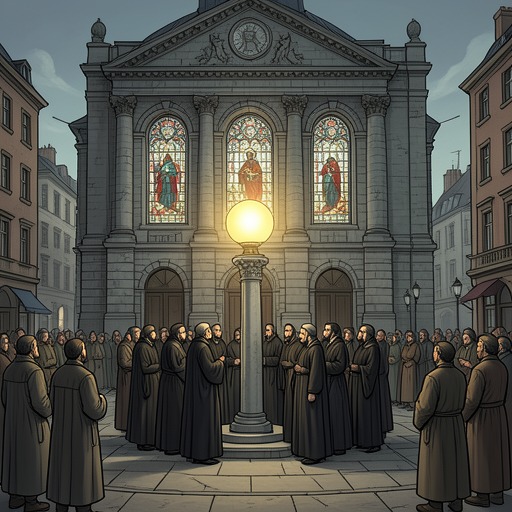
The token enters the story during the Illuminated King's audience with Jonathan Heights. The King says that he has heard Jonathan found sunlight and that the Crown has a particular interest in the matter; he then announces that a representative will accompany the expedition to safeguard royal interests. In return, Jonathan is given the coin.
The transfer is itself disturbing. Jonathan suddenly finds the object in his hand without remembering how it arrived there. It is white, inscribed, and faintly luminous, and his unease is strong enough that his knuckles whiten around his cane. The moment changes his assessment of the monarchy: passages in Reginald Heights's notes acquire a new meaning, and Jonathan's dislike of corrupt nobility becomes a deeper distrust of the royal system itself. The token therefore functions as evidence of an uncanny power, not merely as a ceremonial gift.
After the audience ends, Jonathan puts the coin inside the breast pocket of his suit and bows to the empty balcony before leaving the Palace's unnaturally white radiance. He continues to touch and handle it during the carriage ride home, contemplating both its usefulness and the burden attached to it. His care is possessive but not devotional; he values the access it provides while refusing to mistake access for friendship.
Practical Authority in the Expedition's Preparation
The token immediately changes the economic and bureaucratic conditions of Jonathan's expedition. When Captain Montgomery visits him, Jonathan produces the coin and tells him that the proposed arrangement remains intact and that the Endeavor will receive preferred treatment during its refit. Montgomery is surprised by the apparent extent of Jonathan's connections, while Jonathan deliberately presents royal access as though it were the result of ordinary friendships in high places.
The coin does not replace money. Jonathan still needs an advance, promissory arrangements, cargo, and the labor required to restore the ship. Its value is institutional rather than monetary: it grants entry to the best shipyards and zint-wrights, where ordinary wealth alone would not suffice. Jonathan insists that he accompany Montgomery whenever the token is required, keeping the object under his own control even while using it to advance another man's ship and crew.
The same authority resolves a problem with restricted equipment. At Carter's workshop, the commission is nearly confirmed when Carter points out that the goods remain subject to royal restriction. Jonathan holds up the coin. Carter examines it carefully, then declares that everything is in order and proceeds with the transaction, including the deposit and the gems intended for the Endeavor's engines. The token thus acts as a portable authorization: a single inspection replaces a potentially obstructive chain of permissions.
Jonathan also uses the royal connection to organize logistics beyond the refit itself. He tells Montgomery that supplies can begin moving by train to Danby's Point, the eastern terminus of the illuminated track, because transporting cargo there before fully loading the airship is faster and cheaper. The expedition's material basis consequently depends on a combination of royal privilege, private wealth, railway infrastructure, and less official exchange. The coin is the visible hinge connecting those systems.
Royal Supervision and Antomine's Counterpart
The token's political meaning becomes clearer when Antomine arrives. Antomine identifies himself as an agent sent by the Illuminated King and proves his credentials with an amulet bearing one of the same faintly glowing coins. The matching symbols establish that the token is not an isolated favor to Jonathan but part of a recognizable apparatus of royal representation and enforcement.
Antomine describes himself as chiefly trained as a chaplain, with additional facility in languages and zint weaponry, including pistols, rifles, and cannon. He also states that he will not tolerate corruption by things in the darkness and that secrets capable of turning humanity away from the light must be purged. Jonathan experiences this declaration as a threat directed at his own concealed history, whether or not Antomine actually knows it. The token therefore brings the Crown's scrutiny into the expedition through a human counterpart whose religious certainty is more dangerous to Jonathan than the coin's silent glow.
Jonathan remains uncertain about the Illuminated King's motives. The King claims interest in sunlight, but Jonathan doubts the sincerity or simplicity of that interest and suspects that the Crown may wish to harness whatever he has seen. Antomine likewise says that his sovereign has a deep interest in illuminating secrets beyond humanity's borders and that the King has supported other expeditions, openly or covertly. The token consequently marks Jonathan's journey as one expedition in a larger program of royal knowledge-gathering and expansion.
The Token at the Eastern Frontier
The expedition carries the token eastward into a frontier where human authority is both strong and compromised. At Danby's Point, the illuminated track ends beneath a tall zint-lit tower built into bruised-purple rock. Human light occupies one side of the plateau, while the architecture and illumination of other races press against it from the other. Trade is unavoidable, yet the Inquisition attempts to contain contact, making the boundary a place where civilization is defended through commerce as much as through force.
A great metal gate separates the human portion of the plateau from territory claimed by darker forces, but the influence crosses in both directions. Near the wall, nonhuman spires have been pulled toward straighter lines; farther away, they become twisted and hunched. The token's authority allows Jonathan's party to move through the human administrative zone and benefits from Antomine's Inquisitorial status, but it does not restore a clean boundary between light and darkness. The frontier instead reveals that royal power is entangled with the very contacts it seeks to regulate.
The same tension shapes Jonathan's dealings with Tiuni. Before ventures beyond human lands, he routinely consults her for intelligence, and she supplies information about shifting caravans, forces, beasts, and the expanding Verdant Expanse. Her knowledge narrows the expedition's possible routes and makes travel possible, even though it comes from beyond the institutions represented by the token. When Antomine identifies one of Tiuni's statements as a lie, the scene exposes the limits of the Crown's portable authority: the coin can authenticate an agent, but it cannot guarantee truth in a region where information itself is unstable.
Limits, Consequences, and Final Meaning
The token helps the Endeavor obtain an enormous cargo: a portable luminiferous terrestrite distillation apparatus, a lifting-gas separator, water siphons and filters, searchlights, crew-served zint guns, food, water, spare parts, raw materials, clothing, bedding, soap, and other necessities. Loading at Danby's Point is cheaper than warehousing everything in Beacon, but the resulting weight makes the ship less agile and increases its zint consumption. Royal privilege can accelerate preparation; it cannot abolish the physical costs of an expedition.
Jonathan also refuses to let the token's political implications dictate every decision. When Antomine argues that a possible Umbraught nest in Angkor Leng must be purged before the creatures learn about zint and carry the danger west, Jonathan objects that the Endeavor is not a navy and lacks the time and resources to cleanse a city. His answer makes the conflict between them explicit: Antomine treats civilization as an obligation to future generations, while Jonathan treats the pursuit of sunlight as a priority that no unrelated danger should displace. The coin gives Antomine's position institutional weight, but Jonathan still resists turning the expedition into an arm of the Inquisition.
The object also belongs to the expedition's wider economy of extraction and exchange. At another frontier stop, Jonathan advises the crew that raw metal is better for barter than gold or silver, and he carries rolled steel rods himself. Elsewhere he approves the division and carrying of a large golden find because returning with it will improve the crew's attitude, even though he has little personal interest in gold. In Ukaresh he buys flowers, spices, steel, and brass, while refusing unfamiliar food and drink. These transactions place the token within a chain of privileges, labor, commodities, and risk rather than treating it as a magical solution detached from material work.
By the time the battered Endeavor returns to Beacon, the greatest public interest centers not on the lone inquisitor or the women who disembark but on the immense quantity of gold brought home. The token is not singled out in the aftermath, yet its consequences remain visible in the expedition's authorized movement, its access to restricted resources, and the presence of Antomine. Antomine then disappears into Beacon's tower, after which observers say that the Illuminated King's light seems brighter and his strength greater, accompanied by talk of pushing the kingdom's boundaries toward a new golden age.
The Illuminated King's token therefore ends as more than a credential. It is a compact emblem of the book's central contradiction: the language of light promises knowledge, civilization, and protection, while the institutions claiming to embody those ideals pursue secrets, resources, and expansion. Jonathan uses the coin to reach the darkness he believes contains sunlight, but every use also confirms that his search has been absorbed into the Crown's larger design.