Johann
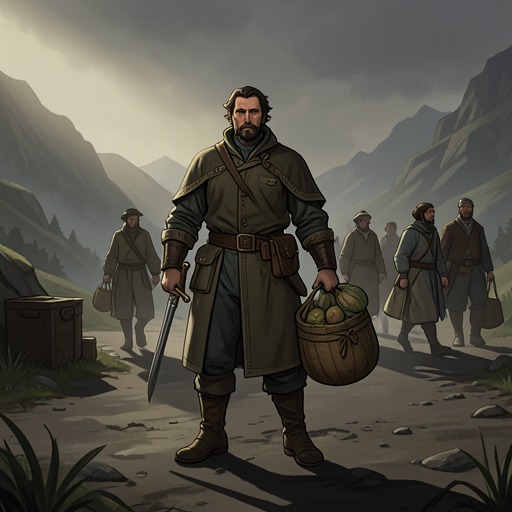
Chasing SunlightJohann is Jonathan Heights’s chauffeur and a quiet but important presence in the machinery of Jonathan’s life. He drives the carriage, manages the practical transitions between Jonathan’s estate, Beacon’s quarters, and expedition departures, and provides a grounded human perspective on adventures that Jonathan treats as professional necessity. Johann’s importance lies less in public authority than in dependable service: when the expedition reaches beyond the mapped world, his concern makes the danger personal before the journey even begins.
Identity and Place in Jonathan’s Household
Johann serves Jonathan in Beacon, a city of white stone, zint-light, traffic, warehouses, walls, and gates. After Jonathan leaves The Likely Prospect carrying the money case he has recovered or acquired, Johann holds the carriage door open while Jonathan climbs into the enclosed rear compartment. The vehicle is deliberately modest rather than luxurious, accommodating only two or three people in the back, and Johann drives it through the crowded city toward Jonathan’s estate in the Merchant Quarter.
His work places him between Jonathan’s private world and the city’s public systems. He summons and operates the carriage, steers through streets marked by pits and maintenance steam, and carries Jonathan safely between the Port Quarter, the Industrial Quarter, the Noble Quarter, and the estate. The repeated attention to his driving and assistance gives him a practical role in an otherwise abstract network of exploration, technology, wealth, and danger. Jonathan may distrust Beacon’s artificial illumination, but Johann is one of the people who keeps him moving through that compromised civilization.
The Assault and Its Consequences
Johann becomes directly vulnerable when four attackers ambush Jonathan’s party near Campbell Yards. Jonathan later finds him unconscious but alive in the carriage, having been struck on the back of the head with a cosh and abandoned on the roadside. The attack confirms that the dangers surrounding Jonathan are not confined to remote ruins or hostile landscapes: violence can reach the chauffeur waiting in the city while Jonathan pursues negotiations and expeditions.
Jonathan responds with unusual emotional force. He is furious that someone has attacked both him and the people who support his work, yet he handles Johann carefully, easing him upright, helping him move in the wet and windy street, and speaking to him in a calm, soothing voice. He promises that Johann will be all right, places him in the rear of the carriage with his head against the cold glass, and refuses to leave him unattended. The contrast between Jonathan’s inward volcanic anger and his controlled treatment of the injured man reveals the protective obligation embedded in their employer-servant relationship.
The incident also changes the household’s security posture. Jonathan gives Captain Montgomery one of the pistols he had taken earlier and accepts the captain’s plan to place proper lookouts around the lodge house, treating it like a dangerous southern port. When they part, Jonathan helps Johann up the stairs, while Agnes opens the door in visible confusion over whether to take Jonathan’s coat or help the injured chauffeur. Johann’s condition thus draws the household into a shared response, and the assault makes the estate itself part of the expedition’s security problem.
Loyalty, Anxiety, and Departure
Johann’s concern is clearest when Jonathan prepares to leave Beacon with the expedition. During the transfer of Jonathan’s crates at the dock, Johann speaks more bluntly than the servants and attendants surrounding the departing party. He tells Jonathan not to get himself killed, explaining that he has read adventure novels and knows that the world beyond the city is not safe. The remark is practical, affectionate, and slightly comic, since Jonathan knows that such novels resemble reality only in passing.
Jonathan answers by assuring Johann that he will be fine, although the narration immediately undercuts the reassurance by acknowledging the expedition’s actual dangers. Jonathan shakes Johann’s hand after the crates are loaded and watches until the chauffeur disappears into Beacon’s bright lights. The farewell is brief, but it gives the departure a human cost: the expedition is not merely an intellectual venture or a logistical operation, because someone who remains behind expects Jonathan to return alive.
Johann’s anxiety is not presented as ignorance. He has seen enough of Jonathan’s habits, injuries, enemies, and preparations to understand that exploration is lethal. His warning therefore functions as a domestic counterpoint to the confidence of the expedition’s leaders. Where Jonathan speaks in terms of routes, cargo, engines, and discoveries, Johann reduces the entire enterprise to its central fact: it is not safe out there.
Service Amid Expeditionary Danger
Although Johann does not accompany the expedition through its major confrontations, his role establishes the everyday support structure on which those confrontations depend. Jonathan’s carriage journeys begin with Johann at the controls, and even the departure for the remote unknown requires him to move crates, wait through the confusion of loading, and worry about the man whose ambitions take him away from the city.
The expedition itself repeatedly validates Johann’s warning. Captain Montgomery receives notice that a ship is running dark and preparing to intercept the Endeavor; Jonathan’s long experience tells him that a newly disturbed creature or phenomenon in ancient ruins is something the party cannot fight; Terminus frustrates Jonathan precisely because its enforced peace conceals none of the threats he expects; and the party later faces an unfamiliar storm while crossing toward the Grave of Wood. At Bright Defile, Jonathan admits that the final terrain is unremarkable but that the entrance and sunlight are extraordinary, while Montgomery remains more concerned about the damage already suffered by the Endeavor. Johann’s offhand warning therefore echoes through the expedition’s successive judgments about danger, from urban ambush to technological pursuit, ruin-born catastrophe, and the perilous edge of the map.
Johann’s absence from these later scenes is itself meaningful. He represents the ordinary world that Jonathan repeatedly leaves behind, while the captain, the inquisitor, and the expedition’s passengers confront increasingly abnormal threats. His work is humble and local, but it makes the threshold visible: every journey begins with a carriage leaving Beacon, and every promise to return is made to people such as Johann who remain exposed to the consequences of Jonathan’s choices.
Narrative Function and Significance
Johann is a supporting character defined by reliability, discretion, and concern rather than by independent ambition. He opens doors, drives through traffic, assists an injured employer, and voices the practical fear that the principal explorers are accustomed to suppressing. His understated presence gives material shape to Jonathan’s social position: Jonathan is wealthy enough to own an estate and a chauffeur, yet his carriage is modest, his household is vulnerable, and his service relationships are sustained by personal trust rather than by luxury alone.
His treatment during the assault also clarifies Jonathan’s character. Jonathan can be calculating with rivals and impatient with delays, but Johann’s injury provokes immediate care and a promise of protection. The chauffeur is not expendable background labor; he is one of the people whose safety Jonathan feels responsible for. Agnes’s exasperated request that Jonathan stay out of trouble, followed by her effort to feed and care for Johann, extends that protective circle into the household.
Johann’s final significant appearance before departure leaves him as a figure of grounded judgment. He has no map, weapon, scholarly theory, or special knowledge of the darkness, but he understands the simplest truth that Jonathan’s grand expeditionary language can obscure. The world beyond Beacon is dangerous, Jonathan may die there, and someone who cares about him has the courage to say so plainly. Through Johann, the novel connects the spectacular hazards of exploration to the ordinary people who drive, wait, worry, and keep the explorer’s world functioning.