Jonathan Heights
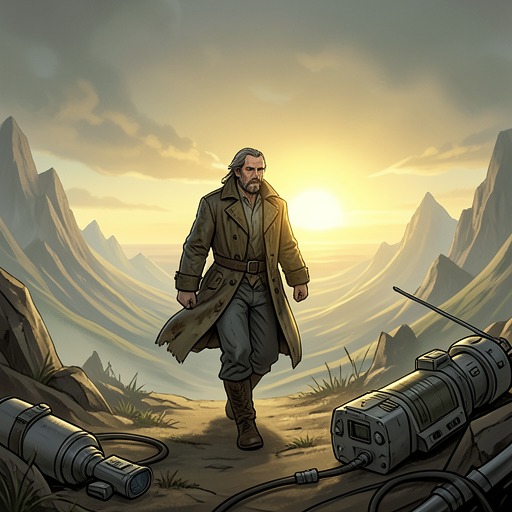
Chasing SunlightJonathan Heights is the central explorer of Chasing Sunlight, a man who turns an impossible memory into the organizing purpose of his life. In a world of lightless skies, he insists that sunlight is not a myth because he has seen it with his own eyes. That claim makes him a visionary to himself and a dangerous fabulist to others, but it also gives the novel its decisive direction: every expedition, alliance, refusal, and act of violence is ultimately measured against his determination to reach the sun again.
Identity and the Call of Sunlight
Jonathan is introduced as a veteran explorer operating within the political and religious order of Beacon, under the authority of the Illuminated King and the threatening endorsement of the Reflected Council. He is not searching for a vague improvement to civilization. He claims to have encountered sunlight already, and his journey is an attempt to recover a reality that the surrounding society treats as a laughable myth. The force of that conviction distinguishes him from ordinary adventurers: he is not seeking novelty, wealth, or merely an eastern horizon, but confirmation of an experience that has made the darkness intolerable.
His confidence is theatrical as well as intellectual. When challenged by Captain Montgomery, Jonathan brushes an imaginary speck from the sleeve of his immaculately tailored suit and assures him that his eyes are exceptionally reliable. The gesture presents him as controlled, polished, and faintly ridiculous, yet the confidence is not empty. He speaks from a memory that has survived disbelief, institutional obstruction, and the absence of any complete explanation of what a sun might be. Even his father, whose records could have supplied inherited authority, had discovered little about sunlight itself. Jonathan therefore inherits a mystery rather than a settled theory, and his expedition begins as an attempt to convert personal testimony into demonstrable knowledge.
Jonathan’s declaration to Eleanor McAvey that he has found sunlight makes the quest explicitly irreversible. He warns that any further agent sent by the Exploration Society will be dead before the party leaves the city, revealing that he understands the expedition as a confrontation rather than a scholarly venture. His language turns obstruction into an existential offense. The expedition is “for keeps” because sunlight has ceased to be one possibility among many; it is the only objective capable of organizing his remaining life.
Organizing the Expedition
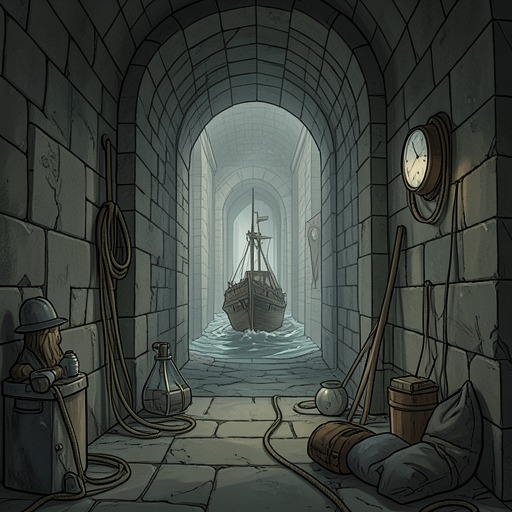
Jonathan recruits Captain Montgomery and directs the refitting of the Endeavor for extreme long-distance travel. He requires distillation facilities, spare parts, and room for himself as a passenger, with perhaps three or four additional people. The practical requirements expose the material underside of his seemingly mystical quest: reaching the sun depends on water, machinery, repair, navigation, and the labor of a crew. Jonathan may speak in absolute terms, but he knows that revelation must be pursued through equipment and logistics.
His preparations culminate in a final departure from his estate. Carrying a case to the waiting carriage, he moves through Beacon as violent wind throws newspapers and wrapping scraps beyond the reach of the streetlights. Agnes witnesses the departure amid the instability of the city, while Jonathan regards the completion of his preparations as the fruition of long labor. The scene places a private obsession within a public environment whose artificial lights are vulnerable, temporary, and physically hemmed in by darkness.
Jonathan plans the eastern route with the same mixture of scholarship and command. At Danby’s Point, where the illuminated human track ends against a tower built into bruised-purple rock, he confronts a frontier in which human civilization meets other peoples and powers. He treats the Crimson Caldera as the gateway to the deep East and explains that reaching it requires a route through shifting landmarks and the recovery of specific materials. Tiuni supplies information about movements among the Thrantin, caravans, beasts, and the expanding Verdant Expanse, while Jonathan converts that intelligence into a navigational program.
The expedition’s movement through the East repeatedly tests the limits of his knowledge. At one point, the crew disturbs something Jonathan cannot identify as either creature or phenomenon. His experience in ancient ruins and the lightless landscape gives him an immediate certainty that it is not something the crew can fight, so he orders action without waiting for a complete classification. This instinct is one of his strengths as an explorer, but it also reveals the danger of his method: he relies on accumulated pattern recognition while pursuing a destination whose nature even his inherited sources cannot explain.
Knowledge, Violence, and the Frontier
Jonathan’s relationship to knowledge is active and possessive. He does not merely wish to understand sunlight; he wants to reach it before institutions, rivals, or hidden powers can prevent him. When the Exploration Society interferes with his expedition, he confronts Harrington and compels him to carry a warning back to Beacon. Jonathan declares the Society petty and irrelevant, threatens to destroy any agent who crosses his path, and insists that no one will bar his way to sunlight. His anger is not a temporary reaction but a political stance: institutional authority loses legitimacy whenever it obstructs the truth he believes he has earned through exploration.
This position does not make him a simple liberator. His expedition passes through a frontier already structured by trade, surveillance, and unequal power. Danby’s Point is described as the place where human civilization’s zint illumination meets the domains claimed by darker forces; the Inquisition is simultaneously strongest and weakest there, compelled to trade with nonhuman powers while trying to contain contact. Jonathan uses this borderland for passage and intelligence, but he also inherits its imperial habits of mapping, classification, extraction, and strategic control.
His conduct toward nonhuman life exposes that tension. A caravaneer encountered by the Endeavor is more than twice the size of a human and bears a long, bioluminescent striped tail that trails thirty or forty feet behind it. The encounter presents the East as a space of beings whose scale, bodies, and movement exceed human norms, yet Jonathan’s expedition treats such encounters primarily in relation to survival and progress. Similarly, when Antomine rejects a strange quailing fruit because it recoils from light, Jonathan must negotiate between the expedition’s need for unfamiliar resources and the Inquisition’s doctrine that anything associated with darkness is corrupting.
Jonathan does not share Antomine’s interest in making the journey serve the Illuminated King’s broader political aims. When Antomine proposes responding to the dangers surrounding Angkor Leng, Jonathan refuses to turn the expedition into a naval or inquisitorial campaign. He says that the party lacks the time and resources to survey and cleanse a city the size of Angkor Leng and admits that he does not know whether the Umbraught are truly a threat. His refusal is practical, but it is also revealing: the suffering or danger of other places matters to him only insofar as it affects the road to sunlight. At Angkor Leng, he helps shatter the stasis sustaining the fevered dream of a sick, sleeping god beneath the city, an act that contributes to the dream’s ending and the collapse of the world organized around it.
Obsession and Human Cost
Jonathan’s fixation increasingly separates him from ordinary bodily and social life. After prolonged exertion, he acknowledges that he has neglected basic physical needs because obsession and concentration on esoteric matters have pushed the demands of the body into the distance. His body remains an unavoidable limit, but he treats it as an inconvenience to be paid for later. The same pattern governs his relationship with the crew: their dislike is visible to Eleanor as they gather in the observation room after a meal, yet Jonathan continues forward without treating their resentment as a reason to reconsider the expedition.
His indifference extends to consequences once the Endeavor has escaped a crisis. When a potential conflict threatens Beacon but no longer concerns the ship, Jonathan states that he has no interest in it. The comment condenses his moral narrowing. He is capable of immense courage and precise judgment in pursuit of sunlight, but he repeatedly refuses claims that would distribute his attention across a wider human responsibility. The expedition’s destination functions as both a source of purpose and a justification for abandoning everything that does not directly serve it.
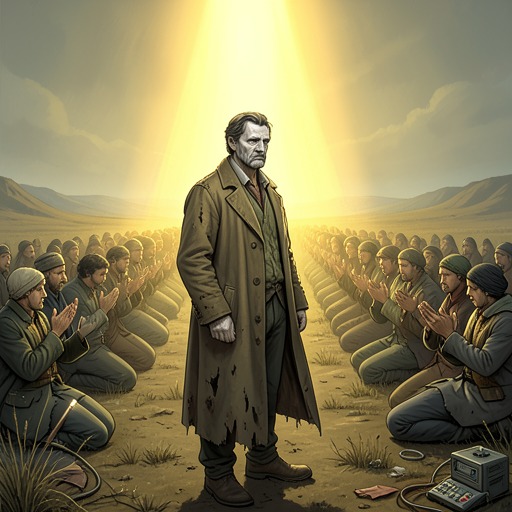
In Ukaresh, Jonathan’s purpose acquires an almost supernatural authority. He introduces Eleanor McAvey and Inquisitor Antomine to She-Who-Must-Be-Obeyed, the immortal Ukari, and openly states that he has found sunlight. In Beacon the claim had been dismissed as unconvincing; Ukari, by contrast, recognizes enough in it to offer a measured sign of respect. Jonathan then moves through the tunnels beneath Ukaresh after being separated from his human companions. Freed from the restraint he maintains around them, he lets the cane’s rhythm announce his approach while the inhabitants avert their eyes from the sunlight burning behind his own.
Even when he apologizes to Ukari for the unintended effects of his attempt to address Eleanor’s behavior, he frames the disturbance of Ukaresh and the Black Garden as an accident rather than a transformation of his aims. His apology does not erase the consequences of his intervention. It instead shows how Jonathan understands responsibility: he can acknowledge damage while continuing to treat his quest as the controlling necessity that made the intervention meaningful.
Bright Defile and the Final Crossing
By the end of the second journey, Jonathan has deliberately stripped away earlier concerns and honed himself to the singular purpose of stepping into sunlight. The Endeavor reaches the edge of the map, where no previous traveler has returned, and he finds that neither tools nor inherited records can aid him on the final leg. This absence of equipment and precedent is important because it removes the explorer’s usual supports. The last passage cannot be solved by accumulated technique alone; it requires a decision about what kind of person he is willing to become.
The appearance of the Discovery briefly disturbs him. The vessel recalls the earlier expedition and provokes vague, uncomfortable emotions, but sunlight burns those memories away with a soothing certainty. The Discovery becomes both relic and salvage: a humble ship connected to a profound discovery, yet reduced in Jonathan’s present vision to a waypoint rather than a destination. His treatment of it shows how thoroughly the quest has reordered value. Even his own past matters only as material on the route forward.
Before entering the final region, Jonathan warns the others not to advance farther than they can endure. Each step toward Bright Defile will allow them to see and understand more, but human beings remain flesh and blood, assembled from mistakes and compromises. Jonathan recognizes that his own journey has been a test of resolve and that he has forged himself into someone who will not compromise concerning sunlight. The statement is not merely a boast: sunlight’s revelation forces truth upon those who approach it, and Jonathan’s certainty becomes inseparable from the willingness to accept what that truth demands.
Antomine confronts him at the threshold. He claims responsibility for safeguarding the Illuminated King’s people and is compelled, in the presence of sunlight, to disclose the deeper motive behind his opposition: a man capable of mastering secrets beyond even the Illuminated King’s comprehension would threaten the entire order the King has built. Jonathan’s conflict with Antomine therefore exceeds personal hostility. It is a struggle between an institution that defines protection as control of knowledge and an explorer who regards unrestricted access to the truth as worth every danger.
Jonathan crosses the final gap by sacrificing his cane. He lays it as a thin sword-blade across the remaining stretch, lets it go, and uses the loss of a familiar tool to complete the impossible passage. The act gives physical form to the pattern that has governed his life: every instrument, attachment, and compromise must be surrendered when it stands between him and sunlight.
Ending and Narrative Significance
Jonathan’s final step takes him into Bright Defile, beyond which lies a green country of mountains, white clouds, rivers, stones, leaves, and grass marked with the secrets of time and space. Above it is a vast blue sky and the sun, older than worlds and older than time. Behind him, the shrouded lands of the journey become a dim mote suspended between sunbeams, an overlooked corner of creation. The image does not simply reward exploration with a new territory; it radically changes scale. Everything Jonathan treated as the center of existence is revealed as a minute region within a larger, illuminated order.
The ending grants Jonathan the experience he has defended against disbelief, but it does not turn him into a conventional returning hero. He does not bring a practical cure back to Beacon, reconcile the human and nonhuman worlds, or restore the institutions that opposed him. His reward is direct apprehension: warmth on his face, a wild wind behind him, and the freedom of truth before him. He smiles because the quest has reached its literal object, not because its consequences have been resolved for everyone else.
Jonathan’s significance lies in the contradiction between liberation and domination embedded in his pursuit. He resists the Illuminated King’s attempt to harness sunlight, rejects the Exploration Society’s obstruction, and refuses to let Antomine define what humanity may safely know. Yet his own quest repeatedly privileges revelation over community, treats the East as a route to be mastered, and accepts destruction when it clears the path. His final triumph is therefore both sublime and unsettling. Sunlight validates the memory that began the expedition, but the journey has also made clear that the desire to possess truth can resemble the authoritarian power it opposes. Jonathan reaches the light by becoming singular, uncompromising, and nearly unreachable—and the novel leaves that transformation standing in the full radiance of his smile.