Jonathan Heights–Antomine relationship
Chasing SunlightThe Jonathan Heights–Antomine relationship is the central ideological and eventually physical conflict between Jonathan Heights’s pursuit of sunlight and Antomine’s duty to preserve the order of the Illuminated King. Their alliance makes the expedition possible, but it is never founded on trust: Antomine is sent to safeguard royal interests, while Jonathan intends to reach a truth that may invalidate the institutions governing Beacon. At Bright Defile, that tension becomes open confrontation, and Jonathan’s passage into sunlight requires him to break Antomine’s authority as completely as he breaks the tether binding him to the west.
A Mandated Alliance
Antomine enters Jonathan’s expedition as an official presence rather than a voluntary equal. The Illuminated King has heard that Jonathan found sunlight and declares a royal interest in the discovery, sending an agent to protect that interest while giving Jonathan the Illuminated King’s token. The arrangement places Antomine aboard the Endeavor as both companion and observer: he travels with the expedition, but his ultimate loyalty is to the King and to the civilization whose borders the expedition is leaving behind.
Antomine describes himself as chiefly trained as a chaplain, with additional facility in languages and zint weaponry, including pistols, rifles, and cannon. His religious and political commitments are inseparable from his practical abilities. He believes that humanity belongs to the light and that corrupting secrets from the darkness must be purged. Jonathan immediately experiences this declaration as a threat, sensing that Antomine may be speaking about his own history and ambitions. The relationship therefore begins with concealed knowledge on both sides: Antomine does not yet fully understand Jonathan, while Jonathan recognizes that the inquisitor may be more dangerous than his youthful appearance suggests.
Conflict Beyond Human Borders
The expedition repeatedly exposes the difference between Jonathan’s pragmatic interest in reaching sunlight and Antomine’s obligation to extend the Inquisition’s priorities. At Danby’s Point, human civilization ends at a zint-illuminated tower built into bruised-purple rock, where human structures meet the architecture and inhabitants of the eastern darkness. A great metal gate separates the human section from territory claimed by darker forces, yet the influence runs in both directions: distant spires are twisted, while structures near the wall have been drawn into straighter lines. Antomine’s presence belongs to this contested boundary, where trade is tolerated but contact is restrained and watched.
Jonathan uses knowledge, maps, and exchange to prepare the expedition for the lands beyond the human frontier. He obtains information from Tiuni about shifting Thrantin caravans, eastern forces, beasts, and the changing Verdant Expanse. Antomine, however, treats such encounters through the categories of contamination and purification. When Jonathan considers using an alien fruit to help the expedition cross Bitter Pass, Antomine seizes one, condemns its antipathy to good and honest light, and throws it into lava. The gesture turns a question of survival and expediency into a religious prohibition, leaving Jonathan furious and the crew hesitant to proceed.
The same disagreement reappears at Angkor Leng. Jonathan refuses to divert the Endeavor to survey and cleanse a city-sized threat merely because Antomine considers the Umbraught dangerous. Antomine answers that civilization cannot be built by doing only the bare minimum: present actions either help or hinder those who come later. Jonathan sees this as an unacceptable distraction from the journey to sunlight, while Antomine sees Jonathan’s refusal as a failure of responsibility. Their opposing definitions of civilization are already clear. Jonathan treats civilization as a means that must not obstruct revelation; Antomine treats it as a duty requiring intervention beyond immediate self-interest.
The Journey Toward Recognition
Their relationship changes when they reach the Discovery, the abandoned vessel that marks the furthest east any human ship has gone. Antomine remarks that its derelict condition offers a lesson, while Jonathan identifies the greatest risk as the unknown. Antomine then challenges Jonathan directly, asking whether he can keep the Endeavor from suffering the same fate. Jonathan responds by proposing that the Endeavor go no farther and that the party continue on foot, making the Discovery a boundary between shipborne civilization and the final approach to sunlight.
Antomine carries a complex metal box with clamps, crossing seams, and a mirrored glass-and-crystal interior designed to capture some portion of sunlight for the Illuminated King. Jonathan doubts that an artifact can contain the reality they are approaching. The device embodies the difference between them: Antomine approaches sunlight as something to safeguard, transport, and place at the King’s disposal, whereas Jonathan understands it as a truth that cannot be mastered through possession.
At the edge of Bright Defile, Antomine finally admits that Jonathan has found something real. He confesses that he doubted Jonathan throughout the journey despite the King’s assurances, then hopes to bring back enough sunlight to satisfy the King’s demands. Jonathan answers that Antomine will find little of value to carry away because the light used by Antomine and his King is only a pale imitation of the truth before them. In Jonathan’s view, sunlight can be approached only by asking, not by harnessing it; he also denies that he intends to control the secrets he discovers. The exchange transforms their disagreement from suspicion into explicit philosophical opposition.
Authority at the Threshold
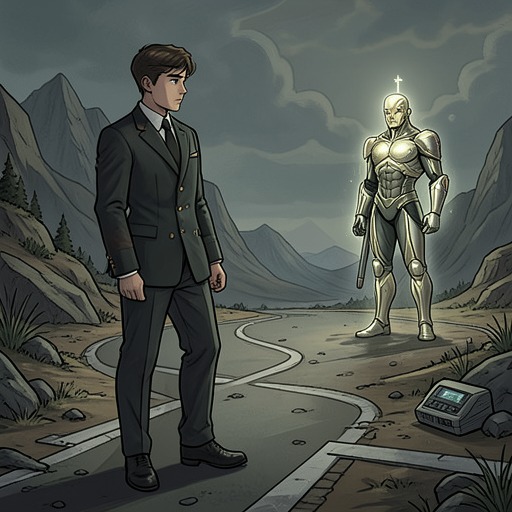
As they advance, sunlight reveals the structure of their identities. Antomine struggles under its pressure, while progressively less substantial versions of him stream behind him, exposing his faith and beliefs as layered attachments. Jonathan sees no such ghostly images because he has shed the attachments that would hold him back. The contrast does not mean that Antomine lacks courage: he reaches farther than Jonathan expected and continues forward with the Lux Guards. But sunlight makes visible the cost of his allegiance, showing how thoroughly his selfhood is bound to the King and the order he serves.
Antomine eventually declares that he has reached his limit. He opens the elaborate box and exposes the mirrored interior intended to trap a fragment of sunlight, while Jonathan takes another step toward Bright Defile. Antomine protests that they cannot go farther, but Jonathan distinguishes Antomine’s inability from his own intention. He says that he did not travel so far merely to taste the fruit when he sought the entire tree, and that he knew from the beginning he would go where truth and revelation led him.
The relationship reaches its decisive turn when Antomine tries to convert official authority into a personal command. Jonathan dismisses him as an insignificant agent of an irrelevant king and orders him to take his box and leave. Antomine replies that his role is to safeguard the humanity of the Illuminated King’s people and that a man capable of mastering secrets beyond the King’s comprehension threatens everything the King has built. Under sunlight, Antomine cannot conceal the fear behind this duty: the danger is not merely that Jonathan might be harmed, but that Jonathan’s knowledge might render the King’s structure of power irrelevant.
Antomine then invokes the deeper connection between Jonathan and the western human order, ordering him to come back. The command reaches into a primal tether within Jonathan, perhaps created by the Illuminated King or produced by Jonathan’s origins. Jonathan does not submit. He lets sunlight burn through that connection, exposing and destroying the hidden attachment. The act is both resistance and self-definition: Jonathan does not merely disobey Antomine but removes the part of himself that could still be summoned by the King’s authority.
Defeat and Final Separation
Jonathan’s resistance overwhelms Antomine. The inquisitor screams as the concentrated force of Jonathan’s anger and the sunlight burns away the white radiance in his pupils, and the Lux Guards move to seize Jonathan. They fail. The wax guardians melt in the sun, their zint leaking out as their armor falls away; a great wind turns the spreading metal and wax into salt. Antomine collapses to his knees, stripped of the commanding presence that had marked him earlier in the expedition and left looking like a lost man.
The defeat is not presented as a reconciliation or a mutual understanding. Jonathan turns his back on Antomine and faces Bright Defile, refusing any further interruption. Antomine remains connected to the King, to the western doctrine of humanity, and to the fear that ungoverned knowledge represents. Jonathan, by contrast, crosses the final barrier only after sacrificing his cane as a bridge across an impossible gap. That sacrifice gives the conflict a material conclusion: the tools, authority, and identity that carried him from Beacon cannot accompany him into sunlight.
Jonathan finally stands within Bright Defile beneath a vast blue sky and the sun, feeling warmth, freedom, and truth before him. He smiles, while far to the west his silhouette briefly stretches from the furthest east to Beacon, where the Illuminated King stands in his tower. The image makes the relationship’s final consequence unmistakable. Antomine fails to preserve Jonathan for the King, the Lux Guards are destroyed, and Jonathan’s emergence into sunlight casts a momentary shadow over the entire order Antomine served. Their relationship ends not with shared revelation but with Jonathan’s emancipation from the authority that Antomine embodied.