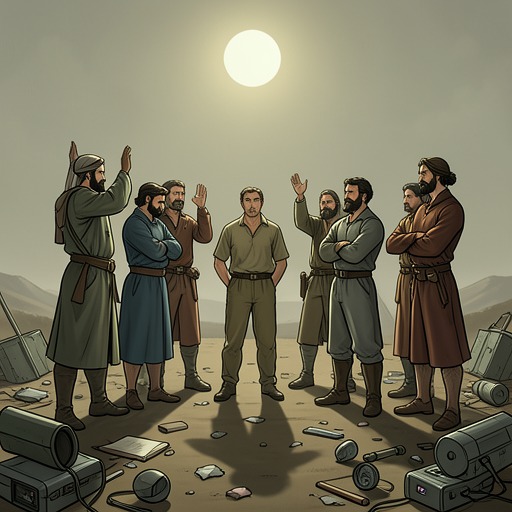
Jonathan Heights–Eleanor McAvey relationship
Chasing SunlightThe Jonathan Heights–Eleanor McAvey relationship is one of the central unstable alliances aboard the Endeavor: Jonathan needs Eleanor’s independence and unusual receptivity to forbidden knowledge, while Eleanor needs the expedition as a route toward freedom but cannot trust the man directing it. Their intimacy is therefore inseparable from unequal information, concealed intentions, and the recurring question of whether Jonathan is protecting Eleanor, exploiting her, or doing both at once.
Formation Through the Expedition
Eleanor joins Jonathan’s journey toward sunlight as an escape from debts and the constraints awaiting her return. When She-Who-Must-Be-Obeyed asks why she has followed this dangerous man so far from home, Eleanor answers that she wants freedom: she intends to return able to reject those who control her, discard her debts, and live on her own terms. That answer immediately defines the relationship’s tension. Eleanor is not presented as a passive companion seeking romance or patronage; she has a concrete emancipatory objective. Jonathan, however, recognizes that objective as something he can guide toward his own ends.
Their early association is also shaped by the world they enter together. At Danby’s Point, Eleanor confronts a frontier where human construction and nonhuman forms press against one another across the great zint-lit gate. The fractured and the Umbraught make the boundary between civilization and the darkness visibly unstable, while Jonathan already possesses the knowledge needed to move through that danger. His role as teacher and guide gives him practical authority over Eleanor and the others. He educates the expedition’s members in local rules so that ignorance will not destroy them, and he treats himself as the person who must take command during emergencies or foreign encounters. The same expertise that keeps Eleanor alive also places her under his interpretive control.
At Danby’s Point, Jonathan consults Tiuni before moving beyond human lands, using her intelligence about the Verdant Expanse, shifting caravans, ruins, beasts, and political forces to narrow the expedition’s routes. Eleanor is present within this broader system of maps, trade, and restricted knowledge, but Jonathan remains the person who decides what information matters and how it will be used. His refusal to pause the journey to investigate the Umbraught threat at Angkor Leng shows the priority governing him: he will not allow the Inquisition’s conception of civilization’s duty to divert him from the search for sunlight. Eleanor’s relationship with him consequently develops inside a conflict between his private objective and the wider claims made by Antomine on behalf of human civilization.
Manipulation and the Black Garden
The relationship changes decisively when Jonathan arranges access to the Black Garden. He tells She-Who-Must-Be-Obeyed that he had intended to show Eleanor the Garden, presenting the plan as a request for permission while concealing how necessary the encounter is to his own expedition. Jonathan already knows that Eleanor’s goals and the Garden’s secrets intersect, or at least suspects that the Garden lies along the path she must take. His request is therefore not merely an act of companionship. It is a calculated use of Eleanor’s desires and abilities within a larger plan.
The Garden’s effect on Eleanor exposes the cost of that calculation. After contact with its secrets, she returns in a state of hysterical avarice and bloodlust, attacking Jonathan with a dagger and then shifting from murderous violence to unsettling sexual aggression. Jonathan tears the weapon from her hand, counters the shadowed hunger through the sunlight within him, and strikes her when the danger continues. The scene makes their relationship physically coercive: Jonathan’s protection is also domination, and Eleanor’s altered consciousness becomes an immediate threat he believes only he can contain.
Jonathan nevertheless regards the transformation as useful. He admits to himself that Eleanor’s new personality is unsustainable and a mockery of her true goals, yet he deliberately preserves the exposed, unstable awareness that follows her encounter with the Garden. He needs her in that condition because she is then capable of performing the Garden’s dark miracle. His responsibility is therefore morally double. He understands that Eleanor is impaired, recognizes that the state does not represent her authentic aims, and still exploits it because the expedition requires what she can do while unbalanced.
At the Keeper of the Pits, Jonathan asks Eleanor to harvest a frozen near-cat for him. Her response draws on secrets he cannot understand: blood, crawling vines, roots reaching toward the heart of the world, and the savage thirst of growing things. The result is the red heart-fruit, a living object that beats inside a thin lattice of hide and fur. Jonathan has brought Eleanor for precisely this purpose, even while he remains excluded from the knowledge that makes the act possible. Their relationship thus reverses the ordinary pattern of mastery: Jonathan controls the route and the decision, but Eleanor becomes the necessary agent of a power he cannot himself command.
When the Endeavor departs, Jonathan carries Eleanor aboard while the surrounding vegetation encroaches on the tethering lines. Antomine confronts him and objects that the supposed errand has become another dangerous crisis. Jonathan replies that he helped Eleanor and that the new knowledge overwhelmed her, but his explanation also reveals his failure of anticipation. He had expected the Garden’s effect to be manageable; he had not expected the connection between its secrets and sunlight to affect her so violently.
Care, Distrust, and Unequal Knowledge
After the encounter, Jonathan apologizes to Eleanor, though he acknowledges that the apology is only partly genuine. He had intended to take her to the Garden regardless and had expected that it would lie along her path. He understands that knowledge cannot be unlearned and that sudden insight forces its recipient to wrestle with truths that cannot simply be removed. His apology therefore does not undo the manipulation. It confirms that he knew enough to foresee danger, but not enough to understand its full consequences, and proceeded anyway.
Eleanor’s response is bluntly accusatory. She says the experience was horrible and objects that Jonathan left her alone with She-Who-Must-Be-Obeyed, asking whether he understands what that figure is like. Jonathan’s calm admission that he does understand her reveals the limits of his sympathy. He can recognize the danger because he has his own history and familiarity with the powers of the east, yet he still treats Eleanor’s exposure as an acceptable element of the expedition. He is less interested in protecting her from every threat than in ensuring that she remains capable of serving the journey’s next purpose.
Their mistrust becomes most visible when the heart-fruit is needed to pass through the Arch of Khokorron. As the tunnel’s red light turns ignorance into knowledge and demands a toll that cannot be paid twice, Jonathan reaches for the fruit and discovers that it is missing. He immediately suspects Eleanor, sees her retreating toward her room, and pursues her. The suspicion is not an abstract fear: their prior pattern has taught him that she may possess knowledge or objects he needs while refusing to disclose what she intends to do with them.
Jonathan finds Eleanor gripping the fruit and trying to bite it. He tears her from hiding, seizes her by the throat, forces her hand open, and takes the object from her. He then consumes it himself before the Arch can claim its value. The act turns their struggle into a contest over survival and possession. Eleanor’s greed and malice may be intensified by the Garden’s secrets, but Jonathan does not pause to determine her responsibility; he treats the fruit as his property and his necessary means of survival. Eleanor’s bodily autonomy is subordinated to the expedition’s immediate demands.
Antomine interrupts while Jonathan is still holding Eleanor by the throat. Jonathan releases her only after being ordered to do so, and the blood on his teeth makes his defense—that he was merely retrieving what belonged to him—look morally inadequate. The scene crystallizes the relationship’s governing contradiction: Jonathan is capable of recognizing that Eleanor is not wholly responsible for what she does, but he is also willing to use extreme force against her when his objective is threatened. His care is practical, not gentle; his restraint exists, but it is measured against necessity rather than Eleanor’s consent.
Conflict, Responsibility, and the Refusal to Kill
Antomine’s questioning forces Jonathan to account for the boundary he has drawn. The inquisitor observes that Jonathan could have killed Eleanor and did not, despite having shown that he is willing to remove anyone who inconveniences him. Jonathan rejects the idea that he is merely a barely restrained thug. He argues that Eleanor was not entirely responsible for her actions and that he used what force was required because gentler persuasion was unavailable. Antomine replies that Jonathan did not even try gentler methods.
This exchange identifies the relationship’s central moral ambiguity without resolving it. Jonathan’s refusal to kill Eleanor indicates that she is not interchangeable with the other obstacles he is prepared to eliminate. She remains useful, but usefulness alone does not explain his restraint: he also regards her as someone transformed by forces neither of them fully controls. Yet his explanation still converts compassion into procedure. He does not say that Eleanor’s wishes must be respected; he says that her condition required a particular method. The distinction between protection and possession remains deliberately unstable.
Eleanor, meanwhile, is caught between dependence on Jonathan and resistance to his authority. She follows him because the expedition promises a way out of the structures that have bound her, but Jonathan’s conduct reproduces a different form of control. He gives her access to forbidden knowledge while deciding when and why she should receive it. He recognizes that the Garden has distorted her personality, but he also values the very state that makes her dangerous because it enables the harvest he needs. Her struggle for freedom therefore does not end when she escapes her old debts; it is redirected into a partnership where information, bodily risk, and decision-making are controlled by the expedition’s leader.
Narrative Significance
The relationship functions as a concentrated version of the expedition’s larger ethics. Jonathan’s journey is organized around a single goal, the recovery of sunlight, and he repeatedly refuses distractions that do not serve it. Eleanor’s freedom is a competing but compatible desire: he can help her approach it, yet only by fitting her aspirations into his own route through the darkness. The Black Garden demonstrates what happens when those aims overlap. Jonathan can offer Eleanor access to a transformation she could not reach alone, but the access is also a calculated exposure to forces he knows may break her.
Their relationship also destabilizes the book’s opposition between civilization and savagery. Antomine speaks of civilization as a discipline that must confront threats rather than ignore them, while Jonathan dismisses the Inquisition’s demand to cleanse Angkor Leng because it interferes with the search for sunlight. With Eleanor, however, Jonathan becomes a private administrator of danger: he decides which violence is necessary, which knowledge may be used, and which consequences can be postponed. He resists institutional authority while reproducing its logic in intimate form.
The relationship has no secure romantic resolution in the supplied events. Its most intimate moments are marked by surveillance, predation, and force: She-Who-Must-Be-Obeyed identifies Eleanor as a companion whose secrets have entered her heart; Jonathan manipulates access to the Black Garden; Eleanor attacks Jonathan under the influence of its knowledge; and Jonathan later restrains her violently over the heart-fruit. The bond persists because both remain bound to the expedition and because each possesses something the other needs, but the same interdependence continually generates distrust. Jonathan and Eleanor are neither simple allies nor simple enemies. They are collaborators whose shared passage toward the unknown repeatedly turns cooperation into a struggle over who may control knowledge, freedom, and survival.