Jonathan Heights–Players relationship
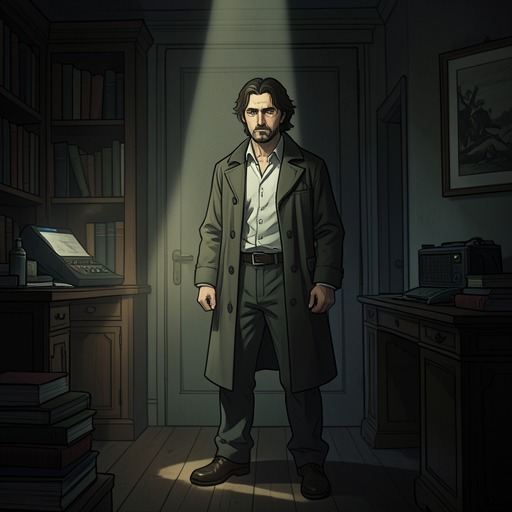
Chasing SunlightJonathan Heights–Players relationship is the encounter between a mortal explorer pursuing sunlight and two incomprehensible beings who invite him into a Game operating across time, distance, history, and forbidden knowledge. Its decisive feature is refusal: Jonathan sees that the Players’ offer could expand his power and understanding beyond ordinary human limits, yet concludes that accepting it would surrender the independence that gives his quest meaning. The Players consequently stand as both guardians of a greater order and a warning about knowledge so complete that it destroys choice.
The Players’ Appearance and Recognition
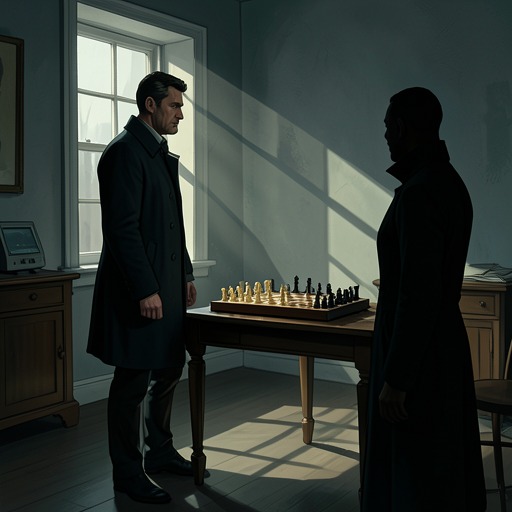
The relationship begins when Jonathan notices that the Dead Battle has changed during a visit by the Endeavor. A full day after first treating the spectacle below as merely an impressive tableau of desperate combat, he realizes that the observation room has expanded: its windows have grown larger, the carpet has flowed over receding borders, and the battle has become more visible under the ship’s spotlights, almost as though the scene itself has contracted. Two immense figures stand in the distance like mountains shaped as people, with the Dead Battle between them. The altered room is therefore not simply a strange chamber but an approach toward the beings who have been present all along.
The figures are impossible to perceive distinctly. They are cloaked in shadow and obscurity, at once familiar and indescribable, their nature inaccessible in the same way that the Illuminated King’s true body cannot be perceived and their scale resembles Ukari’s transcendence. Jonathan understands them as beings who have grasped primal secrets from the depths of the world, meditated on mysteries beyond mortal thought, and returned with enough understanding to shake the firmament. Their presence explains both the raw force of the Dead Battle and why its particulars change on every visit. It also explains why the Players’ sudden self-disclosure alarms Jonathan: they have never revealed themselves on an earlier expedition.
The encounter makes the Game’s physical and metaphysical dimensions overlap. The Players direct their Game from an observation deck that has grown fat on the residue of their presence, while the Dead Battle below functions as its visible manifestation. Jonathan is not merely looking at a battlefield; he is seeing the outward form of a system whose true reach extends beyond ordinary space and time.
Recognition, Attention, and Unequal Regard
One Player addresses Jonathan in the language of Beacon with a soft, ordinary voice. Its lack of grandeur makes it more deceptive, not less, because the voice does not announce the scale of the being speaking through it. Jonathan acknowledges his identity but cannot determine which of the two figures is actually speaking. The Player claims that they are already acquainted and repeats the phrase “Once met, never strangers,” producing in Jonathan a shock of near-recognition. Jonathan knows that phrase cannot be forgotten, but the being clarifies that the figure encountered previously was its master and that a lesser being such as itself had been lost within that master’s presence.
The Players’ attention is selective and hierarchical. They identify Antomine, Eleanor McAvey, and Jonathan as the three beings of interest, while dismissing the rest of the crew as ephemeral, barely tracing the surface of the world’s deeper pattern. Jonathan receives a more pointed assessment: the Player names his connection to Lightless Life and the Illuminated Order, then says that even the Players do not understand the hooks he has sunk into their world. The relationship is thus established through mutual scrutiny. Jonathan is not important because he commands the Endeavor’s crew or because he belongs to ordinary human institutions; he is important because his encounters with sunlight, the Illuminated Order, and powers of the east have made him anomalous even to entities accustomed to seeing beyond humanity.
Their authority also appears in the way they describe the Arch of Khokorron. They guard it, but not to control whatever might travel from the east. Beyond it lie wild lands reached through paths long closed, forbidden, and dead, from which no salutary thing can come. When Antomine objects that the travelers are already in the true east, the Player answers that “There is always a further east.” The statement turns Jonathan’s geographical quest into a principle of endless transcendence: every apparent boundary conceals another frontier, and every attainment can become the threshold of a more dangerous one.
The Offer of the Game
After Jonathan presses for the purpose of the welcome, one Player asks whether he wants to play a round. The offer is made against a distorted board: the Game is represented by the Dead Battle spread below and simultaneously occupying the Endeavor’s observation deck. With eyes that have seen sunlight, Jonathan can look past the simple conflict and perceive that the battle is only a misleading surface.
The Game is not a contest for ordinary political dominion. It extends over time and distance and touches what must always exist as well as what will never exist. Its movements resemble a slow dream-drift through mysteries and histories, kindling secret fires and producing the fruits of forbidden trees. The Players’ strategy is presented as the grandmaster’s execution of what the Exploration Society only approaches through infantile fumbling: each move reaches backward into the past and forward into the future, and each intention becomes obscure because it requires knowledge beyond human scale.
For Jonathan, the temptation is concrete rather than abstract. He imagines that the sunlight within him could make him imperishable, allowing him to reach farther into the world and seize increasingly fundamental secrets from physical and nonphysical depths. He imagines no longer depending on the unenlightened and following whatever paths he chooses whenever he chooses. The Players’ invitation therefore targets the exact desire driving his expedition: not merely travel, but the removal of limits imposed by ignorance, dependence, and ordinary mortality.
Refusal and the Preservation of Agency
Jonathan recognizes the offer as a trap, although not necessarily one motivated by malice. The danger lies in the scale of understanding itself. The greater the insight, the clearer the perspective becomes, and the fewer choices remain. To immerse himself in the Players’ depths and be remade by the terrible clarity of truth would mean surrendering to knowledge that dictates action from within. His personal goals might become irrelevant, and even the pursuit of sunlight might cease to matter once he understood too much.
He therefore declines the Game, stating, “I respectfully decline,” and explaining that the offer is not meant for him. The refusal is not a retreat from knowledge in general. Jonathan still intends to continue beyond the Arch of Khokorron, and he insists that his own interests take him elsewhere. What he rejects is knowledge that replaces the self rather than enlarging it. Antomine’s faint, unmistakable sigh of relief shows that the decision has stakes beyond Jonathan’s private philosophy: the inquisitor appears to know something about the Players or their Game and fears what Jonathan might become if he accepted.
The Players regard Jonathan’s decision as unusual. Most visitors who play have already secured their own stakes, including the Illuminated King and She-Who-Must-Be-Obeyed, and therefore approach the Game with a considered position. Jonathan has not secured such a stake, yet he still refuses. His independence is precisely what distinguishes him from those powers. He does not deny the Game’s magnitude; he denies it the right to define his purpose.
Aftermath and Narrative Significance
Eleanor McAvey attempts to claim the opportunity for herself, saying that she would like to play and would take Jonathan’s round. The Players reject her because she does not yet qualify: she is “not yet herself.” This response leaves the relationship between Jonathan and the Players sharply distinct from Eleanor’s possible future involvement. Jonathan is already sufficiently constituted, altered, or entangled to attract their attention, while Eleanor’s identity remains incomplete in the Players’ judgment. Her frustration does not change the outcome, and Jonathan reiterates that the price of the offer is too high.
The refusal carries a lasting cost. The Player states that the offer will not be made again and that rejecting the master’s favor means Jonathan must arrive at the Players’ domain the hard way. Jonathan accepts this consequence. The altered perspective then collapses: the Dead Battle remains below, the observation deck returns to its ordinary size, and the Endeavor once again appears to contain merely Jonathan and Antomine standing on the carpet. The encounter leaves no simple alliance, bargain, or visible physical damage, but it changes the terms of Jonathan’s route toward the Arch of Khokorron.
As a relationship, Jonathan Heights–Players relationship is best understood as a refusal at a threshold. The Players embody an extreme version of the quest’s promised reward, in which discovery becomes total mastery and the explorer can pass beyond dependence on ordinary humanity. Jonathan’s rejection reverses the conventional invitation into a higher order: he chooses the harder road because preserving a self-directed purpose matters more than acquiring limitless comprehension. The Players remain interested, perhaps even expectant, but Jonathan has denied them the decisive power of defining his next move.