Jonathan Heights—Eleanor McAvey
Chasing SunlightJonathan Heights—Eleanor McAvey is one of the central unstable alliances of the eastern expedition: a partnership sustained by familiarity, competence, and mutual protection even as Jonathan Heights’s pursuit of sunlight draws him away from Eleanor McAvey’s priorities. Their connection is neither simple friendship nor uncomplicated romance. It is a working intimacy shaped by secrets, danger, and the knowledge that each carries motives the other cannot fully access. Eleanor can still joke with Jonathan, challenge his judgments, and move confidently through the expedition’s dangers, but Jonathan increasingly treats her as a person whose usefulness and loyalty must be managed rather than as a shared destination.
A Familiar but Guarded Alliance
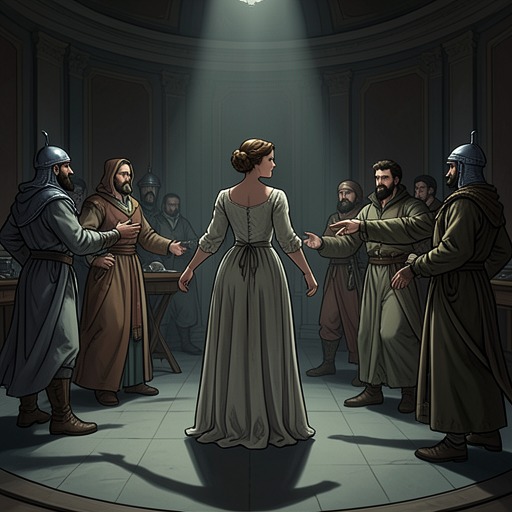
Eleanor’s familiarity with Jonathan allows her to address him with a bluntness few others would risk. When the Endeavor emerges from the foul air of the interregnum, she complains that he does not seem bothered by the ship’s stench and asks whether he even has a nose. Jonathan answers with patient restraint, explaining that other matters had taken precedence. The exchange is domestic in form, but it reveals the widening distance between them: Eleanor remains attentive to bodily discomfort and immediate conditions, whereas Jonathan’s obsession with esoteric matters has made ordinary physical demands increasingly remote to him.
Their communication is also marked by testing and concealment. When Eleanor appears after the investigation into sabotage, she jokes that she expected to catch Jonathan harboring a plant, knowing that he does not mingle with the crew. Jonathan does not react visibly, and her disappointment suggests that she is accustomed to probing him for information through provocation. He understands that Eleanor has secrets of her own and that certain fictions must be maintained, particularly in Antomine’s presence. Their relationship therefore depends not on full disclosure but on recognizing when the other is withholding something.
Jonathan’s long familiarity with alien places gives Eleanor a contrasting human point of reference. He tells her that he has visited dozens of strange locations, beginning with expeditions alongside his father and continuing through his own journeys, while admitting that even he would not be comfortable in the places associated with the Reflected Council. Eleanor responds that people are broadly alike wherever one goes and easier to understand than the inhuman architecture around them. Jonathan disagrees, insisting that non-human thought can also become familiar. Their disagreement expresses a fundamental difference in orientation: Eleanor trusts recognizable human motives, while Jonathan has trained himself to navigate forms of intelligence that exceed human expectations.
Shared Dangers and Practical Dependence
The expedition repeatedly forces Jonathan and Eleanor into the same dangerous physical world. They pass beneath the great metal gate separating the human section of the plateau from territory claimed by darker forces, witnessing the distorted buildings and the Fractured, whose bodies shift between human likeness and impossible variation. Eleanor reacts strongly to her first sight of the nonhuman races, while Jonathan’s experience makes him comparatively composed. His knowledge does not make the environment safe, but it gives him authority Eleanor must rely on when ordinary categories fail.
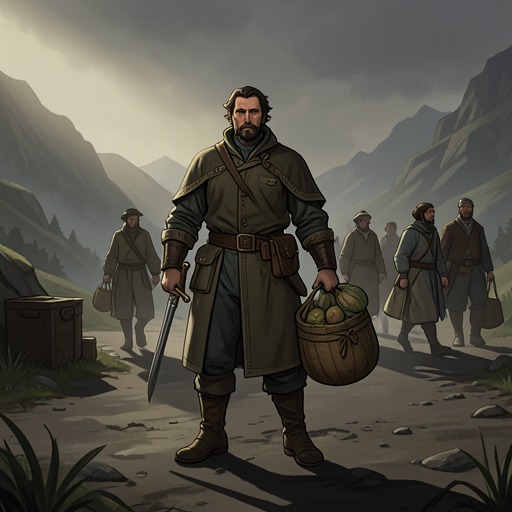
That dependence is reciprocal rather than one-sided. Eleanor accompanies Jonathan through the expedition’s hazards, remains armed, and retains enough initiative to act without waiting for his permission. After the Endeavor reaches a dangerous eastern landing, she is already dressed to go ashore, with both maids carrying rifles, and says that confinement aboard ship has made her feel ready to snap. Jonathan warns her not to stray before he establishes defenses, but he does not attempt to keep her below deck. Their arrangement recognizes Eleanor as an active participant whose courage and judgment are valuable, even when Jonathan privately doubts her commitment to his ultimate objective.
Their cooperation is especially visible during encounters with the caravaneers and the eastern wilderness. Jonathan can address a caravaneer in its language, while Eleanor remains part of the human contingent confronting creatures, storms, and unfamiliar customs. When the caravaneers tear into the enormous carcass of a beast in a sudden frenzy, Antomine is nauseated, but the incident also illustrates the expedition’s dependence on negotiated contact with beings whose social practices cannot be reduced to human etiquette. Eleanor’s presence belongs to this practical world of armed travel, supplies, bargaining, and survival, even as Jonathan’s attention increasingly turns toward meanings beyond expeditionary necessity.
Divergent Aims and the Problem of Sunlight
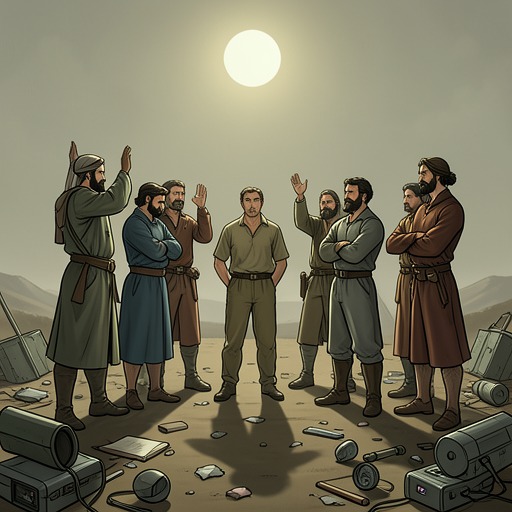
The decisive fracture in the relationship is ideological rather than merely personal. Jonathan has found sunlight, and its discovery has reorganized his identity. Eleanor does not share that revelation. When she asks whether the expedition may uncover something like sunlight, she immediately rejects the possibility, saying that she will pass and that she still does not understand why Jonathan and Antomine are so interested. Jonathan recognizes that words cannot convey the purity and reality of sunlight, particularly to someone whose own secrets are rooted in darkness and whose interests are directed elsewhere.
Eleanor’s priorities remain concrete. She acknowledges the value of the expedition’s discoveries and understates the enormous fortune already obtained from precious metals, but then says that she wants a few extra daggers for dealing with people back home. The remark joins material gain and anticipated conflict: Eleanor sees the expedition’s rewards as resources for future maneuvering, not as steps toward metaphysical transformation. Jonathan warns her to focus on completing the journey and returning with what they already possess, while privately realizing that he can no longer depend on her interest in sunlight to carry her forward.
The same scene shows how Jonathan’s trust has changed. He believes Eleanor might happily turn back, because she has no investment in sunlight, yet he also expects her to seize any treasure that crosses her path. He therefore treats her as both unreliable in purpose and reliable in appetite. That distinction is important to their bond. Jonathan does not dismiss her competence; he doubts the possibility of a shared final goal. Eleanor can remain an ally in a crisis while becoming an opponent in the interpretation of what the journey means.
Secrets, Threats, and Unequal Knowledge
Eleanor’s relationship with Antomine intensifies the strain between her and Jonathan. Antomine’s doctrine insists that humanity belongs to the light and that corrupting secrets must be purged. Jonathan hears the threat as potentially directed at himself, but Eleanor’s own hidden allegiance to darkness makes his silence toward her strategically significant. He knows that Antomine’s defenses and zeal could make her vulnerability catastrophic, yet he does not expose everything he knows. His protection is therefore inseparable from secrecy and control.
When Eleanor returns shaken from the city’s assault on mortality and ending, Jonathan notices her distress but keeps silent as she gives him a sour look and retreats to her room. The moment is intimate precisely because it refuses consolation. Jonathan understands that she has endured something that Antomine’s defenses and his own sunlight-derived resistance allowed them to withstand differently. Still, he does not offer an explanation or comfort. His silence preserves distance, perhaps because he cannot risk revealing more, perhaps because his fixation has made Eleanor’s fear secondary to the expedition’s objective.
Eleanor, meanwhile, is capable of exploiting the gaps in Antomine’s understanding. She thanks Jonathan for not reporting her and remarks that the beings they encountered are creepy, while Jonathan replies that it is not his responsibility to keep secrets Antomine cannot keep himself. She then observes that some force completely counters the Illuminated King’s power. Jonathan does not need to be told the importance of that fact: Eleanor can recognize a strategic vulnerability in the monarchy even when she has no desire to pursue sunlight itself. Her political and survival instincts complement Jonathan’s scholarship, but they also make her a potential danger to the structures he is confronting.
Endurance, Separation, and Narrative Meaning
At the encounter with the Players, Eleanor rises alongside Jonathan and Antomine, glancing toward the entrance as if confirming that it still exists. Her reaction places her within the same uncanny crisis, but not within Jonathan’s singular mode of response. Jonathan draws upon the sunlight within himself and advances toward the Game, while Eleanor remains behind him with Antomine. The arrangement is visual and relational: she is still part of his expeditionary circle, yet Jonathan has become the figure who must move toward the unknown alone.
The final confrontation at Bright Defile makes their divergence explicit. Jonathan refuses Antomine’s authority and declares that the inquisitor is no longer significant; Eleanor is not the direct target of that argument, but her presence belongs to the same group from which Jonathan is separating himself. He crosses the final impossible gap, sacrificing his cane as a thin sword-blade across the last stretch, and enters the country beyond the barrier. In the sunlight he experiences warmth, freedom, and truth, and smiles. Eleanor does not share this culminating vision in the supplied ending. Jonathan’s shadow stretches westward to Beacon, while the expeditionary world that included Eleanor is reduced to a distant, dim remnant behind him.
Their relationship consequently ends not with a declared betrayal but with asymmetrical transformation. Eleanor survives as part of the world Jonathan leaves behind, and the later return of the Endeavor to Beacon places her again among the ship’s continuing orbit, alongside Sarah and Marie, while Captain Montgomery prepares another expedition. Yet the narrative’s decisive image is Jonathan’s crossing beyond the shared human horizon. The relationship has carried both characters through monsters, storms, sabotage, wealth, and forbidden knowledge, but it cannot survive as an equal partnership once Jonathan’s discovery becomes the measure of all meaning. Eleanor represents attachment to practical survival, secrecy, and future leverage; Jonathan represents the consuming revelation that makes former companions appear, however unfairly, like inhabitants of a smaller world.