Jonathan Heights’s Discovery of Sunlight
Chasing SunlightJonathan Heights’s Discovery of Sunlight is the decisive revelation behind Jonathan Heights’s eastern expedition and the central value against which he measures the rest of existence. In a world defined by lightless skies, artificial illumination, and what is called eternal darkness, Jonathan claims to have encountered the natural sun. The sight is doubted as a myth, yet it gives him an unusually clear purpose: he will cross the uncharted east aboard the Endeavor, whatever wonders, horrors, political interests, or private dangers stand between human civilization and the place where sunlight waits.
The Sight and Its Immediate Meaning
Jonathan describes sunlight as “the most beautiful thing I’ve ever seen.” The memory is not presented as a casual observation but as a permanent inward event: the clarity and purity of one ray descending from the heavens has burned itself into his soul, making the rest of the world seem faded and dull while simultaneously giving him strength and purpose. That combination of impoverishment and empowerment defines the discovery. Sunlight does not merely add another wonder to Jonathan’s experience; it diminishes every substitute for it and makes return to ordinary life impossible.
The first public formulation of the revelation is deliberately stark: “Sunlight is a myth.” Jonathan’s answer is equally absolute: “I have seen it with my own eyes, and my eyes are very, very good.” The exchange with Captain Montgomery establishes the discovery’s unstable social status. For everyone formed by the lightless world, sunlight belongs to fairy tale and forbidden aspiration. For Jonathan, direct sight outranks communal belief. His certainty is therefore both evidentiary and solitary: he possesses an experience that cannot be transferred by argument, and he expects others to understand only by seeing it themselves.
From Revelation to Expedition
The sight determines Jonathan’s decision to return east. He tells Captain Montgomery that the Endeavor, despite being part melted, partly dissolved, burned through the envelope, and cracked by luminiferous detonation, is still the vessel that can carry them toward the goal. Jonathan recruits Montgomery by appealing not only to his skill and reputation but also to his desperation, making the expedition a meeting point between visionary purpose and material necessity. The damaged airship becomes the vehicle of a quest whose objective sounds irrational to the surrounding society but is perfectly coherent to its leader.
Jonathan’s motive remains deliberately guarded. He repeatedly confirms that he has seen sunlight while refusing to explain more than that. When André calls the claim a fairy tale, Jonathan says that he is pursuing sunlight and does not wish to share anything beyond that fact. His reserve protects the discovery from scrutiny, but it also makes the expedition politically and ethically ambiguous. The stated purpose is clear, while the full reasons for Jonathan’s fixation remain uncertain even to those traveling with him.
The expedition begins under the attention of powers that want to appropriate or regulate the revelation. The Illuminated King has heard that Jonathan found sunlight and declares an interest in the matter, intending to send an agent to safeguard royal interests. The monarch gives Jonathan the Illuminated King’s token, an inscribed white coin that faintly glows and appears in his hand without any remembered transfer. Rather than reassuring him, the supernatural delivery deepens his distrust of the monarchy and causes cryptic passages in Reginald Heights’s notebooks to acquire a more threatening meaning.
A Journey Through Substitute Lights
The journey east repeatedly places Jonathan’s discovery against artificial, alien, and ideological forms of illumination. At Danby’s Point, the illuminated track reaches its easternmost human terminus at a tall zint-lit tower embedded in bruised-purple rock. Human blue-white light meets the colored illumination of other races, and the plateau becomes a contested border where trade is accepted even as contact is restricted. A great metal gate divides the human section from territory claimed by darker forces, but the influence runs both ways: alien spires are straightened near the wall, while human presence is distorted by proximity to what it condemns.
Jonathan’s passage through this frontier depends on knowledge as much as on force. He trades books and information with Tiuni, studies the movement of powers and beasts, and uses maps to narrow the possible routes through the Verdant Expanse. Tiuni’s intelligence about the eastern caravans and the shifting forces beyond Danby’s Point is indispensable, yet the encounter also shows that knowledge is never neutral in Jonathan’s expedition. Maps, translations, trade, and route planning turn unfamiliar lands into navigable objects, even as the landscape resists the categories imposed upon it.
The discovery also exposes a conflict between Jonathan’s goal and Antomine’s doctrine. Antomine, trained largely as a chaplain and equipped with knowledge of languages and zint weaponry, insists that “Humanity belongs to the light” and that corrupting secrets must be purged. He rejects alien resources that might help the expedition survive, including a quailing fruit that hisses and shrinks from his touch, because its apparent hostility to good and honest light makes it unacceptable. Jonathan sees such prohibitions as obstacles to reaching sunlight; Antomine sees them as necessary defenses of human souls. Their disagreement reveals that sunlight has become two incompatible things: Jonathan’s destination and Antomine’s moral standard.
The Discovery’s Costs and Ritual Thresholds
The expedition’s progress is marked by deaths, funerals, destruction, and crossings that make the search resemble a succession of threshold rites. After the Endeavor leaves the smoldering remains of Danner’s Grasp, Antomine conducts a service for three dead crew members. George’s casket is empty because his body cannot be recovered from the ruined settlement; each closed casket is then rendered into dust by distilled luminiferous terrestrite and dispersed into the wind. The ritual gives form to loss while the ship continues eastward, and Penelope’s survival provides the only bright note in a scene otherwise governed by death.
A later encounter with the corpse of a dead titan receives an even more solemn treatment. As the Endeavor escapes the grasping rot of the immense body, Antomine recites, “From dust ye were made and dust ye shall be.” Jonathan and Antomine, otherwise divided by doctrine and method, agree that the corpse must be given a proper pyre. The shared ceremony suggests that the search for sunlight does not erase older obligations to the dead; instead, each act of passage accumulates moral and material consequences that Jonathan must carry toward the final threshold.
At Angkor Leng, Jonathan’s pursuit becomes directly destructive. When he decides that the expedition cannot pause to cleanse a city-sized nest of Umbraught, Antomine argues that civilization requires doing more than the minimum and that present actions determine what will be possible for those who come afterward. Jonathan rejects the broader obligation, activates a sequence of controls recorded in his notebook, and causes the machinery beneath the city to fail. The commands trigger an earthquake, a metallic collapse, and the release of a massive, fevered presence whose effects imprint themselves on reality. The route to sunlight is therefore not a clean pilgrimage: it is opened through decisions that destroy places and release dangers beyond human comprehension.
The approach to the Arch of Khokorron makes the price of knowledge literal. The machinery withdraws to reveal a tunnel miles in diameter, lined with burning lights and extending beyond sight. As the Endeavor enters, the passage strips away the instant in which ignorance becomes knowledge. Jonathan expects to pay with the alien fruit he has hidden in his safe, but the fruit is missing. The event converts accumulated experience into a toll: knowledge gained along the expedition has become part of the price of reaching the truth, and the expedition’s survival depends on sacrifices that cannot simply be repeated.
Entry into Sunlight
At the final crossing, Jonathan’s sacrifices form a compressed history of the expedition and of his own self-erasure. His empty estate, his connections to his chauffeur and housekeeper, Tiuni’s death, the destruction of Tor Ilek, the books thrown from the Endeavor, the burial of a god, the sacrifice of Angkor Leng, the loss of Eleanor’s friendship, his banishment from Ukaresh, his rejection of the Players and the Game, and the other severed ties become lights along an impossible path. The discovery is thus inseparable from abandonment: the nearer Jonathan comes to sunlight, the fewer relationships and identities remain behind him.
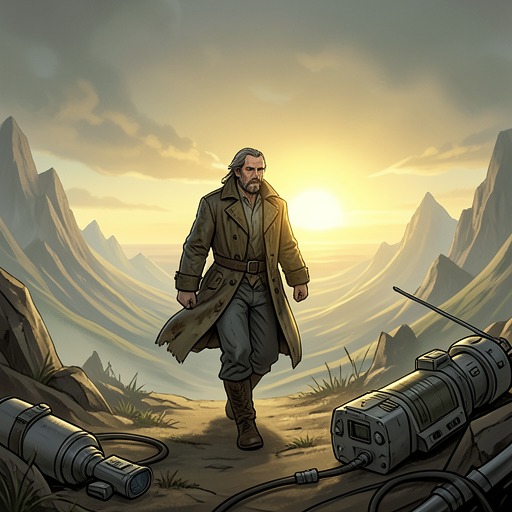
The final sacrifice is his cane. Its thin sword-blade spans the last gap, and Jonathan gives it up to make the dangerous crossing. He then steps through the darkness washed by light and enters Bright Defile. Beyond the narrow valley lies a green country of mountains, white clouds, rivers, and a vast blue sky; every leaf, stone, and drop of water bears the secrets of time and space. Above all stands the sun, older than worlds and vaster than imagination. Behind Jonathan, the shrouded lands he crossed have become a dim mote between sunbeams. He feels warmth on his face, wind at his back, and the liberty of truth before him, and he smiles.
Narrative Significance
The discovery changes the story from a debate over whether sunlight exists into a confrontation over who may define truth, civilization, and legitimate knowledge. The Illuminated King seeks to safeguard and perhaps harness the revelation; Antomine measures it against the doctrine that humanity belongs to light; Jonathan treats direct experience as superior to both royal authority and inherited belief. His expedition also exposes the violence hidden inside the language of civilization, since human light is maintained through borders, regulation, trade control, armed purification, and the classification of eastern peoples and places as savage or dark.
The ending confirms the discovery in the strongest possible terms, but it does not restore Jonathan to the society he left. Sunlight is real, yet reaching it requires the destruction of his estate, affiliations, alliances, possessions, and former place in the human world. The event is therefore both an epiphany and an exile. Jonathan finds the light he sought, but the truth does not return him to civilization with an easy remedy; it completes his separation from the world of artificial lights and leaves the reader with the unsettling possibility that revelation can be liberating precisely because it makes return impossible.