Jonathan–Antomine Confrontation
Chasing SunlightThe Jonathan–Antomine Confrontation is the climactic rupture between Jonathan Heights’s quest for sunlight and Antomine’s duty to preserve human obedience to the Illuminated King. At the threshold of Bright Defile, Antomine tries to turn an expeditionary partnership into an act of royal command; Jonathan answers by destroying the concealed authority that still reaches into him. The confrontation changes the expedition from a supervised search into Jonathan’s solitary passage into sunlight, while exposing the political and spiritual limits of the western order that sent Antomine after him.
Causes and Opposing Missions
The conflict grows from two incompatible purposes carried together aboard the Endeavor. Jonathan has organized an expedition into the far east because he claims to have seen sunlight, a claim treated in human lands as myth even though it remains the fixed purpose of his life. The journey passes through increasingly unstable borderlands: Danby’s Point is the eastern terminus of the illuminated human track, where zint-lit construction meets alien architecture and the Inquisition is simultaneously strongest and weakest; a great metal gate separates the human plateau from darker forces, although influence crosses in both directions. Jonathan’s mapping, trading, and information-gathering extend the reach of human exploration, but they also place him inside the same civilization whose boundaries he intends to exceed.
Antomine enters that expedition as an agent of institutional control. The Illuminated King has heard that Jonathan found sunlight and declares an interest in the matter, sending an authorized representative to safeguard royal interests while granting Jonathan the Illuminated King’s token. Antomine describes himself as chiefly trained as a chaplain, with additional abilities in languages and zint weaponry, but his religious commitment is inseparable from his political function. He insists that humanity belongs to the light and that secrets drawing people away from it must be purged. His later objections to using alien fruit for survival and to passing an Umbraught threat without cleansing it show the same principle in practice: expediency must yield to a doctrine that defines civilization through disciplined resistance to darkness.
The confrontation therefore repeats an earlier disagreement on its largest possible scale. Jonathan rejects Antomine’s demand that the expedition stop to survey and cleanse Angkor Leng, arguing that they are not a navy and lack the time and resources for such a campaign. Antomine replies that civilization is built by doing more than the minimum and by making the world easier, rather than harder, for those who come after them. At Bright Defile, the argument over one city becomes a struggle over who may decide the future of humanity: the explorer who will cross the final boundary, or the inquisitor who believes every boundary must remain answerable to the crown.
The Command at Bright Defile
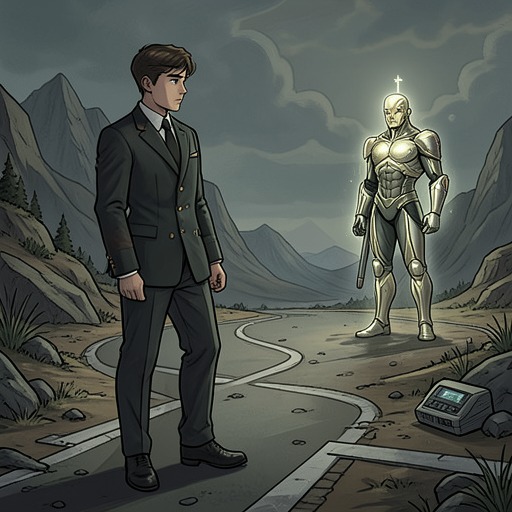
Sunlight makes concealment impossible. As Jonathan advances, Antomine becomes haggard and strained, while progressively less substantial versions of him stream behind him, as though the light is exposing the faith and belief that compose his public identity. He declares that the threshold is the limit and opens a box whose folded faces reveal a gleaming glass-and-crystal interior, a mirrored array intended to trap and carry a small portion of sunlight. The device embodies Antomine’s purpose: revelation must be reduced to an authorized object that can be transported, controlled, and delivered to the institution that sent him.
Jonathan refuses the limit. He explains that he did not travel so far merely to taste the fruit of knowledge rather than reach the tree itself, and that his path toward sunlight and revelation was fixed from the beginning. Antomine responds not with persuasion but with prohibition. Jonathan’s authority, he says, no longer matters; Antomine has permitted him the liberties required to reach this point, but now dismisses him as an insignificant agent of an irrelevant king and orders him to take the box and leave.
Antomine then reveals the fear beneath his official responsibility. He states that his role is to safeguard the humanity of the Illuminated King’s people and that a man such as Jonathan mastering secrets even the Illuminated King cannot fathom would threaten everything the king has built. The admission transforms the confrontation from a quarrel about procedure into an explicit defense of monopoly. Antomine is not merely protecting travelers from danger or collecting a sample for study; he is trying to prevent knowledge from escaping the structure that defines who may possess it.
When Jonathan challenges him to stop the crossing, Antomine invokes the deeper power of the crown. For a moment the presence of the Illuminated King seems to radiate through his white pupils, and he orders Jonathan, still a human and still one of the men of the west, to return. The command reaches beyond ordinary speech. Jonathan feels a tether in his mind being grasped, perhaps established when he first met the Illuminated King or perhaps arising from his origin within the western human order. It is not a crude whip but an appeal to a primal attachment, a buried readiness to answer the authority of home.
The Severing of Authority
The command fails because Jonathan recognizes the mechanism it tries to awaken. Someone uninitiated in deeper mysteries might have obeyed without understanding the compulsion, but Jonathan is no longer willing to act as a starving creature responding to an offered morsel. He lets sunlight blaze through him and directs its force at Antomine. The light does more than illuminate the scene: it reveals the hidden connection between Jonathan and the royal power, then burns that connection away under the pressure of raw reality.
This severance is the event’s decisive reversal. Antomine’s command has briefly restored the crown’s reach, but Jonathan converts the same setting of absolute truth into a weapon against it. The inquisitor screams as the white in his pupils burns, and the Lux Guards rush forward to seize Jonathan. They cannot protect Antomine or restore his authority. The wax guardians melt in the sunlight, their zint leaking out as their armor falls, while a great wind turns the spreading metal-and-wax puddles into salt. Antomine collapses to his knees, stripped of the luminous signs that had made him appear more than a frightened and exhausted man.
Jonathan does not remain to negotiate after the defeat. He turns his back on Antomine and faces Bright Defile, treating the ruined command structure behind him as an interruption that has finally ended. The confrontation thus has a material consequence, the destruction of the Lux Guards, and a psychological one, the removal of the last hidden western attachment capable of pulling him backward.
Passage and Consequences
The crossing itself completes the meaning of the confrontation. Jonathan’s cane becomes a thin sword-blade across the final stretch, and he sacrifices it to bridge an impossible gap. The object that supported his progress through the expedition is relinquished at the instant he enters the world beyond the barrier. His final step carries him from darkness washed by light into Bright Defile, where a green country, white clouds, mountains, rivers, and a vast blue sky stand outside the shrouded lands he has known.
Sunlight gives the revelation a scale that no captured sample could contain. Jonathan feels its warmth on his face, the free wind at his back, and the liberty of truth before him; he smiles. Antomine’s crystal apparatus can attempt to preserve a fragment, but Jonathan crosses into the source itself. The contrast makes the confrontation an argument about possession as much as access: the Inquisition seeks to collect and regulate illumination, while Jonathan accepts the transformation demanded by direct exposure to it.
The consequences reach back across the geography of the novel. From the lands westward of Bright Defile, a flash of light reveals a great silhouette whose shadow stretches from the furthest east to Beacon, where the Illuminated King stands in his tower. Jonathan briefly appears as a titan capable of bestriding the world before the image vanishes. The moment does not restore him to human civilization or show a conventional return; instead, it reverses the direction of power. The explorer who was summoned, monitored, and commanded by the western center becomes, for an instant, the figure whose shadow falls over that center.
Narrative Significance
The Jonathan–Antomine Confrontation crystallizes the book’s opposition between light as doctrine and sunlight as revelation. Antomine’s language treats light as a boundary-making principle: it defines humanity, authorizes walls, and licenses the purging of secrets. Jonathan’s passage treats sunlight as a force that invalidates concealment, including his own dependence on the authority he has resisted. The scene refuses to make either position simple. Jonathan’s route has relied on maps, trade, weapons, and the infrastructure of civilization, yet his final act requires him to sever the institutional bond that made the expedition possible.
The scene also turns the expedition’s recurring imperial language against itself. Human civilization names the east, its peoples, and its architectures as savage or dark while extending its own illuminated track toward them; Danby’s Point makes that contest visible in buildings that distort one another across the gate. Jonathan has participated in that knowledge-making system through maps and negotiations, but at Bright Defile he no longer seeks to improve the western order’s map or supply it with a manageable resource. He crosses beyond the point where its categories and commands can govern him.
As a quest and discovery climax, the confrontation replaces return with irreversible departure. Antomine is left behind with his box, his guards, and the authority that sunlight has exposed as contingent. Jonathan proceeds without his cane and without the tether to the Illuminated King, entering a landscape where every natural thing contains more knowledge than the western regime can safely possess. His smile is therefore both triumph and transformation: the sought-after sunlight has not merely been found, but has made obedience to the old world impossible.