Jonathan’s Crossing into Bright Defile
Chasing SunlightJonathan’s Crossing into Bright Defile is the decisive threshold event of Jonathan Heights’s expedition. It transforms his long pursuit of a supposedly impossible sunlight into an achieved passage, but the crossing is not won through discovery alone. Bright Defile admits him only after he has surrendered the accumulated structure of his former life, making entrance into the light both a physical arrival and an existential severance.
The Final Barrier
The threshold before Bright Defile is unlike the ordinary obstacles Jonathan has overcome. A deep gulf lies ahead, and the distinction between a barrier of understanding and a barrier in the land itself has disappeared. The darkness within a country defined by sunlight is not an ordinary absence of illumination; it is the material shape of everything still concealed. Because Bright Defile exposes all secrets, the final barrier can be crossed only by shedding every remaining shadow. To live in sunlight, the event establishes, is to have no hidden self left behind.
This condition gives the approach its peculiar moral and spatial logic. Earlier stages of the expedition have placed Jonathan in settlements where human order meets alien influence, in cities whose apparent safety conceals malign purpose, and in regions where time, distance, and ordinary geography cease to behave reliably. The eastern journey therefore prepares him for a final space in which knowledge is not merely acquired but exacts a total cost. The threshold does not ask whether he can locate sunlight; it asks what remains of him when concealment is no longer possible.
The Sacrifices That Open the Way
Jonathan’s first sacrifice is his empty estate, which burns like paper and illuminates only a small fraction of the gulf. The image turns property into a literal remnant of the past: the house is not carried into the new world, but consumed as fuel for progress. His connections to his chauffeur and housekeeper follow as two more lights. These losses erase not only possessions but the ordinary domestic structure that once anchored his identity and offered a route of return.
The path is then lit by the expedition’s accumulated costs. The death of Tiuni and the destruction of Tor Ilek become separate sources of fire; the books Jonathan threw from the Endeavor appear as individual stepping-stones; and the laying to rest of a god is represented by the burning of its corpse. The sacrifice of Angkor Leng contributes the temporary radiance of a golden city inside a god’s dream. In this sequence, the expedition is re-read as a chain of irreversible payments. Events that had seemed like separate disasters now form the material of Jonathan’s approach to the light.
Personal and political severance carry the same weight. Jonathan sacrifices his friendship with Eleanor McAvey and his banishment from Ukaresh. She-Who-Must-Be-Obeyed appears in the reckoning, stern and commanding, and seems to acknowledge him before joining the pyre. He also gives up his rejection of the Players and the Game, the dark inverse of sunlight’s bright truths. The crossing therefore includes not just bereavement and exile, but the abandonment of rival systems of knowledge, authority, and possible belonging.
The Act of Crossing
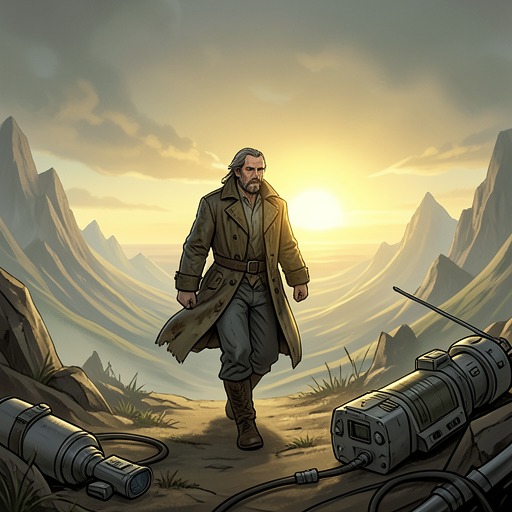
At the last stage, Jonathan places his cane across the remaining stretch like a thin sword-blade and sacrifices it as well. The object has accompanied him through the expedition as an instrument of movement and control, so its surrender removes one of the final practical continuities between the traveler at the threshold and the man who began the journey. He cannot shrink from the perilous crossing. His final step passes through darkness washed by light, closing the infinitesimal distance between himself and sunlight.
The event completes a ritual pattern of departure, liminality, and re-entry, but its re-entry is not into the human world he left. Jonathan enters a new order whose governing principle is revelation rather than secrecy. The crossing is consequently both an arrival and a death of previous affiliations. The estate, household ties, books, companions, enemies, political authorities, games, and cane have all become payment; what passes through is a person stripped of the supports that once defined him.
Bright Defile and the Sunlit World
Beyond the narrow valley lies a great green country extending in every direction, with proud mountains, pure white clouds, and rivers moving through a landscape in which every leaf, blade of grass, stone, and drop of water contains the secrets of all time and space. Above it is a vast blue sky and the sun, older than worlds and older than time, vaster than anything Jonathan could imagine. The scene gives concrete form to the truth he has pursued: sunlight is not merely a brighter substitute for the zint-lit civilization of the human lands, but an order of reality whose scale exceeds the expedition’s maps and categories.
The contrast with the eastern world is absolute. Behind Jonathan, the shrouded lands he crossed have become a dim mote suspended between sunbeams, an overlooked corner of creation. The human world that treated sunlight as a laughable myth is reduced to a remote fragment, while the supposedly impossible destination becomes the larger reality. His experience is bodily as well as intellectual: he feels warmth on his face, a wild wind at his back, and the liberty of truth before him. For the first time, the goal is not represented as rumor, temptation, or danger; it is physically present.
Consequences and Significance
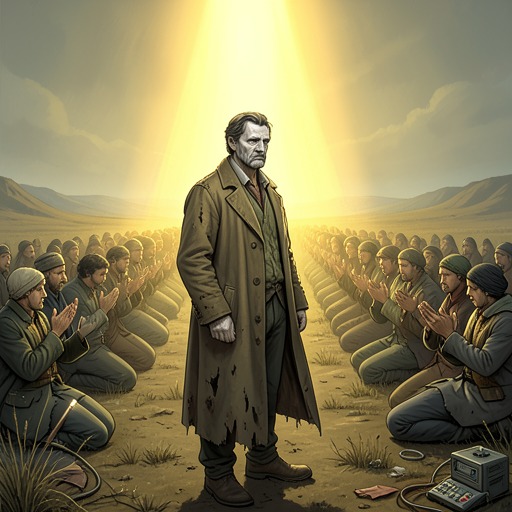
Jonathan smiles when he reaches the sunlit country, a small human response at the end of an immense sequence of sacrifice. Yet the conclusion does not restore him to the society that sent him east. A flash of light appears in the lands westward from Bright Defile, and Jonathan’s shadow stretches from the furthest east to Beacon, where the Illuminated King stands in his tower. For a moment Jonathan becomes a titan capable of bestriding the world before the image disappears.
That final shadow makes the crossing consequential beyond Jonathan’s private fulfillment. His passage into revelation reaches back toward the institutional center that dismissed or controlled the truth he sought. The Illuminated King remains in Beacon, but the light now casts Jonathan’s presence across the human lands. The expedition’s apparent quest for a lost fact thus ends as a transformation of scale: Jonathan does not merely find sunlight; he becomes, briefly and symbolically, an event visible to the civilization that denied it.
The crossing also gathers the book’s recurring tensions into one irreversible value shift. The darkness that once defined safety, law, and human belonging is left behind; truth, freedom, and direct contact with the sun replace them. The gain is immense, but it is purchased through the loss of nearly every former connection. Jonathan’s triumph is therefore neither a simple return nor a conventional reward. It is an ascension achieved by subtraction, in which the explorer reaches the desired world only after making himself unable to go back.