Kōhōgun
Chasing SunlightThe Lux Guards are the Illuminated King’s elite protective force and the most visible military extension of his authority beyond Beacon. They accompany Antomine on Jonathan Heights’s eastern expedition, where their discipline, unusual resilience, and dependence on the kingdom’s light-based order make them both valuable escorts and evidence of the monarchy’s obscure power over human life.
Nature and Service
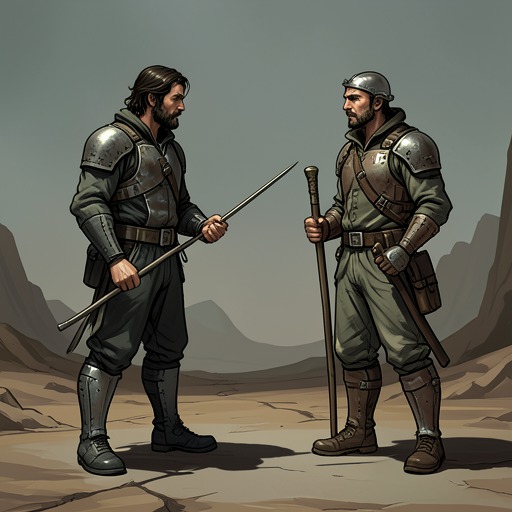
The Lux Guards appear as a guarded detachment assigned to Antomine, whose role combines chaplaincy, Inquisition authority, linguistic training, and expertise with zint weaponry. Their presence is not ornamental: they are expected to protect the royal agent during a journey lasting many months and extending beyond the settled human world. At Danby’s Point, where human civilization meets alien powers and the Inquisition is simultaneously strongest and weakest, the guards remain behind Antomine as he enters territory defined by unfamiliar races, architecture, and political danger.
Their service also places them within the Illuminated King’s larger project of extending human security into the darkness. The royal regime presents itself as a defender of humanity against corruption and alien influence, while Antomine repeatedly frames that defense as a duty to those who will come after. The guards therefore function as instruments of containment as much as bodyguards: their assignment links the expedition’s private search for sunlight to the crown’s public effort to control forbidden knowledge, frontier contact, and threats moving westward.
Unusual Constitution
The guards’ most important distinction is their unexplained immunity to the mental assault encountered in the abandoned city. When the stolen luminiferous gems blaze in Antomine’s hands, the suicidal pressure afflicting the others recedes, but the Lux Guards had not been affected in the first place. Jonathan Heights suspects that the Illuminated King has touched and altered them, and concludes that their lives may no longer be theirs to spend. This suspicion turns their apparent strength into something morally ambiguous: protection may have been achieved through the removal or transformation of ordinary human autonomy.
Their bodies confirm that suspicion during the Umbraught attack at Angkor Leng. After the guards and airmen fight off the attackers, one injured guard is carried aside while Antomine refuses the ship’s doctor and asks Jonathan for privacy. Beneath the damaged armor, the figure is not quite human but appears to be made of colored wax, with a face shaped as though formed by hand. Liquid zint leaks from a crack in the glossy jaw and temple, and the injury produces neither ordinary blood nor ordinary pain. Antomine reseals the wax and presses his softly glowing inquisitor’s seal to the guard’s forehead, but the procedure shows no visible effect.
The revelation changes the meaning of every earlier appearance. The Lux Guards are not simply exceptionally trained soldiers protected by armor; they are manufactured, transformed, or otherwise sustained beings whose relationship to zint and the Illuminated King differs fundamentally from that of the expedition’s human crew. Their altered bodies also mirror the Umbraught in an unsettling way: both groups possess forms that challenge ordinary definitions of humanity, although the guards serve the light-based civilization that the Umbraught threaten. The distinction between civilized defender and inhuman danger is consequently less secure than the Inquisition’s rhetoric suggests.
Combat Role and Operational Limits
At Angkor Leng, the Lux Guards serve as a compact defensive force rather than as an independent army. When Antomine prepares to move the Endeavor into the ancient hangar, he asks Jonathan Heights for men to establish a perimeter and specifically orders that the guards use no zint, only cold steel. The restriction reflects the danger of operating among poorly understood machinery and alien light, while also placing the guards within Antomine’s broader effort to control every source of illumination that might expose the expedition. Their assignment is therefore practical and restrictive at once: they must secure the ship, but they must do so without relying on the very technology around which the kingdom’s power is organized.
Conflict with the Umbraught and the Limits of Protection
The guards’ operational value is tested when Umbraught attack the expedition inside Angkor Leng. The creatures’ luminous spheres expose the danger of using ordinary zint in their vicinity, so Antomine orders the attackers’ lanterns crushed rather than merely driving the bodies away. Jonathan Heights and Eleanor McAvey help overpower the assailants, while the Lux Guards fight alongside the airmen; one guard is badly damaged and another carries him from the battle. The victory is costly even though no human injury is immediately fatal: the airmen suffer cuts, sprains, bruises, and broken limbs, while the surviving guard’s condition requires concealment and specialized attention. When the Umbraught’s light is destroyed, their bodies begin to fade, suggesting that their existence is incompatible with the zint-based order the guards defend. Antomine then concludes that an Umbraught nest must be purged before the creatures can learn to hunt human illumination and move westward, but Jonathan refuses to divert the expedition into a full survey and cleansing of Angkor Leng. The disagreement reveals the guards’ larger limitation: they can protect a royal agent and secure a perimeter, yet they do not give the Inquisition the resources to impose its preferred order across the eastern ruins. Their presence embodies the kingdom’s reach, but the damaged guard, the uncertain machinery, and the surviving Umbraught all expose how fragile that reach becomes beyond human territory.
Political and Thematic Significance
The Lux Guards make the Illuminated King’s authority physically present within an expedition that Jonathan Heights otherwise treats as his own undertaking. They are attached to Antomine, whose mission is to safeguard royal interests in the search for sunlight, and their presence turns a voyage of exploration into an extension of state surveillance and religious enforcement. The crown’s interest is not limited to recovering a useful source of illumination: the Illuminated King has heard that Jonathan found sunlight, wants the matter investigated, and sends an agent to protect his interests. The guards therefore stand at the junction of knowledge, coercion, and technological power. Their bodies and abilities suggest that the monarchy’s claim to defend humanity may depend on remaking human beings into instruments that no longer possess ordinary human vulnerability or independence.
Their role is especially revealing at the frontier. At Danby’s Point, human light reaches its eastern terminus beneath a zint-illuminated tower, while alien construction and nonhuman populations press against the human settlement. The great gate dividing the plateau does not preserve a pure human sphere: influence passes in both directions, drawing distant alien spires into straighter forms while the nearby human world becomes entangled with the shapes and customs it seeks to contain. The Lux Guards belong to the force that attempts to hold this unstable boundary, but the expedition repeatedly demonstrates that the boundary is neither natural nor secure. Antomine regards the Umbraught as a threat that must be purged before it can travel west, whereas Jonathan Heights rejects the demand to cleanse an entire city because the expedition lacks the time and resources. The guards can accompany an inquisitor into forbidden territory, yet they cannot make the frontier conform to the doctrine that produced them.
This tension also complicates the language of civilization and darkness. Antomine insists that humanity belongs to the light and that dangerous knowledge must be purged; later, in confronting Ukari, he argues that humans can bend darkness to their purposes and that walls place borders upon it. The Lux Guards are the embodied counterpart of that claim. They are supposedly defenders of human order, but their waxen constitution places them close to the very category of altered, inhuman beings that the Inquisition condemns. Their immunity to the death-inducing pressure in Angkor Leng further implies that the kingdom’s light has not merely protected them but has changed what they are. When Jonathan Heights reaches Bright Defile and experiences the sun’s warmth, freedom, and truth, the guards are absent from the final movement toward revelation. The ending consequently leaves their order behind with the Illuminated King’s walls: powerful enough to project a shadow across the world, but unable to determine what humanity becomes when it encounters a reality beyond the light it controls.