Light of civilization
Chasing SunlightLight of civilization is the central practical and ideological force of the human world: an artificial illumination that turns hostile darkness into habitable space while presenting human order as a moral light opposed to savagery. It is embodied in Beacon’s machinery, the Inquisition’s discipline, fortified settlements, trade, maps, and the codes carried by expeditions, but the narrative also exposes its limits. The farther Jonathan Heights travels from human territory, the more clearly civilization appears not as a universal truth but as a contested system of power, knowledge, and belonging.
Material Light and Human Habitation
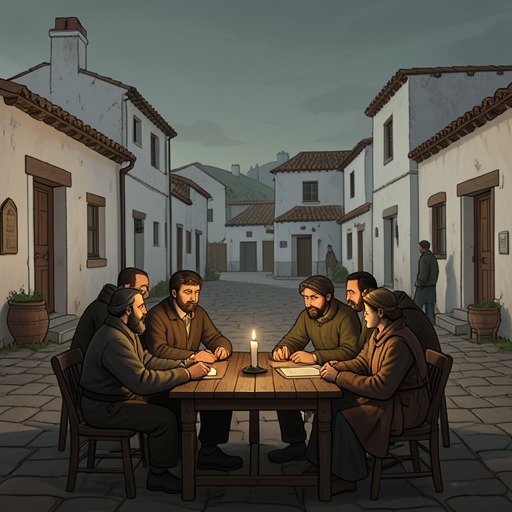
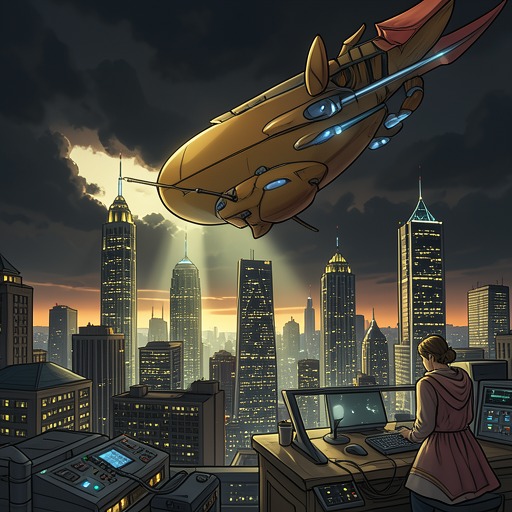
Light of civilization is first experienced as infrastructure. Beacon is a city of white stone, bright lights, and deep shadows, with Zint-light spread throughout its streets and with the accumulated soot of earlier torches and gas lamps still being scrubbed from some districts. Its technology and machinery support thousands of inhabitants and make organized urban life possible, yet Jonathan Heights distrusts the city’s illumination. He depends on its inventions, but the light seems dishonest to him because it is manufactured rather than naturally revealed; the lethal darkness outside the walls feels more truthful, and only sunlight appears to illuminate honestly.
The same principle governs the frontier. At Danby’s Point, the illuminated track reaches its eastern terminus beneath a tall Zint-lit tower built into bruised-purple rock. Human civilization occupies one side of a plateau, its blue-white light climbing toward a summit where it competes with the colored illumination of other races. The settlement is therefore not merely a safe outpost but a visible boundary between systems of life and authority. The Inquisition is strongest there because it controls the human side of the border, and weakest there because trade makes sustained contact with nonhuman powers unavoidable.
The Endeavor’s departure makes the dependence explicit. Once the airship leaves Danby’s Point, its own spotlights are soon the only illumination available, revealing the turgid green waters of the Khorus River while the surrounding world disappears into blackness. Antomine describes this condition as the nature of the world: only the light of civilization renders it habitable, while everything beyond it is dark savagery better left untouched. His formulation turns a technological fact into a doctrine. Light does not simply help humans survive; it divides the world into the protected realm of civilization and the threatening remainder.
Borders, Trade, and the Production of the Other
At Danby’s Point, civilization’s light is also a mechanism for organizing difference. A great metal gate under intense Zint light separates the human part of the plateau from territory claimed by darker forces. Yet the boundary does not seal the two worlds apart. The twisted eastern spires become straighter near the wall, while the human constructions are themselves pressed against and altered by nonhuman influence. The border is therefore reciprocal: each side reshapes the other even while human authority presents the gate as a defense against contamination.
The inhabitants beyond the gate are described through the uneasy categories produced by human perception. The Fractured wear clothing that subtly mocks human finery, but their bodies continually change: faces shift from angle to angle, limbs appear to skip across intervening space, and hands gain or lose fingers within seconds. Tarfolk, by contrast, are black, many-limbed forms with unsettlingly human eyes, ranging from creatures as small as Penelope to immense beings that barely fit the category of living things. These contrasts show civilization’s classificatory impulse at work. The unfamiliar is first rendered as threat, distortion, or savagery, while its strangeness is measured against a human norm.
Trade complicates that hierarchy. Jonathan Heights warns Antomine not to insult the hosts because the inhabitants of Danby’s Point may refuse to trade, and the human presence there depends on the very contact it tries to contain. He meets Tiuni, a Fractured information broker, before venturing beyond human lands. In exchange for human literature, including books she finds especially desirable, Tiuni provides intelligence about the Thrantin, caravan movements, beasts, and the shifting routes of the Verdant Expanse. Her knowledge narrows the expedition’s possible paths and becomes indispensable to Jonathan’s planning. Civilization’s maps and paperwork therefore rely upon information obtained from beyond civilization’s own borders, even as the people who supply that information are treated as alien or dangerous.
This dependence also reveals a form of imperial knowledge production. Jonathan travels east, names routes, copies maps, negotiates access, and turns local intelligence into an instrument for further exploration. The human world claims to bring order into wilderness, but its ability to move through that wilderness depends on trade, translation, and the expertise of communities it does not regard as equal. Light thus marks not only protected space but the reach of human administration into spaces that remain materially and culturally outside it.
Civilization as Moral Doctrine
Antomine gives Light of civilization its clearest theological expression. When Jonathan insists that the expedition must make concessions to the hazards beyond Beacon, Antomine rejects the idea that distance from human walls permits a relaxation of standards. Civilization, in his view, travels with its people. Moral strictures and codes of behavior remain present in the expedition, and what separates humans from beasts and inhuman monsters is located in the heart and soul rather than in the surrounding environment. He identifies the travelers with the declaration, “We are the light in the darkness.”
For Antomine, carrying the light farther into the dark is an ethical obligation rather than an optional convenience. He argues that civilization is built by doing more than the minimum required to survive, because every present action can make life easier or harder for those who come after. This principle explains his insistence that the Umbraught threat at Angkor Leng cannot simply be ignored because pursuing it would inconvenience the expedition. Jonathan objects that the Endeavor is not a navy and lacks the time and resources to survey and cleanse a city the size of Angkor Leng. Their dispute places two versions of civilization against each other: Antomine’s expansive duty to future human communities and Jonathan’s narrower obligation to reach sunlight.
Jonathan is not persuaded by Antomine’s doctrine, but he recognizes its usefulness. The inquisitor’s faith appears pale and inadequate beside the sunlight Jonathan believes he has encountered, yet it still gives Antomine the resolve to act beyond the protection of Beacon. The disagreement is consequently not between civilization and barbarism in any simple sense. It is between competing claims about what civilization demands: restraint and purpose in Jonathan’s expedition, or intervention and obligation in Antomine’s religious politics.
Frontier Settlements and Unstable Light
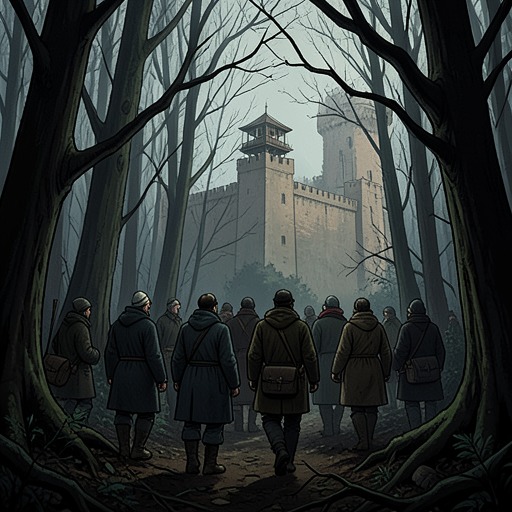
The farther east the Endeavor travels, the less stable the category of civilization becomes. After repairs and shortages have already exposed the expedition’s dependence on supplies, a vein of terrestrite reveals an apparently impossible settlement in the wilderness. Walls, mooring towers, streets, and bright lights announce Terminus as an outpost of human infrastructure surrounded by darkness. Its existence seems to contradict the expected boundary between civilization and the wild, and Jonathan’s lack of immediate suspicion becomes suspicious in itself. The settlement’s hospitality and order function as a temptation, and he concludes that the trap’s purpose is malign whether its appearance is natural or artificial.
Terminus presents a gentler image of the same ideal. Green and blue vines climb its lampposts, street signs are carefully engraved, pedestrians greet one another, and families move through the streets. The sight reminds Jonathan of time spent with his father before his long expeditions, briefly connecting civilization’s light with domestic continuity rather than military or religious authority. Yet this promise of ordinary life cannot overcome his distrust. The apparent safety becomes part of the danger, and the settlement’s orderly illumination is revealed as something that must be tested rather than accepted.
Ukaresh offers the inverse model. Its towers are the eastern dark mirror of Beacon, but it has no central light and no wall separating the city from the surrounding darkness. Its subdued radiance merges with trees, mushrooms, and the landscape, so that the city seems to grow from nature instead of standing against it. Buildings of myceliplank, slanted stone, and glowing black wire crowd together, and some structures can raise themselves on stilts and move. Antomine sees this mingling of civilization and untamed land as madness, while Jonathan warns that the people of the east regard western civilization with equal hostility.
Ukaresh is not without order. Its streets contain beings of many forms, linked by ramps, elevated walks, and tunnels, and its many kinds of light cast shadows in different shades across the stone. The city is clean because Ukari will not tolerate anything else, and violence that threatens to expand beyond a personal dispute is suppressed with murderous enthusiasm. Its order is therefore neither the protected, moral order Antomine imagines nor simple lawlessness. It is a power-based urban system that recognizes few laws beyond strength, making it a direct challenge to the western assumption that civilization must be centralized, walled, uniformly illuminated, and human.
Limits and Significance
Light of civilization gives the expedition its practical means of survival, but the narrative repeatedly separates usefulness from truth. Beacon’s lamps power human life while seeming false to Jonathan. Danby’s gate contains contact without preventing mutual transformation. Terminus offers safety so convincing that it becomes suspect. Ukaresh demonstrates that complex urban order can exist without the walls, central light, or human identity that western civilization treats as defining. In each case, artificial light illuminates a social arrangement while leaving its hidden motives and exclusions unresolved.
The concept also organizes the book’s political tensions. Under the authority of the Illuminated King and the Inquisition, light is linked to human supremacy, regulated knowledge, trade control, and the policing of forbidden frontiers. The eastern peoples and their cities are repeatedly framed as dark, twisted, or savage, yet the expedition cannot proceed without their markets, intelligence, infrastructure, or negotiated cooperation. Civilization’s claim to self-sufficiency is therefore exposed as a fiction sustained by frontier dependence.
Jonathan Heights’s pursuit of sunlight provides the decisive counterpoint. He does not reject civilization’s tools; he travels in a Zint-powered airship, relies on human machinery, uses maps and paperwork, and carries supplies purchased in Beacon. What he rejects is the assumption that artificial light is equivalent to revelation. Antomine believes that civilization must carry its light into darkness, whereas Jonathan seeks a light that would make the entire inherited order appear provisional. The resulting tension makes Light of civilization both a survival technology and a contested myth: the shield that permits humanity to endure, and the ideology that claims the darkness exists chiefly to be mastered.