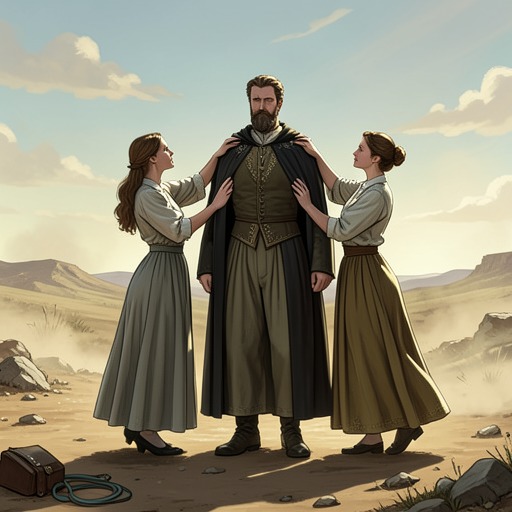
Marie
Chasing SunlightMarie is Eleanor McAvey’s tall, fair-haired maid, but the apparent modesty of that role disguises a capable and repeatedly tested expeditionary operative. She travels with Eleanor aboard the Endeavor, participates in armed confrontations, survives serious injury, contributes technical and tracking skills, and remains with the expedition as its human members cross increasingly hostile boundaries. Her characterization depends on the tension between servant-like discretion and the lethal competence that repeatedly breaks through it.
Identity and Introduction
Marie is first presented as one of Eleanor McAvey’s attendants rather than as an independently prominent figure. She and Sarah appear in the clothing and manner of maids, and both are described as impeccably groomed, forgettable, and almost as faceless as Antomine’s guards. Yet their polished servant personas carry a telltale aura of danger. Marie is the tall and fair member of the pair, while Sarah is shorter and dark-haired; their contrasting appearances make them distinguishable even though Antomine initially sees no visible difference between his own two guards. Eleanor identifies the women by name, and the exchange of names between the two groups gives the scene a strangely childish surface, one that Jonathan Heights immediately recognizes as misleading because the apparent attendants are prepared for violence.
Marie’s position is therefore defined by concealment. She is close enough to Eleanor to supervise cargo and accompany her through public and private spaces, but her real usefulness is not announced through rank or uniform. The maid’s dress functions as camouflage, allowing her to pass as part of the ordinary machinery of a noblewoman’s household while preserving access to the dangerous work surrounding Eleanor. Even Jonathan, who distrusts the secrecy around Eleanor’s companions, recognizes that there are many ways for such women to be lethal.
Combat and Injury aboard the Endeavor
Marie’s concealed capability becomes explicit during the attack on the Endeavor. While combat erupts through the stairwell, she remains in her maid’s dress but arms herself with a brace of long black stilettos. Her response is immediate and disciplined: when Jonathan signals toward the fighting below, she acknowledges him and disappears down the stairwell on silent feet. The movement establishes her as an active defender rather than a protected passenger, and it also contrasts her quietness with the noise and confusion of the assault.
The battle exposes both her effectiveness and her vulnerability. Weaponized zint burns through crates, an intruder in an ornate wingsuit attacks with a hooked boarding-pike, and Eleanor strikes from concealment while Sarah shields Marie from zint-gun fire with improvised piping. Marie is wounded by shrapnel from a zint grenade, with blood staining her right side as Jonathan helps her to her feet. Her injury is substantial enough for him to ask whether she needs a doctor, but it does not remove her from the expedition permanently. Eleanor later takes Jonathan’s place beside her as they approach the stair, while the wounded Marie is protected during the continuing exchange of fire.
The scene gives Marie a distinct form of courage: she is not invulnerable, and the narrative does not treat her as a merely decorative extension of Eleanor’s household, yet injury does not erase her agency. Her presence in the fight helps defend the ship, and her survival has practical consequences for the expedition’s timetable. When Eleanor later returns to the Endeavor after Marie has been sent away for treatment, Marie’s absence is explained as convalescence in a better-equipped place rather than abandonment. After medications retrieved in Autochthon Reach aid her recovery, she returns with enough strength to rejoin the ship. By the Endeavor’s departure from Autochthon Reach, she is present in the observation room despite wearing numerous bandages beneath new maid garments—a recovery Jonathan regards as nearly miraculous given the deadline he had imposed.
Operational Skills and Expeditionary Use
Marie’s value to the expedition extends beyond close combat. After recovering sufficiently to return to the Endeavor, she resumes the controlled, inconspicuous service expected of Eleanor McAvey’s maid while remaining available for tasks that require unusual competence. During the journey through the eastern territories, she and Sarah lead the human party through dark streets with zint lanterns, apparently tracking a missing crewman across bare stone without the ordinary signs Jonathan Heights would expect. Jonathan cannot explain how they follow the trail, and the mystery is presented as part of the Reflected Council’s habit of gathering people with exceptional and unfamiliar abilities. Marie’s skill is therefore practical but not fully legible to him: she can perform work essential to the expedition without making its method visible.
That capacity becomes especially important when the search leads into an apparently ordinary building. Jonathan is reluctant to cross the threshold because the stolen luminiferous gems and the hidden crewman have drawn the party into an environment where danger may remain concealed behind walls and around corners. Marie’s tracking, however, brings the group to the location, allowing the pursuit to continue despite the absence of obvious physical evidence. Her competence changes the balance between Jonathan’s caution and the expedition’s need to act. She does not command the investigation, but her ability to locate what others cannot see makes her one of the operational figures on whom the group depends.
Marie also contributes through ordinary technical labor, a detail that prevents her servant persona from being reduced to camouflage alone. In the overheated interior of the Endeavor, she uses a screwdriver to work at a vent, trying to force more air into the room while Eleanor McAvey stands nearby without her greatcoat and fans herself. The gesture places mechanical improvisation beside domestic service: Marie may repair clothing with needle and thread while aboard the ship, but she can also intervene directly in the vessel’s failing circulation. Her work remains quiet and utilitarian, yet it repeatedly supports the expedition’s survival in conditions where rank, force, or formal authority cannot solve the immediate problem.
Persistence within the Expedition
Marie’s recovery does not restore a simple return to domestic normality; it enables her to remain a useful presence as the Endeavor moves through environments where the distinction between passenger, servant, and operative continually breaks down. When Captain Montgomery prepares the ship to leave Autochthon Reach, Marie is already back aboard, her injuries concealed beneath new maid garments and a conspicuous number of bandages. Her attendance in the observation room during the departure registers both the cost of the earlier attack and the urgency of the expedition: she has not fully healed, yet she has returned in time to leave with the group. The decision places her body within the expedition’s timetable rather than treating convalescence as a reason to remove her from its dangers.
Her continued presence also preserves Eleanor McAvey’s protective and operational network. Marie travels with Sarah and the rest of Eleanor’s party into territories marked by nonhuman populations, unfamiliar laws, and physical threats that make the performance of ordinary service increasingly precarious. At one stage, the two women lead the group through darkness with zint lanterns; at another, they move armed through the halls of Ukaresh, where their visible strain and unfamiliarity mark them as potential prey. When airborne creatures descend upon them, both maids ready their pistols, and later Marie advances only to the threshold of Bright Defile while Sarah withdraws into darkness. These moments show a disciplined relationship to danger: Marie neither mistakes courage for immunity nor abandons her role when the expedition reaches a boundary that most of the crew refuse to cross.
The contrast between Marie and the more hesitant members of the Endeavor becomes especially clear at Bright Defile. Montgomery, Marie, and much of the crew remain at the threshold, drawing what knowledge they can from a minute exposure to the place, while Jonathan Heights, Antomine, and the Lux Guards proceed farther. Marie’s restraint is not presented as cowardice. She squares her shoulders, looks into the defile, and betrays no eagerness to move ahead, making her one of the figures who recognizes that survival may require accepting a limit rather than pretending that every boundary can be conquered. Her position at the threshold gives concrete form to the expedition’s widening division between those willing to surrender their established place in the world and those still attached to it.
By the Endeavor’s later departure from Beacon, Marie remains within Eleanor’s orbit, though the old disguise has loosened. She and Sarah no longer present themselves as maids, yet they still stand behind Eleanor on the bridge, each carrying a cat on her shoulder as the airship leaves once again. Marie’s trajectory thus ends not with a promotion or a declaration of independence, but with a revealing alteration in how she is seen: the servant identity remains part of her history, while her repeated injuries, armed interventions, tracking work, and endurance have made it impossible to regard her as merely ornamental. She is a quiet specialist whose importance lies precisely in the gap between what the expedition sees first and what its crises compel it to recognize.
Persistence within the Expedition
Marie’s recovery does not restore a simple return to domestic normality; it enables her to remain a useful presence as the Endeavor moves through environments where the distinction between passenger, servant, and operative continually breaks down. When Captain Montgomery prepares the ship to leave Autochthon Reach, Marie is already back aboard, her injuries concealed beneath new maid garments and a conspicuous number of bandages. Her attendance in the observation room during the departure registers both the cost of the earlier attack and the urgency of the expedition: she has not fully healed, yet she has returned in time to leave with the group. The decision places her body within the expedition’s timetable rather than treating convalescence as a reason to remove her from its dangers.
Presence Beyond the Maid Persona
Marie’s role becomes increasingly legible as the expedition moves beyond the social settings in which her disguise is most effective. In Ukaresh, she remains demure and silent behind Eleanor McAvey when the monstrous She-Who-Must-Be-Obeyed examines the human visitors, but the posture is tactical rather than passive. Later, when Marie asks Jonathan Heights where they are, the question marks her awareness of how completely the journey has exceeded familiar geography. She and Sarah then hurry toward the exit with pistols ready, walking beside Jonathan through halls populated by parasitic creatures and other dangers. Their vulnerability as conspicuous outsiders attracts an attack from airborne beings, yet the maids respond as armed participants rather than helpless attendants. Marie’s composure is therefore double-edged: she can perform obedience and anonymity before overwhelming power, then abandon that performance the moment survival requires direct action.
Final Position in Eleanor McAvey’s Circle
Marie’s later appearances confirm that her importance lies in continuity rather than spectacle. She remains attached to Eleanor McAvey’s traveling household while the expedition’s public identities become less stable: in Ukaresh, she and Sarah resume the silent, demure posture of maids before She-Who-Must-Be-Obeyed, but they are plainly armed and alert when the party withdraws through the city’s dangerous halls. Marie’s brief question to Jonathan Heights about their location underscores the disorientation produced by that journey, while her readiness to move toward the exit with a pistol shows that uncertainty does not paralyze her. At Bright Defile, she reaches the threshold, squares her shoulders, and refuses to feign eagerness for a step that would sever the crew from its familiar world. Her restraint is matched by endurance: when the Endeavor later leaves Beacon again, she stands behind Eleanor on the bridge without the old maid persona, carrying Penelope on her shoulder. Marie therefore ends as neither a decorative servant nor an independent adventurer, but as a durable operative whose discipline, practical intelligence, and willingness to recognize danger allow her to remain beside Eleanor McAvey after the expedition has transformed everyone’s understanding of what that companionship requires.