Martin’s Caravaneer Judgment
Chasing SunlightMartin’s Caravaneer Judgment is the expedition’s most explicit negotiation between hospitality, theft, and bodily punishment. After the Endeavor’s return to the caravaneer camp, a stolen statuette places Martin under the camp’s law: he has violated the guesting agreements and forfeited the right to keep his flesh. Jonathan Heights prevents a larger confrontation, but only by accepting a punishment that leaves Martin alive and permanently maimed. The judgment therefore preserves the expedition’s movement while exposing the cold arithmetic by which Jonathan treats obligations, injury, and human life.
The Standoff in the Caravaneer Camp
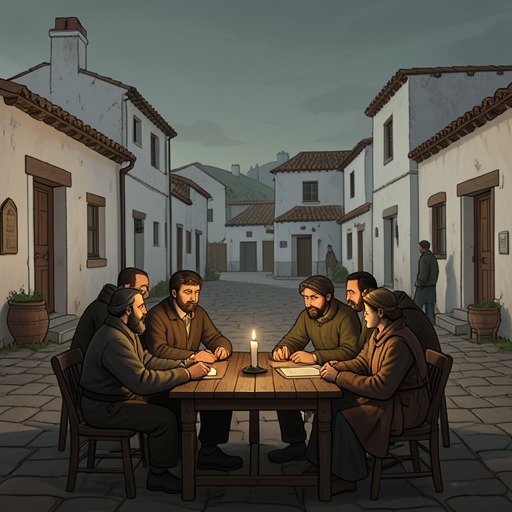
The crisis begins when the expedition discovers that the gondola linking the camp to the Endeavor has been ripped from its vine. Several airmen stand around it with guns, while Eleanor McAvey and her maids face a group of motionless caravaneers. Montgomery moves toward the gondola despite the tension, and an airman strikes a caravaneer’s reaching forepaw with a baton. Jonathan recognizes that violence is close, but also that the dispute cannot be settled without translation, so he addresses the camp in its own clicks and whistles and asks what has caused the disagreement.
The caravaneers answer that they want to take Martin. Their accusation is not merely that he has taken property: they say that the human has stolen, violated the guesting agreements, and sacrificed his rights to his flesh. The wording makes the judgment a matter of communal and contractual law rather than an improvised act of revenge. As guests, the humans are protected by obligations; as violators, they can lose the protection that made their presence safe.
Jonathan does not first ask whether the accusation is true. He understands that a false accusation would expose the accuser to the same dangerous legal position as the accused, and he calls on Antomine to investigate. Antomine’s participation matters because the Inquisition provides an authority capable of determining the immediate fact without forcing the armed groups into combat. Eleanor nevertheless asks whether anything can be done if Martin is guilty, because the expedition cannot simply surrender one of its people without resistance.
Martin’s Theft and the Competing Debts
Antomine returns almost immediately with the evidence: Martin believed that he could spirit away a statuette without being noticed. The object is made of pale blue amber, translucent and shimmering in the ghost-light cast by the caravaneers’ tails. Martin’s offense is therefore concrete, not speculative. He has taken a distinctive local object, and the camp’s demand for redress rests on an established violation rather than on suspicion alone.
Jonathan assumes that Martin was one of the men hired at Danby’s Point and is astonished that Montgomery would have accepted someone of such poor judgment had the captain known his character. Antomine objects that Martin’s stupidity does not make him undeserving of empathy. Jonathan is not wholly indifferent to the airman’s plight, but he refuses to risk anything valuable merely to spare him. The expedition had been warned about the consequences of theft, even if airmen habitually interpreted ownership loosely in foreign ports.
Rather than plead for clemency, Jonathan returns the statuette to the caravaneer who made the accusation and proposes an exchange of debts. He argues that the expedition’s guides led it directly into an entrapping ruin without warning, and that the humans escaped only through their own efforts. This failure, in his account, breaches the guides’ duties as hosts and guards. Jonathan deliberately does not claim credit for rescuing a caravaneer from the ruin, because he understands that the camp would treat leaving the creature behind as a penalty, not the rescue as a favor.
The caravaneer rejects the idea that the expedition’s grievance cancels Martin’s offense. One of the humans, the reptile says, carries forbidden desires, making the situation absolutely untenable. Jonathan answers that this does not absolve the caravaneers of their obligations. The humans are owed their default of flesh because the guides failed to provide services in good faith, but Jonathan offers to trade the two debts and hold the caravaneers’ debt in abeyance for a later time. His proposal is not reconciliation: it is a postponement that he privately imagines lasting until the guards responsible are dead.
The Judgment and Its Bodily Cost
The caravaneer accepts the exchange but declares that the scales remain unbalanced: the camp still requires a pound of flesh. Jonathan then gives the decisive order to Antomine. Martin is to be brought out, and he will live, though he will not be happy. The sentence is framed as a compromise, but its terms are exacting. Jonathan will not surrender Martin to be killed, yet he accepts that the camp must receive a physical payment.
Antomine and his guards drag Martin from the gondola. Jonathan describes him as a ratty-looking specimen whom he certainly would not have hired, though the limited offerings at Danby’s Point may explain how he entered the crew. That contempt does not alter the practical purpose of the judgment: Martin is an expendable member of the expedition whose injury can purchase the safety of everyone else and reopen the route to the Endeavor.
Jonathan tells Martin to consider himself lucky and assures him that he will live. He removes a length of cord, then whistles to the waiting caravaneer. The creature lunges with a flash of scales and jaws, and Martin is left staring at the stump of his wrist where his hand had been. Jonathan immediately wraps the cord around the arm and pulls it tight as a tourniquet before pushing the shocked man back toward Antomine. The order, the amputation, and the first aid form a single act: Jonathan authorizes the punishment, limits it to the agreed bodily price, and takes responsibility for keeping the condemned man alive.
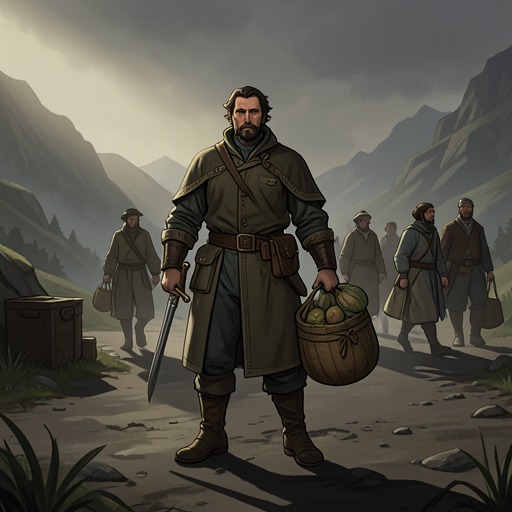
Jonathan then ignores the shocked looks of the others and orders the expedition to retrieve its sleds and leave. The judgment has changed the expedition’s immediate condition from armed standoff to continued travel, but it leaves a permanent mark on Martin and a moral wound within the human group. The caravaneers’ law has been satisfied, the humans’ counterclaim has been deferred, and the expedition proceeds without either side receiving a clean victory.
Jonathan Heights’s Ethics of Survival
The event clarifies the difference between Jonathan’s stated honor and his operative morality. In another confrontation, when Eleanor questions whether he abandoned Stoneface on an earlier expedition, Jonathan violently seizes her by the throat and insists that he betrayed nobody; he says that they were simply unequal to what they discovered. In the caravaneer camp, that same refusal to accept an accusation governs his conduct. He does not allow the camp to define him as a negligent leader, but he also does not pretend that Martin’s theft can be erased by argument.
Jonathan’s solution follows consequence rather than compassion or an absolute prohibition against bodily violence. He weighs the lives and safety of the entire expedition against Martin’s hand, then chooses the injury that permits the greatest number to pass. Yet the judgment is not presented as triumphant pragmatism. His mood turns sour after the amputation, and the shocked reactions of the others remain around him even as he resumes command. The scene makes survival look less like moral clarity than the management of incompatible debts.
The judgment also anticipates later sacrifices in Jonathan’s pursuit of Sunlight. At the final barrier before Bright Defile, he remembers the death of Tiuni, the destruction of Tor Ilek, the sacrifice of Angkor Leng, the loss of his friendship with Eleanor, and his banishment from Ukaresh among the costs that illuminate his path. Martin’s hand is a smaller sacrifice in scale, but it belongs to the same pattern: progress is purchased by treating attachments and bodies as weights that can be surrendered. By the time Jonathan reaches Sunlight, the capacity to make such exchanges has become central to his identity.
Consequences and Narrative Significance
Martin’s punishment exposes the caravaneer guesting agreements as a system that protects travelers only conditionally. Hospitality is reciprocal and enforceable, but the penalty for violating it is not financial restitution or expulsion; it is the surrender of flesh. Jonathan’s negotiation shows that the agreement also contains room for counterclaims when hosts fail in their duties, although the resulting balance is still measured in bodily terms.
The event further establishes Jonathan as both mediator and threat. He prevents the airmen and caravaneers from immediately fighting, speaks across the language barrier, identifies the relevant obligations, and bargains a failure against another failure. But his diplomacy ends in a command that removes Martin’s hand. He does not simply interpret law; he makes himself the instrument through which law is applied, converting the camp’s alien custom into an expeditionary decision.
Its final irony is that Martin survives because Jonathan is willing to permit mutilation. Life is preserved, but dignity, bodily integrity, and the expedition’s claim to civilized conduct are all damaged. The sleds can be recovered and the journey can continue, yet the passage eastward has exacted a visible human cost. Martin’s Caravaneer Judgment therefore functions as a compact rehearsal of the book’s larger moral world, in which every advance toward knowledge and Sunlight demands a payment, and the person who calculates that payment must live with what the calculation makes of him.