Penelope
Chasing SunlightPenelope is the Endeavor’s ship cat and one of the expedition’s most persistent survivors. She moves through scenes of bombardment, funerary ritual, temporal distortion, and cosmic revelation with an independence that contrasts sharply with the human characters’ anxiety. Her importance does not come from speech or conventional heroism, but from action: she survives what destroys people, recognizes when the atmosphere of a scene has changed, touches the board of the Players’ Game, and chooses where to sit when human beings cannot understand what is happening.## Identity and Place Aboard the Endeavor Penelope belongs to the Endeavor’s living community rather than merely decorating it. During the service for the three dead crew members, she remains perched on Captain Montgomery’s shoulder, grooming her wings and regarding the ceremony with what the narration describes as haughty feline grandeur. Her survival has particular weight because she had already endured the bombardment that turned the Endeavor into a wreck before Jonathan Heights paid for its refit, and she came through the later boarding action unscathed. Against the ship’s losses and damage, her continued presence becomes a modest sign that not everything associated with the vessel has been destroyed.
Her status is also shaped by the wider world’s dependence on nonhuman life. The expedition encounters mountain-sized Glacilium carrying Glaciwings, fractured beings whose bodies cannot hold a stable human form, and Caravaneers whose immense tails and alien language make ordinary human categories inadequate. In that setting, Penelope is not a decorative exception to the human cast. She is one of the nonhuman beings through whom the narrative tests human assumptions about intelligence, danger, and belonging. Even the ship cat’s actions are treated as potentially meaningful rather than automatically dismissed as instinct.
Survival and Companionship
Penelope’s survival recurs as a counterpoint to human vulnerability. She remains present after the Endeavor’s wrecking and refit, survives the violence surrounding the ship, and later appears during the expedition’s approach to Bright Defile. When Jonathan Heights senses the nearby sunlight and restrains his impulse to press forward, Penelope trots past him, gives him a haughty look, sniffs the air entering through the broken glass, and sneezes. The gesture is comic, but it also restores an ordinary animal response at a moment when Jonathan is increasingly dominated by revelation and compulsion.
Her companionship extends beyond Jonathan. During the Endeavor’s later departure from Beacon, Dreyfus rests on Sarah’s shoulder while Penelope rests on Marie’s, as Eleanor McAvey’s former maids remain within her orbit despite no longer presenting themselves as maids. The cats therefore help mark a new social arrangement after the previous expedition: human roles have shifted, the ship has a new crew, and the women’s association with Eleanor has persisted, while the animals provide a visible thread of continuity. Penelope’s presence is relational without being domesticated into obedience; she belongs among the travelers while retaining the authority to ignore them.
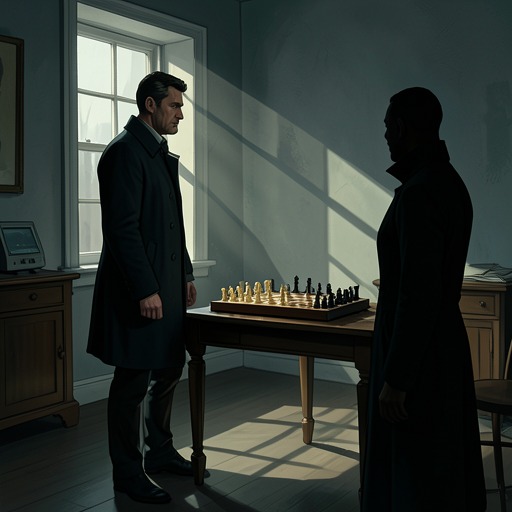
That authority is clearest in the contrast with the dangers that humans attempt to control. When the Endeavor’s fire kills a huge beast during the Verdant Expanse encounter, the Caravaneers immediately tear into the carcass, revealing that polite exchange and savage appetite coexist within the same society. Penelope is not placed on the same scale as the hunted animal, but her presence contributes to the book’s larger refusal to separate civilization cleanly from animal life. She is a companion species within an expedition whose human members repeatedly depend on, fear, exploit, and misunderstand nonhuman beings.## Penelope and the Players’ Game Penelope becomes most mysterious when the Endeavor encounters the Players. Jonathan Heights sees two Players directing a Game whose board has grown enormous on the residue of their presence, and he approaches only after Penelope uncoils from beneath a chair, stretches, and walks toward them. He trusts her judgment enough to use her movement as a practical sign that he should proceed, strengthening his mind and soul with the sunlight within him before confronting the Game.
At the board, Penelope does not behave like a passive observer. While Eleanor McAvey attempts to take Jonathan’s place and is told that she does not yet qualify because she is not yet herself, Penelope reaches out and touches one of the pieces. The piece is simultaneously a small figurine and a massive statue, and her slight nudge produces a realignment across interlocking perspectives and bodies of knowledge. Jonathan looks away to avoid understanding too much and becoming trapped by the revelation. The cat’s paw thus causes an effect that the human characters cannot safely reproduce through will or intellect.
The Players refuse to explain her eligibility in human terms. When Eleanor protests that Penelope has been allowed to interfere with the Game despite being denied a turn, the answer is simply, “Cats are cats,” as if that statement were sufficient. The line makes Penelope a threshold figure: she is excluded from the human qualification demanded by the Game, yet her nonhuman status grants her a freedom or opacity that Eleanor lacks. She cannot be reduced to a contestant, but neither is she outside the Game’s reality. Her intervention exposes the limits of systems built around human knowledge and ambition.
Penelope’s later conduct reinforces this independence. After altering the board, she saunters away with feline self-possession and curls up on Antomine’s chair. Her movement dismisses the cosmic encounter without explaining it, and the Players’ answer treats her nature as its own justification. In narrative terms, she acts as a trickster-like companion and an animal threshold guardian: she opens a path toward the unknowable, then refuses to translate what she has done for the humans who witnessed it.
Reunion with Dreyfus
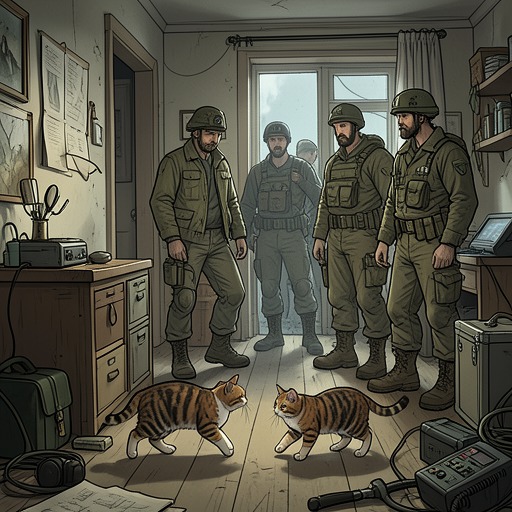
At the wreck of the Discovery, Penelope encounters another ship cat, Dreyfus, who has survived the attack and years of abandonment. A frantic meow precedes the ragged tortoiseshell tom’s arrival through the open hatch. Penelope and Dreyfus face each other in a brief standoff, their ears twitching and low growls surfacing, before Penelope sneezes and walks away. Dreyfus follows her and immediately forms an attachment to Sarah, jumping into the surprised maid’s arms.
The scene turns survival into recognition without sentimentalizing it. Dreyfus is proof that the Discovery’s destroyed expedition has left behind a living remnant, while Penelope represents the Endeavor’s continuity through its own disasters. Their confrontation is not resolved by human command; Penelope simply ends it by departing, and Dreyfus chooses to follow. Jonathan cannot explain how Dreyfus remained alive for so long, and concludes that the explanation matters less than the fact of his return. The cats’ reunion therefore does what the human expedition often cannot: it acknowledges the past without making it fully intelligible.
The two cats also reshape the expedition’s emotional texture. At the next departure from Beacon, Dreyfus and Penelope travel on Sarah’s and Marie’s shoulders respectively. Their paired presence turns the animals into bearers of memory and companionship, carrying traces of two ships into a new journey. The Discovery is a derelict vessel associated with catastrophe, while the Endeavor continues onward; the cats allow that opposition to coexist rather than being resolved through a simple victory over the past.
Narrative Significance
Penelope’s significance lies in the way the narrative grants an animal consequential agency without converting her into a talking human or an explanatory supernatural guide. She does not offer theories about the Players, the Game, sunlight, or the eastern world. Instead, she reacts: she watches a funeral, approaches the cosmic board, moves a piece, chooses Antomine’s chair, sniffs the air near Bright Defile, and leaves one cat encounter on her own terms. These small acts become legible precisely because the humans around her are reaching the limits of ordinary comprehension.
Her behavior also provides a recurring contrast to Jonathan Heights’s transformation. Jonathan increasingly treats the sunlight within him as a source of strength and moves toward Bright Defile by sacrificing possessions, relationships, and former identities. Penelope, by contrast, remains materially and behaviorally consistent. She does not need to renounce a past or prove herself through revelation; her continued cat-like independence survives beside Jonathan’s attempt to shed every attachment. When Jonathan later gives up his cane, his links to Eleanor, and his refusal of the Players’ Game in order to cross the final barrier, Penelope’s earlier intervention remains an alternative model of relation to the unknown: not mastery, not surrender, but alert participation without explanation.
For that reason, Penelope quietly complicates the expedition’s hierarchy of knowledge. Human explorers chart mines, ruins, oases, caravans, and sources of terrestrite; Jonathan bargains in secrets; Antomine attempts to capture sunlight; and the Players organize knowledge into a Game. Penelope needs none of these systems to act effectively within their consequences. Her presence suggests that the world’s deepest forces may be encountered through attention, timing, and embodied instinct as much as through scholarship or power. She is the ship cat, but she is also the expedition’s recurring reminder that the nonhuman world is not merely scenery surrounding human discovery.