Pits of the Condemned
Chasing SunlightThe Pits of the Condemned are the deepest and most disturbing underworld of Ukaresh: a restricted place where living beings are confined, traded, and held at the pleasure of powers strong enough to exclude them even from that city’s famously permissive society. The Pits embody Ukaresh’s unstable blend of commerce, violence, and power, but they also become the point at which Jonathan Heights’s attempt to exploit forbidden knowledge unleashes the Black Garden and destroys the Pits’ function as a controlled prison.
Nature and Position within Ukaresh
The Pits are one of the few locations in Ukaresh that openly trade in living beings. Those sent there are generally creatures who have provoked the ire of the truly powerful, either by displaying an appetite too destructive to tolerate or by possessing a temper too unruly to leave at large. Their confinement therefore reflects Ukaresh’s governing principle: the city recognizes few laws except power, yet even a society that permits extraordinary freedom maintains an ultimate boundary around threats capable of destabilizing it.
The route to the Pits passes through Ukaresh’s shifting subterranean infrastructure. Stone and metal tunnels force inhabitants through cramped passages beneath the city, while sudden violence breaks out between beings that prey upon one another or allow disagreements to reach lethal conclusions. Jonathan bypasses these hazards and descends toward the Pits, entering a domain separated from ordinary urban life not by moral purity but by a more concentrated form of coercion. The Pits are a market, a prison, and a place of political disposal at once.
Architecture and Atmosphere
Deep beneath Ukaresh, the Pits open into a vast, hushed space of arched galleries extending in every direction. Flickering torches burn with chalk-white wood that never seems to be consumed. Broad holes gape in the uneven brick floor, appearing as voracious mouths that swallow light and sound and conceal whatever lies below. The architecture is ancient, worn, and repeatedly defaced by engravings of the same long face, whose gouged-out eyes watch from every intersection.
The enforced quiet makes the place more disturbing than open cries would have been. A faint, pervasive music moves through the galleries, stately and soothing despite its uncanny source. Even the sound of Jonathan’s cane is muffled, refusing to echo from the worn bricks. Every turning looks identical except for the stairway upward, so Jonathan memorizes the route rather than trusting the Keeper of the Pits to guide him safely. The space thus defeats ordinary orientation as thoroughly as it suppresses ordinary sound: it is a labyrinth designed for custody, secrecy, and controlled movement.
The Keeper and Jonathan’s Purchase
The Pits are administered by the Keeper of the Pits, a grotesque composite creature whose body combines limbs and features from numerous forms of life. It emerges from an enormous steel barrel containing an eldritch engine, with pipes venting steam and sound from its metal torso. By the time Jonathan encounters it, the Keeper has acquired another head and neck, including bulging eyes and a mouth sewn shut, while several other heads produce a harmonized welcome. Its appearance is repellent, but its music is unexpectedly pleasant, creating the Pits’ characteristic union of aesthetic attraction and physical horror.
The Keeper is not presented as a moral guardian. It possesses its own limited integrity, but Jonathan considers it trustworthy only to the extent that it keeps and delivers its merchandise. Those who enter its domain do so at their own peril. Its role is commercial and custodial rather than judicial: it preserves the condemned until someone with sufficient authority or payment claims them.
At one pit, the Keeper illuminates a creature with stripes of every color and a markedly feline cast, though its eyes and jaw carry a cruel distortion. The being appears nearly frozen under the effect of the Keeper’s music, which soothes rather than eliminates its savage nature. The Keeper emphasizes that the creature is old, heavy, large, and responsible for killing many other things. Jonathan recognizes the weight of its presence and the suggestion that it understands profound secrets. He purchases it for his purposes but leaves it in the Pits because neither the Endeavor nor any lodging in Ukaresh could safely contain it. The location therefore functions as temporary storage for a danger Jonathan intends to deploy later.
The Black Garden’s Eruption
Jonathan returns to the Pits with Eleanor McAvey after she has been exposed to a fundamental aspect of reality and placed in a state of uncontrolled awareness, bloodlust, and hunger for knowledge. He requires that exposed state because he believes it will allow her to perform the dark miracle associated with the Black Garden. As they descend the long ramp, Eleanor moves fearlessly among the arches and looks over the edge of a pit as though she can sense knowledge available for harvesting. The solemnity of the place does not restrain her, and the Keeper’s music is the only interruption strong enough to break her concentration.
Jonathan’s plan changes when he releases sunlight from within himself. The radiance suppresses the Black Garden’s original dark vines and crimson appetite, but it also allows the Garden to perceive and incorporate the light. Its nature shifts from blackness toward something greener and more expansive without becoming less consuming. The transformation passes through Eleanor and reaches the source of the secret itself, joining Jonathan’s sunlight to the Garden in a form neither of them understands.
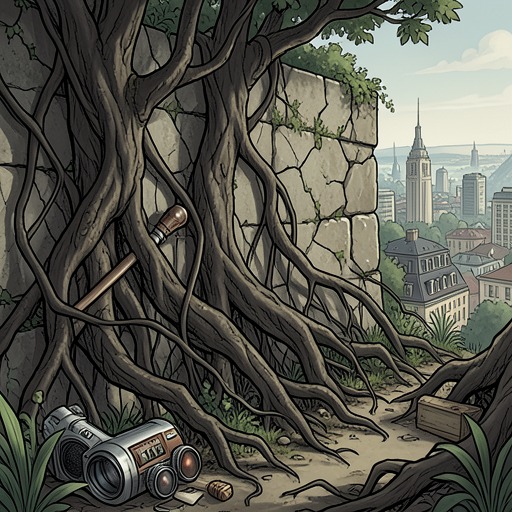
The result is not a controlled miracle but an eruption. The Black Garden bursts into the Pits, and something claws its way out through Eleanor to bathe in the radiance of Jonathan’s memory. Jonathan and Eleanor remain protected, but the rest of the underground complex does not. The Keeper reacts with confusion and amusement as two woody limbs grow from its metal barrel; then the barrel bursts apart, a blood-slick trunk drives upward, and roots crack through the stone floor.
Hundreds of trees rise from the pits, one from each opening. Eleanor screams and bleeds from her eyes, tongue, and nails while the galleries tremble around her. The Garden’s growth pierces the ceiling, shakes the ground, and sends fragments of stone raining into the prison. Jonathan finally withdraws the sunlight, but the change has already escaped his control. He drags Eleanor toward the staircase and flees, leaving the Black Garden to continue expanding through the Pits.
Consequences and Significance
The eruption reverses the Pits’ defining logic. They had been a place where dangerous life was confined by Ukaresh’s power and reduced to merchandise under the Keeper’s supervision. The Black Garden abolishes that containment: every pit becomes a point of growth, the Keeper’s engineered body is torn open, and the ancient architecture becomes a structure being invaded from within. A space built to hold the condemned becomes an active organismic force that can no longer be treated as a market or prison.
The final image of the escape is especially important. Just before Jonathan reaches the staircase, he sees one of the identical defaced engravings—and the long face is smiling. The image turns the Pits’ repeated architecture into something more than background. Its apparently fixed, exhausted, and watchful surfaces have registered the transformation, suggesting that the place’s ancient history is implicated in the Garden’s arrival or at least capable of responding to it. The Pits therefore mark a threshold between forbidden knowledge as a commodity and forbidden knowledge as an ecological, bodily, and architectural catastrophe.
Their significance also lies in the contrast between controlled illumination and uncontrolled growth. The torches, the Keeper’s music, and the ordered repetition of the galleries create an artificial system for managing dangerous beings. Jonathan’s sunlight, by contrast, is authentic and revelatory, but its contact with the Black Garden produces a new form of consumption rather than simple purification. In the Pits, the novel makes that contradiction physical: illumination can expose and destroy, yet it can also feed transformation. The location is consequently both the prison where Jonathan stores a weapon and the place where his confidence in mastery collapses.