Pursue and execute Robert Masterson
Chasing SunlightThe pursuit and execution of Robert Masterson is a decisive episode in the Endeavor’s eastern expedition: a practical act of recovery becomes a political confrontation and then a private killing. Masterson’s death removes the immediate saboteur, but it also exposes the expedition’s moral fracture. Jonathan Heights treats opposition to his search for sunlight as an intolerable obstruction, while Robert believes that stopping Jonathan is an act of defense on behalf of humanity.
Causes and Background
The crisis begins with damage to the Endeavor’s machinery. Robert has smashed the intermixer manifold and taken the pair of luminiferous gems inside it. Antomine can repair the manifold if supplied with enough glass stock, but the gems are irreplaceable. Their loss would force the airship to travel more slowly, refuel more often, and proceed with much greater caution. Because the stolen components are useful only within civilization or aboard a ship, Robert’s escape into the eastern city seems nearly impossible; nevertheless, recovering them is essential to the expedition’s continued movement.
The theft occurs within a heavily equipped operation whose supplies have been assembled through elaborate logistical and commercial arrangements. Jonathan has arranged for expedition cargo to be shipped by train to Danby’s Point, where the Endeavor can be loaded more cheaply and quickly. The equipment includes a portable luminiferous terrestrite distillation apparatus, a lifting gas separator, water siphons and filters, portable searchlights, crew-served zint guns, food, water, spare parts, raw materials, clothing, bedding, and toiletries. Earlier inspections had already found that some cases containing fire dust and unflame had been opened, with minor pilfering elsewhere. Jonathan chooses not to trigger an investigation because he is unwilling to endure another delay on the road to sunlight. Robert’s later sabotage therefore develops from an atmosphere in which the expedition’s material vulnerability and Jonathan’s impatience are already visible.
The Search in the Eastern City
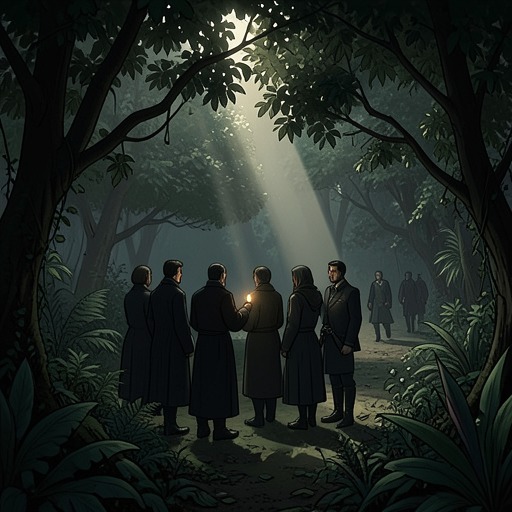
Once the stolen gems are discovered, the pursuit moves away from the Endeavor and into the unfamiliar city beyond the human settlement. Jonathan, Antomine, Eleanor McAvey, Marie, Sarah, and Antomine’s guards descend from the airship with zint lanterns at their belts. Marie and Sarah lead the tracking, although Jonathan cannot determine how they follow a person across bare stone without closely examining the ground. Their unexplained skill is one of the unusual resources associated with the Reflected Council, whose agents possess abilities Jonathan finds useful even when he does not understand them.
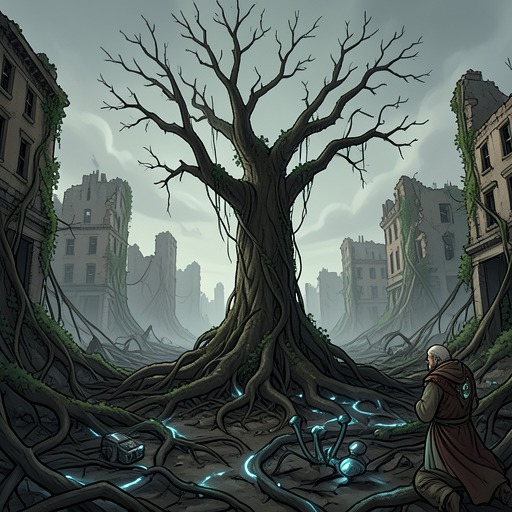
The search passes into a maze of slanted streets and buildings where no right angle appears in the roofs, doors, or ancient tripod lamps. The architecture repeats so completely that concealment is easy: a fugitive can hide in a building that looks no different from its neighbors. Jonathan distrusts the interiors and expects an unseen presence to attack from behind walls or around corners, but the immediate danger remains Robert. The setting makes the pursuit more than a conventional manhunt. Human categories of direction, proportion, and recognizable civic space have been displaced, while the stolen gems carry the technological power of the human expedition into a city shaped by other forms of life.
The pursuit also follows a longer pattern of contact between the expedition and the eastern frontier. Danby’s Point is the eastern terminus of the illuminated track, built beneath a zint-lit tower in bruised-purple rock. Human civilization occupies one side of the plateau, while alien construction and nonhuman populations occupy the other. A great metal gate separates the human portion from the territory claimed by darker forces, although the influence crosses in both directions: distant spires are twisted, while structures near the wall have been drawn toward straighter human lines. The city’s fractured inhabitants and its enormous, many-limbed tar-like beings establish the environment in which Robert disappears, and the pursuit makes literal the expedition’s attempt to impose human purposes upon a space it cannot fully comprehend.
Robert Masterson’s Motive and Capture
The search ends when Sarah identifies a seemingly ordinary building. Marie opens its slanted door, and the party hears rapid, panicked breathing beyond canted stairs. Robert attempts to flee before the lantern light reaches his hiding place. Eleanor catches him and pins the scrawny, bald crewman against a wall with her dagger. Jonathan is relieved that she has not killed him, because he wants the punishment for himself.
Antomine formally identifies Robert Masterson and charges him with dereliction of duty, treason, and sabotage. The question is not whether Robert acted, but why he would sacrifice himself and his fellow crew. Robert’s answer changes the meaning of the pursuit. He says that the expedition risks the rest of humanity and that the Exploration Society had warned Jonathan, but Jonathan refused to listen. Robert has therefore stolen the gems and fled because Jonathan has sent a dangerous thing back toward Beacon, drawing attention from entities that live in the east. His resistance is not presented as simple greed or personal betrayal; it is an attempted intervention against a danger he believes the expedition is unleashing.
Robert also challenges the authority behind the expedition. Antomine declares that he is the Illuminated King’s representative and that he alone decides whether the expedition has gone too far. Robert counters that the King has never left the kingdom and does not care about the actual risk, wanting only whatever Jonathan intends to obtain. The exchange places three competing claims to legitimacy in the same confined space: the Exploration Society’s warning, the Inquisition’s delegated royal authority, and Jonathan’s private certainty that sunlight justifies continued advance. Robert’s accusation is factually incomplete from his perspective, but it correctly identifies Jonathan as the person who will not be stopped by ordinary institutions.
Execution and Immediate Consequences
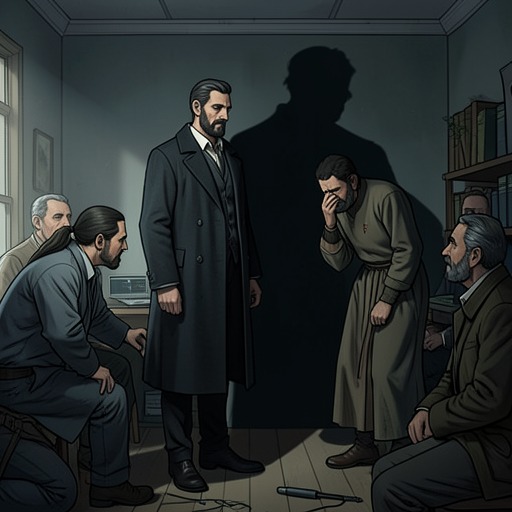
Jonathan steps forward after announcing that he had promised to destroy the next agent of the Exploration Society who crossed his path. His response is not an act of military discipline or a sentence issued through Antomine’s authority. He seizes Robert by the throat while Robert is already trapped against the wall. Antomine moves to stop him, but the intervention comes too late. Jonathan’s suppressed fury takes over, and the power of his sunlit soul burns through Robert: the crewman’s eyes are destroyed by the intensity of the light, and his body falls scorched and smoking.
The execution answers Robert’s fear with the very force that made the fear plausible. Robert believed Jonathan’s contact with the eastern darkness threatened humanity; Jonathan demonstrates that his connection to sunlight has made him capable of killing a human opponent with that power. The scene also establishes a sharp contrast between Jonathan’s earlier argument that his companions had simply been unequal to what they found in the east and his present willingness to remove anyone who challenges his honor or objective. His expedition is presented as a project of knowledge and discovery, but its progress depends increasingly on coercion, secrecy, exceptional authority, and violence.
Antomine reacts with taut rage, addressing Jonathan after the body falls. The confrontation is interrupted when the presence that had seemed to wait behind every door and window of the city comes howling in after Robert’s corpse. Thus the execution does not restore safety. It ends the human pursuit while opening or intensifying a larger danger, and Robert’s corpse becomes the point at which Jonathan’s personal vengeance and the eastern city’s inhuman threat meet.
Wider Significance
Robert’s death has consequences beyond the immediate recovery of the stolen machinery. The Endeavor’s expedition depends on a chain of material systems: steel, gold, zint equipment, luminiferous gems, food, water, transport, trade, and the labor of airmen who must carry and maintain the cargo. Later scenes emphasize that raw steel is more valuable for barter than gold in some eastern markets, while the expedition also acquires spices, metal stock, and other goods. Against this economic background, the luminiferous gems are not merely treasure. They are specialized infrastructure whose loss changes the ship’s speed, range, and vulnerability. Robert’s sabotage attacks the material basis of exploration, even as his stated motive attacks its political and moral basis.
The expedition nevertheless returns with immense quantities of gold, and the damaged Endeavor eventually limps back to Beacon. The gold attracts far more public interest than Antomine or the three women who disembark, turning the returning passengers into minor celebrities among those hoping to profit from the windfall. Robert’s warning is not publicly vindicated in the aftermath; instead, the expedition’s wealth helps normalize the journey and encourages talk of expanding the Illuminated King’s kingdom into a new golden age. His execution therefore remains buried beneath the visible success of extraction. The episode’s irony lies in that contrast: the man who tried to prevent a danger to humanity disappears, while the expedition that he opposed returns with a material reward that strengthens the institutions and ambitions driving it farther east.
As an action, the pursuit and execution compresses the novel’s central conflict into a single reversal. The expedition begins under the language of civilization, royal sanction, and humanity’s vigil of light against eternal darkness. At the moment of Robert’s capture, however, the question is no longer whether the expedition has encountered something dangerous, but who possesses the right to decide what danger means. Antomine claims institutional authority, Robert claims collective responsibility, and Jonathan claims the imperative of sunlight. Jonathan wins the physical confrontation, but the interruption by the unseen presence and the later return of the battered ship prevent that victory from becoming proof that he was right. Robert’s death is consequently both an act of elimination and a warning: the expedition’s greatest threat may arise not only from what waits in the east, but from the transformation of its leader into the means by which dissent is extinguished.