Reginald Heights
Chasing SunlightReginald Heights is the vanished explorer whose incomplete work forms the hidden foundation of Jonathan Heights’s search for sunlight. He is absent from the expedition in person, yet his surviving notes, maps, artifacts, and unanswered theories determine what Jonathan knows, what he suspects, and how far he is willing to travel beyond the human lands. Reginald’s legacy is therefore more than family history: it is an intellectual summons from the dead, drawing Jonathan toward the possibility that the world is only one layer of a larger and more dangerous reality.
Identity and Reputation
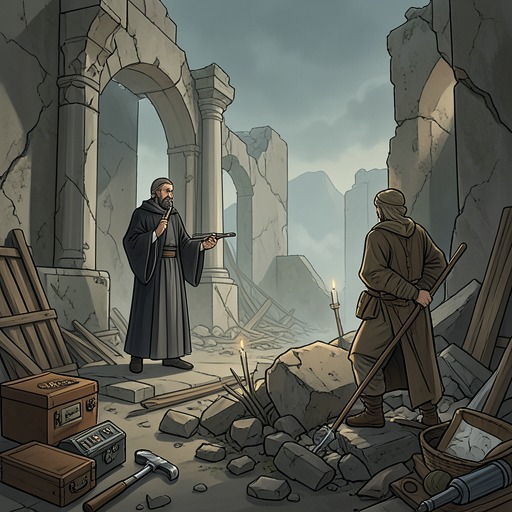
Reginald Heights was an explorer associated with the old exploratory culture that once pushed beyond the safe boundaries of Beacon. His work was sufficiently unusual to attract the attention of André Ludwig, who received some of the first pieces of his collection, and sufficiently controversial that its meaning remained difficult to recover. André remembered understanding only about one word in ten when Reginald spoke, suggesting a man whose research had carried him beyond ordinary scholarly language and perhaps beyond ordinary human certainty.
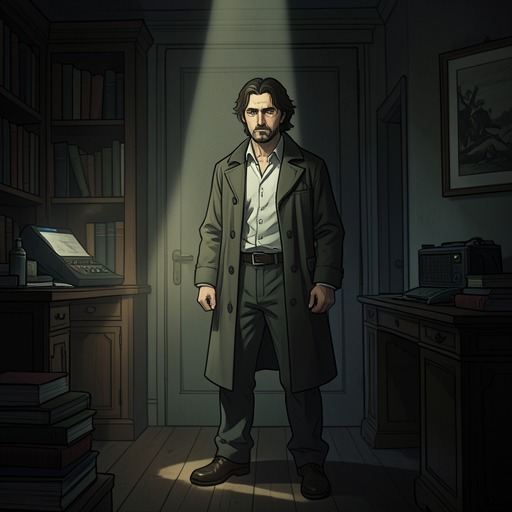
The surviving evidence presents Reginald as both respected and isolated. Jonathan’s study contains fragments of pottery, scraps of paper, grotesque statues, framed symbols, and an ancient map marking the future site of Beacon with an ominous red glyph. These objects are not merely family possessions. They are the material residue of civilizations and places that official history denies, and they give Reginald’s investigations a forbidden, almost archaeological presence within Jonathan’s home. The study makes the absent father visible through the disturbing order of his collected world.
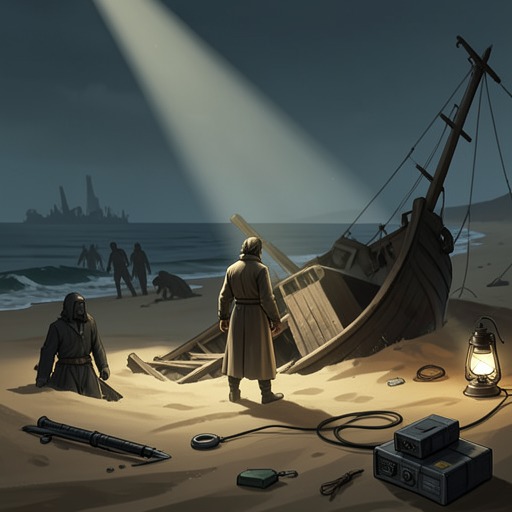
Reginald’s final expedition ended without his return. Jonathan states that his father did not come back from that journey, while the last notebook eventually reached Jonathan’s hands in a damaged and fragmentary condition. The loss is therefore both personal and epistemological: Reginald’s death or disappearance removed the one person who might have explained the route, while leaving behind evidence that continually suggests a larger answer.
Research and Cosmology
Reginald was fixated on the idea that the known world was only one layer among several. According to André Ludwig, he believed that phenomena such as zint-light were leakage from other realities or levels of existence. His practical objective was to locate points where that leakage became an actual passage. He had not found such a passage as far as André knew, but the distinction between failure and near-discovery remains deliberately unstable: Reginald’s notes are incomplete, his language obscure, and Jonathan’s later journey confirms that the kind of boundary he sought genuinely exists.
Jonathan inherits all of Reginald’s notes except the last notebook that Reginald carried on his final expedition. The surviving materials are not a clear scientific program but a patchwork of clues, ciphers, maps, and living thoughts whose logic Jonathan must reconstruct. He compares an old leather notebook with a battered map case, finding that neither is written in any human language and that each must be consulted against the other. Reginald’s method thus survives as a demand for interpretation rather than as a finished theory.
The father’s work also shapes Jonathan’s understanding of the far east. Jonathan has charted mines, ruined cities, isolated oases, caravan migrations, and resources such as raw terrestrite, but the impulse to treat the darkness as a territory containing hidden routes and forgotten civilizations comes from the same exploratory inheritance. The expedition is not simply an attempt to travel eastward. It is an attempt to continue a line of inquiry Reginald began and failed to complete.
Influence on Jonathan Heights
Reginald’s influence on Jonathan is expressed through objects and habits rather than direct instruction. Jonathan uses the father’s notes to plan routes, identify resources, and interpret evidence that official institutions either ignore or suppress. When André reveals what Reginald believed about layered worlds and interdimensional leakage, Jonathan replies that the theory aligns with his own findings, even though he does not entirely share his father’s interpretation. The agreement is therefore neither filial imitation nor outright rejection; Jonathan is extending the investigation while attempting to preserve his own judgment.
Reginald’s absence also creates a pressure toward completion. Jonathan’s possession of the missing notebook is itself a secret he refuses to disclose to André, because the fragmentary document may contain the key to the final expedition and to Jonathan’s own route. He seeks information about what Reginald told André not from simple curiosity but because every unresolved gap threatens the success of the new expedition. The father’s silence has become a practical danger that Jonathan must overcome through reconstruction.
The expedition’s intellectual and political stakes are intensified by Reginald’s reputation. The Illuminated King has heard that Jonathan found sunlight and takes an official interest in the matter, while the Reflected Council has previously shown interest in Jonathan’s treasury. Reginald’s investigations place Jonathan within a history of knowledge that both the crown and darker powers may wish to control. The son’s journey therefore inherits not only the father’s questions but also the institutional suspicion surrounding them.
Reginald’s Legacy and the Eastern Unknown
Reginald’s ideas connect the domestic spaces of Beacon with the strange frontier beyond Danby’s Point. At that eastern terminus, human civilization meets alien illumination, nonhuman architecture, the Fractured, and the Umbraught, while the boundary between human and foreign forms is visibly altered in both directions. The setting gives concrete shape to the kind of layered world Reginald imagined: familiar reality does not simply end at a wall, but presses against other orders of being and is changed by contact with them.
The route beyond human lands also confirms the value and danger of Reginald’s exploratory model. Jonathan relies on information about shifting forces, beasts, caravans, and the Verdant Expanse, yet knowledge gathered from the eastern peoples is uncertain and may be deliberately false. Tiuni’s intelligence narrows the expedition’s possible routes, while Antomine detects a lie in her account. Reginald’s legacy thus leads Jonathan toward knowledge without guaranteeing truth; every map and fragment may illuminate a passage, conceal a threat, or expose the limits of human interpretation.
This tension distinguishes Reginald from the officials who claim to defend humanity through the language of light. Antomine insists that humanity belongs to the light and that dark secrets must be purged, while the Illuminated King treats sunlight as a matter of political interest and control. Reginald’s investigations are less concerned with preserving a sealed human order than with discovering what lies beyond it. His work makes the darkness a field of inquiry rather than merely an enemy, even though the evidence also shows that the eastern unknown contains genuine horrors.
Narrative Role and Significance
Reginald functions as a posthumous mentor and a threshold figure in Jonathan’s journey. He supplies maps, notebooks, concepts, and clues, but not a completed answer; Jonathan must cross the boundaries his father could only investigate. In that sense, Reginald’s narrative role resembles an inverted inheritance story. The son receives knowledge from the father, but the inheritance is broken, encoded, and dangerous, so advancement requires both loyalty to the investigation and independence from the investigator’s conclusions.
His disappearance also preserves the book’s central uncertainty. Reginald may have been pursuing sunlight, passages between worlds, or a reality more expansive than either Jonathan or André can fully articulate. Because his final work survives only in fragments, the reader encounters him through competing acts of interpretation: André recalls a theorist of layered worlds, Jonathan sees a predecessor whose discoveries remain useful but incomplete, and the physical artifacts in the study suggest civilizations that official history has erased.
Reginald’s legacy reaches its most powerful fulfillment when Jonathan finally enters Bright Defile and stands beneath the sun. Jonathan feels warmth, freedom, and the truth he has pursued, then casts an immense shadow westward toward Beacon and the Illuminated King. The achievement does not restore Reginald or solve every mystery in his notes, but it completes the kind of crossing Reginald sought: leakage and theory become passage and direct experience. Reginald remains absent at the moment of discovery, yet the sunlight Jonathan reaches is inseparable from the dead explorer’s unfinished work. The father’s failure becomes the son’s threshold, and the son’s success gives retrospective meaning to the fragments left behind.