Reginald Heights's notebooks
Chasing SunlightReginald Heights's notebooks are the surviving intellectual foundation of Jonathan Heights's expeditions and the most important material link between Jonathan's quest for sunlight and the unfinished work of his missing father. Written in cipher and assembled from explorations across a world of darkness, they contain geographical knowledge, unresolved theories, and the clues from which Jonathan derives his maps. Their value is not merely archival: they determine where the Endeavor can travel, what resources it can obtain, and how Jonathan interprets the strange reality beyond human civilization.
Identity and Physical Form
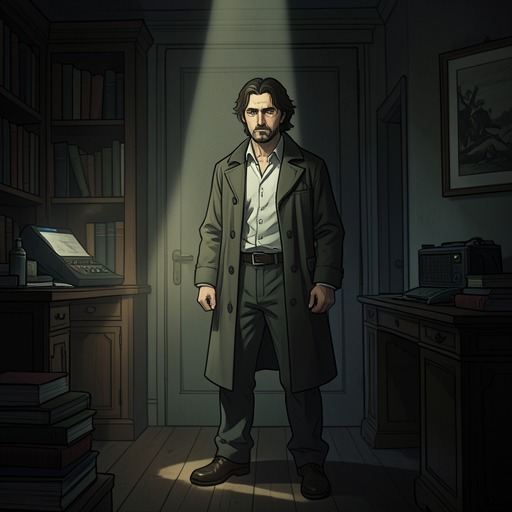
The notebooks are old, private working records rather than a polished account intended for publication. Jonathan keeps them in a heavy safe aboard the Endeavor alongside an old leather notebook and a battered map case. The materials are marked in no human tongue, with their meaning distributed between ciphers and cross-references rather than presented as immediately readable prose. Jonathan spreads the maps across his desk and consults the notebooks against them, treating the two forms of record as a single investigative system.
Their encryption gives the notebooks a double character. They are evidence of knowledge, but they are also barriers to knowledge: a reader who obtains them does not automatically possess what they contain. Jonathan relies on that distinction when his maps are stolen. He believes that anyone who has taken the maps will struggle to interpret them because the underlying records remain ciphered, and because copying the maps themselves would be difficult. The notebooks therefore protect the expedition even while making Jonathan's work slow, solitary, and dependent on his own familiarity with his father's methods.
Inheritance and Reginald Heights's Theory
Jonathan inherited nearly all of Reginald Heights's notes, except for the final notebook that Reginald carried on his last expedition and from which he never returned. That missing volume nevertheless eventually came into Jonathan's possession, though Jonathan refuses to admit this to André Ludwig. In Jonathan's judgment, it is only a patchwork puzzle of a living man's thoughts rather than a complete explanation, but it remains too valuable to discard. Reginald's notes are thus connected to both a family inheritance and a disappearance that the surviving records cannot resolve.
Reginald's work shaped Jonathan's career even where Jonathan rejects or revises its conclusions. As Jonathan explains to André Ludwig, his father became increasingly distant and uncommunicative near the end of his life, leaving behind discoveries and observations that were vital to Jonathan's own explorations. The notebooks preserve that influence in an incomplete form: they offer the means to continue Reginald's investigation without providing the certainty that would make the investigation unnecessary.
André Ludwig recalls that Reginald believed the world was only one layer of existence and that phenomena such as zint-light represented leakage from other layers. Reginald was searching for points where that leakage became an actual passage, although André knew of no passage he had successfully found. Jonathan says that this theory aligns with his own findings, even though he does not entirely share his father's understanding. The notebooks consequently establish a line of inquiry from speculative cosmology to practical expedition: a theory about layered realities becomes a reason to map remote territories and search for thresholds.
Cartography and Expeditionary Use
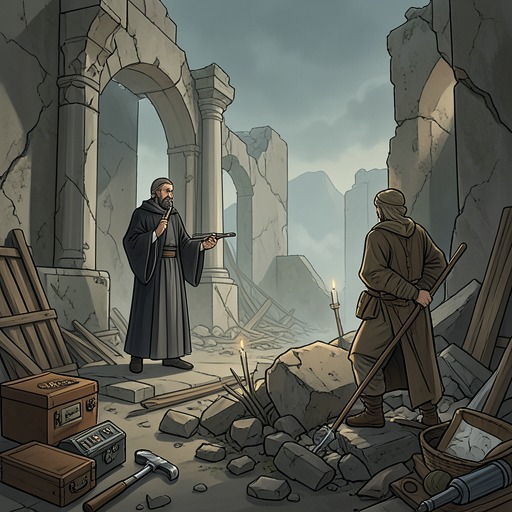
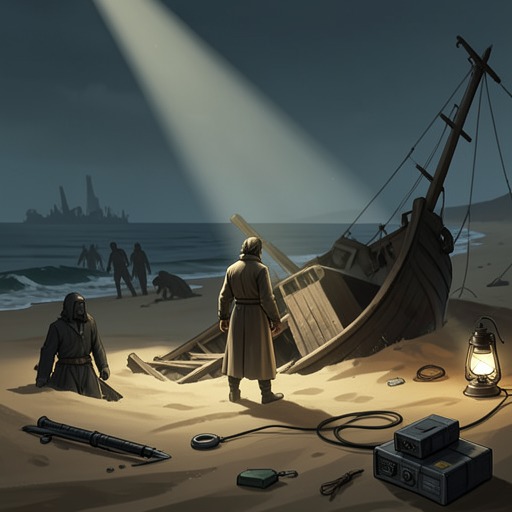
The notebooks provide the raw intelligence from which Jonathan constructs his maps. His accumulated records include crumbling mines, ruined cities, isolated oases, caravan migrations, and areas inhabited by races that the Illuminated King does not acknowledge. This information transforms the journey east from a simple directional movement into a chain of logistical decisions. The Endeavor must rest, resupply, repair damage, and secure raw terrestrite that can be distilled into zint fuel; the notebooks help Jonathan identify the places where those needs might be met.
Their usefulness becomes especially clear at Danby's Point, the eastern terminus of human civilization. There Jonathan trades with Tiuni, presenting a deciphered map whose diagrams describe the lands beyond the human boundary. Tiuni supplements the record with intelligence about shifting Thrantin houses, caravan movements, beasts, the Verdant Expanse, and ancient ruins. Jonathan records her information and narrows the possible routes, showing that the notebooks and maps are not static relics but working documents continually revised through exchange, observation, and risk.
The maps also expose Jonathan to political danger. The expedition has already attracted enough attention for mercenaries to attack the Endeavor, and Jonathan asks André Ludwig whether anyone has been seeking information about him or opposing the expedition strongly enough to hire an entire airship. When Jonathan later discovers that the maps have vanished from his safe, he understands the theft as evidence that an organized power possesses the resources to move against him. The notebooks are still intact in a concealed compartment, but the separation between source records and derived maps reveals how knowledge can be stolen, copied, delayed, or weaponized.
Theft, Protection, and Material Agency
Jonathan finds the safe's papers and petty cash untouched but immediately notices the absence of the maps. He does not panic. Instead, he takes a fragment of broken mirror from his desk and uses its reflection to inspect the safe, finding and opening a hidden compartment. There he discovers his original notes and his father's notebooks intact. The scene makes the archive's material arrangement as important as its intellectual content: a broken mirror, a concealed mechanism, a cipher, and the division between notebooks and maps collectively determine what the intruder can and cannot take.
Jonathan regards the notebooks as irreplaceable. The maps derived from them are less so, although reconstructing them would consume more time than he is willing to spare. Their survival preserves the possibility of rebuilding his routes, while the stolen maps create an immediate threat to the expedition. He writes to André Ludwig about the theft, even while giving André equal odds of being responsible, and recognizes that his assumption that the Endeavor or his cabin would remain secure in port was an error. The archive therefore changes Jonathan's conduct: its preservation does not remove danger, but it gives him the confidence and means to respond rather than abandon the journey.
The notebooks remain active throughout the expedition's most consequential decisions. Jonathan consults them when considering hazards and routes, refuses to divert the Endeavor into a prolonged campaign against Umbraught in Angkor Leng because he lacks the time and resources, and verifies a remembered line before entering a sequence of controls that causes the machinery beneath the city to fail. That action releases the fevered god-dream beneath Angkor Leng and forces Jonathan to escape by the descent line as the city shakes. The records do not act independently, but they materially organize the knowledge through which Jonathan triggers events far beyond ordinary exploration.
Legacy and Narrative Significance
Reginald Heights's notebooks embody the book's tension between knowledge as liberation and knowledge as danger. They make Jonathan's passage possible, yet they are written in forms that resist easy comprehension; they preserve a theory of other realities, yet they cannot tell Jonathan exactly what his father found or why he disappeared. Their incompleteness keeps the past from becoming a stable explanation and turns inheritance into a mandate to continue searching.
They also complicate the ideology of civilized exploration. Jonathan's records map the eastern frontier, identify resources, and support contact with peoples and territories the Illuminated King refuses to acknowledge. At Danby's Point, such knowledge crosses a fortified boundary between human construction and darker forces, and the maps become a medium through which trade, espionage, and unequal power operate. Jonathan uses the notebooks to move beyond that boundary, but the theft of his maps demonstrates that the same knowledge can be appropriated by opponents and converted into a means of interception.
At the end of Jonathan's journey, the notebooks are part of what must be surrendered rather than what can simply be carried forward. To cross the Arch of Khokorron and enter Bright Defile, Jonathan sacrifices accumulated attachments and possessions, including books thrown from the Endeavor's deck. The notebooks' exact final fate is not separately identified, but the broader sacrifice of books places the written archive within the material history he burns away to reach sunlight. Their lasting significance lies in that paradox: Reginald's records lead Jonathan toward the final threshold, while Jonathan's arrival requires him to pass beyond the world of maps, ciphers, inherited theories, and mediated knowledge into direct sunlight and truth.