Sabotage of the Endeavor
Chasing SunlightSabotage of the Endeavor is the act of internal treachery that nearly destroys the expedition during its passage over Widow’s Peak. A crewman named Robert smashes the ship’s main zint manifold and steals the two luminiferous gems housed inside it, leaving the Endeavor powerless in hostile air currents. The sabotage does more than damage machinery: it converts the expedition’s outward journey toward sunlight into a crisis of trust, pursuit, and containment, while revealing how dependent the grand project is on fragile equipment, scarce materials, and disciplined labor.
Causes and Circumstances
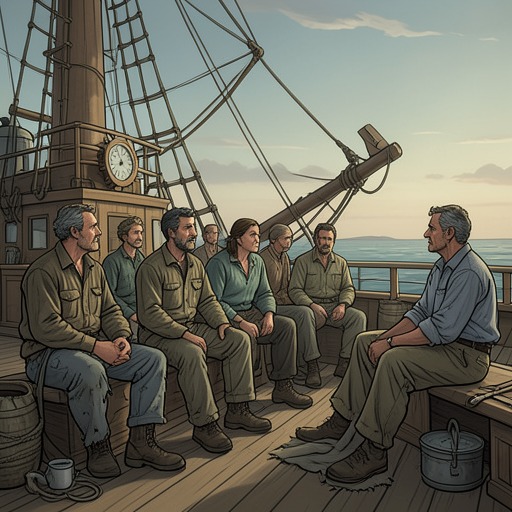
The Endeavor reaches the region beyond the fallen monument of Widow’s Peak while navigating difficult winds above the Bitter Pass. The route already demands careful handling because the ship cannot safely tether near the monumental ruins, and the weather threatens to become a storm. The attack occurs at the worst possible moment. The wind howls through the Pass, the deck shudders, and then the spotlights fail; the ship falls into darkness and begins to list as the engines cease answering the pressure of the air.
Captain Montgomery’s experienced crew prevents an immediate crash by manually operating the vanes and ailerons. Veterans keep the unpowered vessel in something resembling controlled flight, but the Endeavor remains crippled until its zint mechanisms can function again. Most of the internal lights continue to work, and the backup gas lamps later reveal red-stone buildings and walls of a dead city directly below. The apparent accident therefore becomes inseparable from the ominous ruin into which the damaged airship is forced.
Discovery of the Saboteur
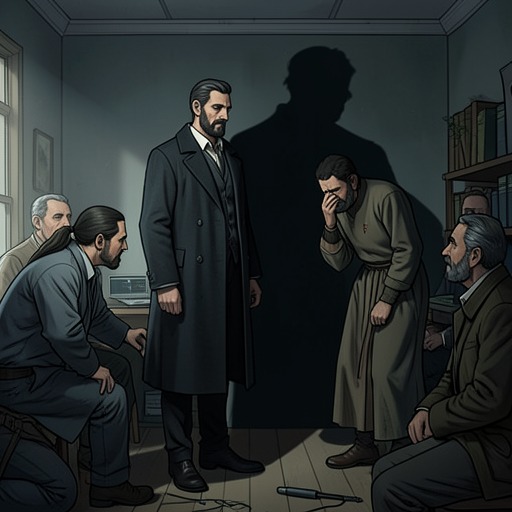
Once the Endeavor’s trajectory has been stabilized, Montgomery identifies the cause as deliberate damage. He reports that someone has smashed the main zint manifold and declares that a member of his crew has injured the ship. Jonathan Heights immediately accepts the implication that the perpetrator must be found before repairs can begin. With Inquisitor Antomine aboard, the expedition possesses an investigator capable of exposing the traitor, and Jonathan treats that presence as one of the few advantages created by the crisis.
The investigation quickly identifies Robert. Eleanor McAvey reports that he broke the intermixer manifold, though she has little understanding of the technical terminology herself. Antomine explains that he can restore the damaged device if the expedition has sufficient glass stock. The repair is therefore possible, but the theft makes the sabotage far more serious: Robert has also taken the pair of luminiferous gems from inside the mechanism.
Damage and Pursuit
The stolen gems are not ordinary replaceable components. They greatly improve the Endeavor’s zint machinery, and without them the ship must travel more slowly, refuel more often, and proceed with greater caution. Robert’s apparent escape into the abandoned city consequently threatens the expedition’s entire timetable and its ability to continue east. Jonathan finds the theft especially intolerable because the thief would have almost no chance of returning to civilization without a ship, yet the missing gems remain too valuable to abandon.
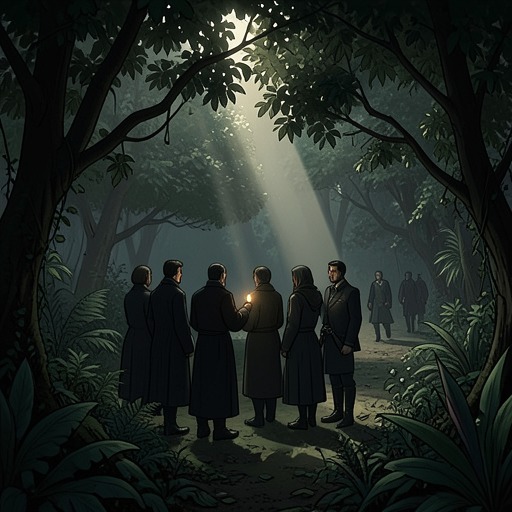
Robert has taken an entire kit with him, suggesting that he believes he can survive in the wilds. Jonathan regards that belief as evidence of his foolishness, but the kit also gives the pursuit a practical dimension: Robert is not merely hiding nearby but has prepared to remain away from the ship. Eleanor proposes that Sarah and Marie can track him through the city, where the built environment should make the search easier than tracking someone through wilderness. Jonathan joins the pursuit because he knows the eastern regions and understands that an apparently deserted city is unlikely to be truly empty.
Before descending, Jonathan gives Montgomery the bronze amulet and instructs him to hang it before the commissioning plaque while the ship remains tethered. He expects it to prevent most things from taking an interest in the Endeavor, providing a temporary defense while the crew searches the ruins. The expedition thus responds to the sabotage on two fronts: Antomine must expose the traitor and restore the manifold, while Jonathan and Eleanor must recover the stolen gems and protect the immobilized ship.
Wider Expeditionary Context
The sabotage is made possible by the material complexity of the Endeavor’s mission. Before departure, the expedition has loaded a portable luminiferous terrestrite distillation apparatus, a lifting-gas separator, water siphons and filters, portable searchlights, crew-served zint guns, food, water, spare parts, raw materials, clothing, bedding, soap, and other supplies. The ship is already expected to become less agile under the weight and to spend more zint between distant stops. Damage to a central manifold therefore compounds the ordinary logistical burden of an eastern expedition.
The episode also belongs to a broader economy of scarcity and exchange. Jonathan has arranged for supplies to be shipped by train to Danby’s Point, where loading is cheaper than storing everything in Beacon. He pays for expeditionary arrangements with golden plates and encourages the crew to barter with raw metal stock, emphasizing that steel may be more valuable than gold or silver in the eastern settlements. Later, the expedition’s willingness to carry heavy discoveries becomes part of its labor discipline: Jonathan orders the crew to divide a massive golden find among the men and offers to carry the main trunk himself because the reward may improve their attitude. Against this background, Robert’s theft of the luminiferous gems is not an isolated act of greed but an attack on the material system that keeps the expedition moving.
Consequences and Significance
The immediate consequence is forced tethering in the dead city and a delay while the Endeavor is repaired and guarded. The sabotage introduces suspicion into a crew already assembled for a long, arduous voyage in which the next stops will not offer ordinary city comforts. Jonathan’s impatience with delay becomes sharper because he believes sunlight is waiting in the east and views every obstacle as an assault on that purpose. Montgomery, meanwhile, responds as a captain whose ship and crew have been violated, promising punishment when the perpetrator is found.
The event also establishes a recurring pattern in the expedition: discovery and danger arrive through the same material channels. The Endeavor carries rare machinery, fuel, weapons, and supplies because the eastern world cannot be crossed without them; those necessities make the ship an attractive target and make every damaged component consequential. The missing gems expose how a seemingly small act by one crewman can diminish speed, range, and safety for everyone aboard.
In the larger arc, the damaged vessel nevertheless survives and eventually returns to Beacon battered and tattered, carrying an immense quantity of gold. That later wealth does not erase the sabotage’s cost. The Endeavor requires extensive repair, and even the repaired ship seems strangely familiar to the laborers who work on its spine and envelope, while its cats watch them with uncanny intelligence. Sabotage is therefore one of the episodes that marks the ship as more than a neutral vehicle: it becomes a wounded, altered participant in the expedition, carrying the physical and moral residue of the dangers through which it has passed.