Sargasso
Chasing SunlightSargasso is a transitional landscape in the eastern world whose apparent geography collapses under fire. It first presents itself as an immense waterway filled with mist and derelict vessels, but the Endeavor’s passage reveals that the ocean is a mirage covering parched hills, abandoned canals, and fallen locks. Its decisive significance lies in this contradiction: Sargasso is both a navigational hazard and a tool, a place Jonathan Heights enters precisely because its unreality can return the expedition to a known position.
Definition and Setting
Sargasso is not simply a body of water but a spatial deception that turns a river crossing into what appears to be an ocean. Jonathan Heights explains that the river leads nowhere and that crossing it from any direction carries a vessel into Sargasso. Before the crossing, powerful light can reveal an apparent far shore; once the Endeavor moves over the water, that shore recedes in every direction, replacing a bounded route with an expanding expanse. The effect makes navigation itself unstable, because the ordinary relationship between distance, sight, and direction no longer holds.
The region also belongs to the wider geography of eastern travel, where cities vanish, landmarks change, and routes cannot be treated as extensions of western experience. Ukaresh has already disappeared behind the expedition, and the loss of that city removes a major navigational reference point. Against this background, Sargasso becomes one more eastern space in which human maps and instruments are provisional rather than authoritative. Jonathan does not mistake it for a normal sea; he recognizes its resemblance to an earlier corpse-related trap and suspects that the phenomena may be connected, though he does not pursue that question because the expedition’s immediate need is orientation.
Entry and Apparent Ocean
Jonathan chooses Sargasso as a controlled retreat. Since crossing the southern river would place the Endeavor in a trap, he proposes allowing the expedition to be pushed backward rather than forcing a direct route forward. The detour should leave the ship farther from its destination, but it should also bring it to a location Jonathan can identify with certainty. He expects the place to resist that deliberate use, because Sargasso’s nature is opposed to straightforward navigation, yet he considers it preferable to the unknown dangers of a direct eastern passage.
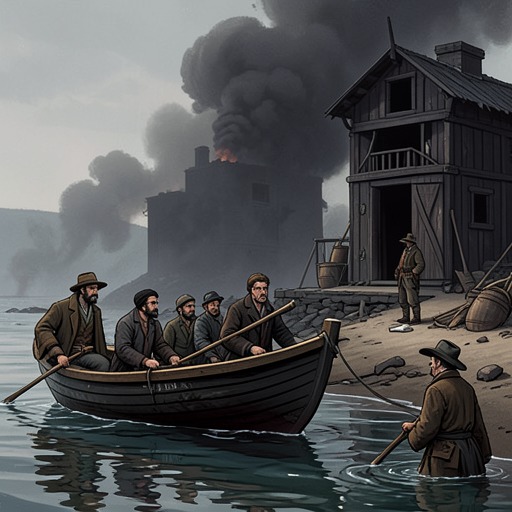
Nearly a day later, the river appears beneath the Endeavor’s lights. The crew directs its most powerful beams toward a bank roughly a mile away, confirming the appearance of an ordinary crossing. As the ship moves out over the water, however, the far shore seems to founder and crumble. Mist rises from the dark, troubled surface and wraps itself around shapes that at first seem to be rocks or islands. The vibration of the engines becomes strangely muted, while the shapes resolve into wooden and iron ships, some rotted in shallow water and others still suspended in the air despite age and decay. At that moment, the expedition has entered Sargasso.
The wrecks make the deception more than an optical trick. They suggest a graveyard of failed journeys, populated by vessels that have been caught in the same dislocation between route and destination. The mist conceals not only the surrounding land but also the remains of earlier attempts to cross the eastern world. The Endeavor’s technology allows its crew to see fragments of this history, but not to master the environment through ordinary observation.
Burning the Mist
Jonathan prefers not to remain in Sargasso. The expedition’s purpose is to regain its bearings, not to explore the region, and he believes that the practical danger of preparing the escape may exceed the danger posed by the becalmed landscape itself. The crew establishes a circle of floating wood over several hours, working in relative silence while waves lap far below and mist-scented wind moves through the void. The absence of an attacking beast or predator makes the operation possible, but the calm does not make it safe; it merely replaces visible violence with an environmental threat.
When the preparations are complete, Captain Montgomery orders the fire started. A rope taken from the Flame Cult ship serves as an improvised fuse, carrying a thin snake of flame away from the Endeavor until the fire dust ignites. The resulting wall of orange-red heat consumes the surrounding mist. The flame’s effect is immediately physical as well as visual: the airmen flush with fever and sudden malaise, recalling the heat of the dream associated with Angkor Leng. Some of the men wilt, but none collapse, and the work continues through the renewed touch of that earlier affliction.
Fire exposes the apparent ocean and then destroys it. The light first reveals a vast field of water scattered with wrecks and derelicts. Then the vista itself begins to burn, wavering and tearing open as the flame consumes the mirage. Beneath it lies a barren, desolate range of dry hills, together with long-empty canals and fallen locks. When the fire dies, the water and wrecks have vanished, leaving the Endeavor, the Flame Cult ship, and the skeletal floating wood in the revealed landscape. Sargasso’s geography is therefore not crossed so much as stripped away: the expedition does not reach another shore, but burns through a false one.
Aftermath and Narrative Significance
The Flame Cult ship departs southward in a burst of fire from its engines. Its departure is abrupt, but Jonathan understands the crew’s desire to leave, while Antomine remains displeased that the Endeavor has assisted a neighboring power rather than destroying its vessel. The episode nevertheless improves the atmosphere aboard the Endeavor, which had grown strained after Ukaresh. The crew’s gold and looted objects offer consolation, and the successful escape restores enough confidence for the expedition to continue.
Sargasso also clarifies the expedition’s larger pattern of movement. Eastward travel is not merely a matter of covering distance; it requires passing through spaces where cities, rivers, instruments, and even apparent physical forms may be withdrawn or rewritten. The place stands between recognizable geography and impossible terrain, making it a literal threshold between the world the crew believes it understands and the eastern regions that repeatedly invalidate that belief. Its hidden canals and fallen locks imply a former infrastructure without explaining who built it or why it failed, leaving civilization itself as another ruin beneath the visible surface.
The contrast between Sargasso and later thresholds reinforces its importance. The Dead Battle initially appears to be a fixed spectacle beneath the Endeavor, but its scale and meaning alter when Jonathan recognizes what he is seeing. The Arch of Khokorron likewise carries the ship from one impossible landscape into another, emerging at Lofted Lakes through an aperture far smaller than the monument entered. Bright Defile finally presents a darkness within a land defined by sunlight, where the last barrier is simultaneously a barrier of understanding and of terrain. Sargasso anticipates these spaces by making perception the first obstacle: before Jonathan can proceed, he must learn that the route in front of him is not what it appears to be.