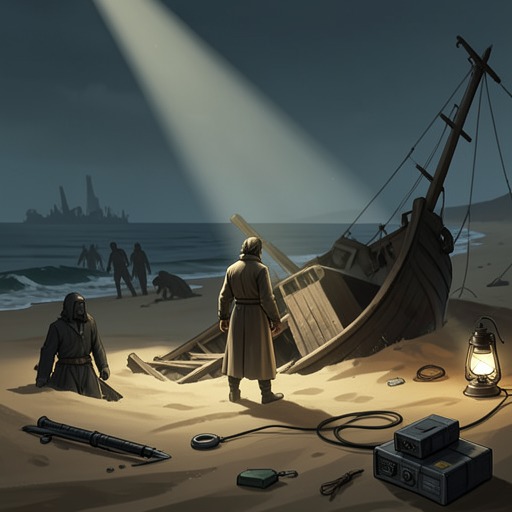
Stoneface
Chasing SunlightStoneface is an absent but consequential figure in the history of Jonathan Heights’s eastern expeditions. He is known chiefly through Jonathan’s references to the expedition in which Stoneface was lost and through the salt likeness that remains near Bright Defile. The narrative withholds his personal history, making his preserved body and the way others speak of him the primary record of his identity.
Identity and Place in the Expedition
Stoneface was a member of an earlier expedition led or organized by Jonathan Heights, one that ended in disaster among the unexplained dangers of the deep east. When Eleanor McAvey accuses Jonathan of having left her to die as he had “with old Stoneface,” the name carries the weight of a shared history rather than a casual example. Her accusation links Stoneface’s death to Jonathan’s responsibility and suggests that the earlier expedition remains an unresolved moral wound between them.
Jonathan rejects that interpretation with unusual violence. He insists that he left nobody and betrayed nobody, arguing instead that the expeditioners were simply unequal to what they discovered. His response does not erase Stoneface’s death; it reframes it as evidence of insufficient preparation, a deficiency Jonathan believes he can correct. Stoneface therefore stands at the origin of Jonathan’s harder, more controlled expeditionary purpose: the dead companion becomes part of the argument for returning better equipped rather than turning back.
The Salt Statue at Bright Defile
Stoneface’s ultimate fate is revealed at Bright Defile, where Jonathan approaches twin statues of Captain Hardiman and Stoneface. Their expressions of determination and fascination are fixed forever in salt, preserving not only their bodies but also the emotional direction that carried them forward. They are among the explorers who advanced into the sunlight despite having exceeded what they could endure.
The statues function as a warning to the living expedition. Jonathan does not know why Stoneface and Captain Hardiman failed to turn back, or what precisely drove them beyond their abilities. Yet the narrative identifies poor judgment as one of the flaws that causes a person to crumble beneath the revealing light. Stoneface’s monument thus transforms an earlier death into a visible limit-marker: the path to sunlight is not merely geographical, and courage without self-knowledge can become self-destruction.
Memory, Blame, and Consequence
Stoneface’s death remains embedded in Jonathan and Eleanor McAvey’s conflict. Eleanor invokes him when Jonathan invites her on another expedition, treating the proposal as proof that he is prepared to repeat the abandonment of the past. Jonathan’s physical assault and his insistence on honor show how deeply the accusation strikes him. His defense is categorical, but the need to defend it reveals that Stoneface’s fate cannot be reduced to a solved logistical failure.
Later, Jonathan’s passage through the final barrier of Bright Defile brings Stoneface back into the larger ledger of sacrifices that made his achievement possible. Alongside the death of Tiuni, the destruction of Tor Ilek, the sacrifice of Angkor Leng, his loss of Eleanor McAvey’s friendship, and his banishment from Ukaresh, Stoneface’s death belongs to the accumulated past Jonathan must relinquish or confront. The dead are not simply behind him; they form the stepping-stones by which he reaches the sunlight.
Narrative Significance and Ending
Stoneface has the structural role of a threshold guardian in absentia. He does not speak, act in the present, or receive a developed biography, but his fate defines the danger Jonathan is trying to overcome and the boundary Jonathan must eventually cross. The salt statue contrasts with Jonathan’s successful arrival: Stoneface remains fixed at the point where fascination became fatal, while Jonathan continues through the final barrier by sacrificing the last attachments that hold him to the world behind him.
His ending is therefore both death and memorialization. Stoneface is not restored, avenged, or explained in full. He endures as a mute figure beside Captain Hardiman, a permanent testimony to the explorers who pursued sunlight without reaching it. When Jonathan finally enters Bright Defile and feels the sun’s warmth, Stoneface’s failure gives the triumph its cost. The achievement does not invalidate the statue; it passes through the knowledge of why such statues exist.