Stutt's Caldera Affliction
Chasing SunlightStutt's Caldera Affliction is the episode in which Airman Stutt's rescue becomes a new danger to the Endeavor. The crew has recovered him from the frozen landscape of the Crimson Caldera, but the bells governing the ship's movement have left him altered. His illness is not merely physical: it binds him to the strange figures fixed within the Caldera, turning a rescued crewmember into the means by which those inhabitants can continue to find and follow the ship.
Symptoms and Immediate Crisis
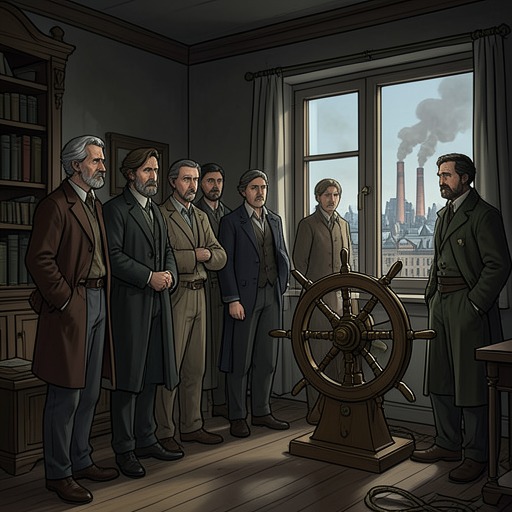
After each bell, Stutt had complained of headaches that soon passed, and the crew initially treated the episodes as temporary aftereffects of his imprisonment. The pattern changed after another bell sounded. Stutt went berserk inside his cabin, forcing the crew to bar the door while he thumped and shouted. The ship's doctor, Timothy, reported that the disturbance followed the bell directly and suspected that the problem belonged to the occult expertise of Jonathan Heights and Inquisitor Antomine rather than to ordinary medicine.
The summons itself establishes the event's divided authority. An able airman fetched Jonathan and Antomine from their respective quarters, while the doctor waited outside the cabin and the crew kept their distance. Stutt was not simply sick; he was speaking a language no one aboard could recognize. Antomine therefore called on Jonathan to determine whether the speech concealed knowledge of the Caldera or its inhabitants.
Jonathan's Interpretation
Jonathan could understand only fragments of Stutt's speech, so he took a notebook and stick of charcoal from inside his jacket and began recording what he heard. His knowledge of the tongues of the true east was moderate, and Stutt's language belonged to an older related dialect, making the translation difficult. Even so, repeated phrases supplied the essential meaning: Stutt said that he was there, demanded to be let out, and urged the ship to stop and find the bells.
The words showed that Stutt was addressing the figures scattered through the frozen landscape. As the Endeavor moved through the Caldera's unstable temporal fragments, more of those figures had become visible: stretched metallic faces, long vertical slit-like eyes, and narrow mouths with a lugubrious cast. They remained fixed while time flickered around them, yet their attention was unmistakable. Jonathan concluded that Stutt, not the ship's otherwise evanescent presence, had become their object of interest.
Jonathan's first practical judgment was severe. Exposure to the secrets beyond human regions had changed Stutt, and Jonathan thought it might be safest to release him back into the world of stasis. Stutt had returned from the Caldera, but he had not returned wholly untouched. His condition threatened the ship precisely because it was a connection rather than an isolated injury: while he remained aboard, the things dwelling in the frozen landscape would continue to dog the Endeavor's path.
Antomine's Decision and the Ship's Risk
Antomine asked whether removing Stutt from the Caldera would end the connection, and Jonathan answered that it would probably fade, perhaps instantly, because of the peculiar nature of the place. Antomine nevertheless refused to solve the problem by sacrificing the rescued airman. Instead, he ordered the captain to drive the engines at full power, choosing to trade efficiency for time while the ship crossed the dangerous region.
That decision carried a concrete mechanical cost. The Endeavor's zint reserves were not yet exhausted, but their potency had begun to diminish; full thrust would consume the remaining supply much faster than normal. Until the crew could refine more zint beyond the Caldera, the ship risked draining its entire system. Stutt's affliction therefore transformed a medical emergency into a navigational and logistical crisis: keeping him aboard might draw the frozen inhabitants after the ship, while accelerating away from them could leave the vessel without the energy needed to survive what came next.
Jonathan admitted that he would need to research the condition and that he had rarely found cures for such afflictions. He regarded treatment as more properly belonging to the Inquisition, but Antomine's options were limited and he ordered Jonathan to see what he could do. Jonathan, irritated at being commanded, nevertheless told the crew to ensure that Stutt did not leave his cabin. The order protected the ship from an uncontrolled breach while preserving the possibility that the connection might weaken or be studied.
Escalation and Aftermath
The engines reached full power before Jonathan had even cleared the stairwell. The Endeavor shivered, lurched, and trembled as metal squealed below, and the immediate danger became ambiguous: either the ship had struck something, or something had struck the ship. The acceleration intended to escape the Caldera thus produced no secure resolution. Stutt's condition had already altered the passage's terms, making every bell, every movement through frozen time, and every contact with the surrounding landscape potentially consequential.
The event's decisive reversal is that rescue does not restore Stutt to ordinary crew life. Earlier, the men responsible for finding him celebrated and hoped that he would recover sufficiently to work and offset some of the Endeavor's losses. The later episode reveals that his survival has a cost. He may still be saved, but his altered state now endangers everyone aboard and exposes the ship to beings whose presence Jonathan cannot fully explain or cure.
Narrative Significance
Stutt's Caldera Affliction dramatizes the expedition's recurring exchange between knowledge and survival. Jonathan's translation gives the crew enough understanding to act, but not enough mastery to remove the threat. The bells remain unexplained, the figures remain fixed beyond ordinary time, and Stutt's speech supplies only a partial bridge between human perception and the Caldera's alien inhabitants. Knowledge improves the crew's judgment while simultaneously proving how little control that judgment can secure.
The episode also turns bodily suffering into a form of contact. Stutt's headaches, groans, violent behavior, and involuntary speech are not decorative signs of fear; they are the physical manifestations of a connection that crosses the boundary between the Endeavor and the frozen world. Antomine's response places compassion against operational necessity, while Jonathan's response places interpretation against containment. Neither man can restore the old separation between rescued airman and hostile landscape. By the end, Stutt is both crewman and conduit, and the Endeavor's flight through the Crimson Caldera has become a race against a danger carried inside its own hull.